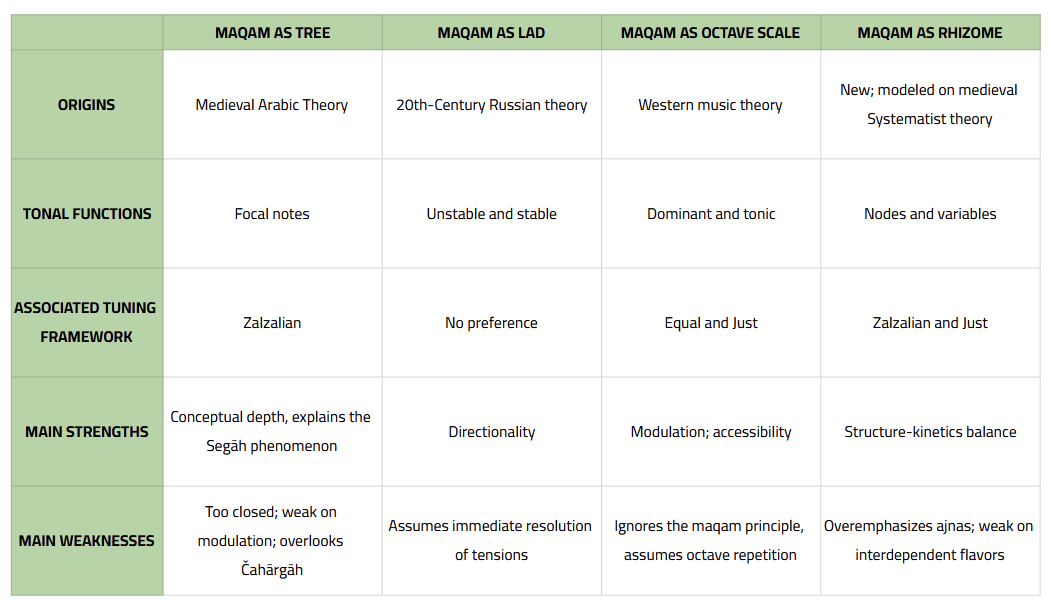
The structure of Maqam - 4 analytical models
Reading through the literature on maqām, one quickly encounters very different ways of understanding and conceptualizing the phenomenon. There is a broad consensus that maqām belongs to the category of modal music, but this immediately raises another question: what, exactly, is meant by “mode”?
Harold Powers’ Grove entry on “Mode” identifies an analytical gray area between the “scale type” and the “melody type”. In the previous article, I proposed the concept of flavors as one way of addressing this gap at the level of the smallest structural unit—the individual building block.
There remain, however, very different perspectives on the modal structure of the larger whole, and on the ways in which these smaller building blocks are organized and related to one another. How do individual elements combine to form something that we recognize as a maqām? What kinds of relationships between these elements are considered structurally significant? And what does each way of conceptualizing these relationships allow us to hear and understand?
The way we conceptualize maqām affects the way we hear it, learn it, remember it, and ultimately perform it. As a performer, I have found it important to explore these questions not only as theoretical problems, but also in relation to the performance situation, particularly in the free non-metered forms, in which we engage in a sort of a real-time compositional process.
Octave-scale - The Western perspective
The octave-scale approach became particularly dominant in maqām theory during much of the twentieth century, a period that also saw the establishment and expansion of Western-style musical conservatories throughout the Middle East, producing generations of musicians and music theorists educated within a Western theoretical framework.
This approach, however, has also been substantially criticized in recent years for how much it leaves out. It goes without saying that any theoretical representation of a maqām cannot be expected to capture every aspect of its melodic behavior, and will necessarily leave certain things aside. However, the octave scale in many cases does not even adequately represent the very basic tonal structure itself. Presenting the maqām as a set of two tetrachords stacked within the octave does not take into account its modulations into other tonal groups, which may themselves be a structural part of the mode. Sometimes the two tetrachords will indeed have equal structural importance, but often one will be more fundamental while the other may be replaced by a different tone group. There are also cases in which the octave does not repeat: as we saw earlier with maqām Saba, a tetrachord may be built on top of a trichord, rather than another tetrachord. Complex modulations that form part of the identity of a maqām may therefore be difficult to conceptualize within a fixed octave-scale framework, and may in time be lost from performance practice. This has demonstrably happened in some cases, producing irreversible damage to the musical tradition.

A scale of Ramal al-Maya as represented in the Wikipedia article on Andalusian Nuba
There is another dimension to this criticism: adoption of Western theoretical frameworks in the Middle East was frequently bound up with ideologically driven projects of modernization and Westernization, in which Western institutions and concepts could implicitly acquire the status of the modern, scientific, or “correct” way of understanding music, as we have previously mentioned, with theorists such as Rauf Yekta and Uzeyir Hajibeyov.
Yet it would be too easy to dismiss the octave-scale approach as simply a Western import. Octave-based conceptions of musical organization have a much longer history in the traditions associated with maqām. Medieval theorists were already working within theoretical frameworks shaped by Greek ideas about intervals, tetrachords, fifths, and octave relationships. The relationship between these inherited concepts and the musical practices of the medieval Islamic world was complex, however, and cannot simply be reduced to the transmission of a ready-made Greek system. The Western concept of tonic and dominant functions on fixed places (I and V) within the scale often coincides with the reality of maqām modes. In Ṣafī al-Dīn al-Urmawī's adwār, for example, many forms are indeed constructed from combinations of a conjunct pentachord and tetrachord, and this fits perfectly within Western tonic-dominant framework (right up until it doesn’t).
In the Tunisian theory books of the mid- to late twentieth century, we find a somewhat more elegant, updated model of scalar representation that addresses some of these limitations. In addition to the basic octave-scale outline, the notation makes use of bows to mark the shifting tone-groups and accidental markings above individual notes to indicate alternative pitches and different possible realizations within the tone-group. This allows the more faithful representation of the modal structure while keeping the scalar model. For a musician educated within the Western conservatory system, this offers the easiest learning curve, since it builds on a familiar way of reading and conceptualizing a tonal structure while adapting it to some of the particularities of maqām.

A scale of Ramal al-Maya after Salah el-Mahdi, as represented in Ruth Davis’ 1996 article “Arab-Andalusian Music in Tunisia” Early Music, Vol. 24, No. 3, Early Music from Around the World (Aug., 1996), pp. 423-426
Arborescent model - Medieval hermeneutic perspective
An entirely different way of conceptualizing maqām can be found in what has been called the hermeneutic school of medieval Arabic music theory. Rather than treating the maqām primarily as a systematic arrangement of constituent tone-groups within an octave cycle, as the now more widely known “Systematist” theorists did, this approach understands modal structures as belonging to a hierarchical and generative system. Nidaa Abou Mrad’s research on the sixteenth-century theorist Muẓaffar al-Ḥiṣnī provides an invaluable reconstruction of this approach, which had dominated discourse on maqām for many centuries.
At the foundation of the system is the core trichord of Rāst: the first three degrees of the fundamental master scale, Rāst-Dugāh-Segāh, or, in Western terms, Do-Re-Mi. The first interval is a 9:8 whole tone, while the second is a 12:11 three-quarter tone. Rather than the natural third favored by Urmawī (which would produce a 10:9 interval between Dugāh and Segāh) the Zalzalian third has structural importance in this approach. A Rāst pentachord incorporating the Zalzalian third takes on a symmetrical, palindromic shape: 1–¾–¾–1 (C-D-↓E-F-G)
All other modal structures, of which there are 18 in total on the diatonic master-scale, can be understood as growing out of this core trichord through a series of inversions and elaborations, following a genealogical principle: one structure gives rise to another, which may in turn become the basis for further structures. The resulting model is naturally arborescent, with Rāst functioning as a root, or trunk from which increasingly differentiated modal branches emerge. In al-Ḥiṣnī’s modal categorization, the four principal structures are called uṣl (pl. uṣūl), literally “root” or “foundation,” while their eight derivatives are called farʿ (pl. furūʿ), literally “branch” or “offshoot.” The botanical metaphor is thus built directly into the terminology of the system itself. Another synonym for “branch,” šūbe (Persian: šobe), is not as prominent in Arabic theory but remains ubiquitous in Persian music theory and is also widely used in the musical terminologies of several Turkic-language speaking lands, such as Azerbaijan, Turkey, and Uzbekistan. Below is the depiction of the trans-modal tree as given by al-Ḥiṣnī. It illustrates how modes were developed from one another through inversion and expansion, but also reveals cases in which different modes appear to share identical tone groups. This suggests that the tone group alone could not fully account for the identity of a mode, and that other defining characteristics, such as the relative weight assigned to particular tones or characteristic melodic motives, must also have played a role. Unfortunately, the scarcity of surviving notated melodic examples prevents us from reconstructing these additional dimensions of the system with any certainty.

The “transmodal tree” depicting the four main usul: Rast and its three derivations, ‘Iraq, Zir’afkend, and Isfahan, as well as eight furu‘ and six aqazat derived from the usul. (source: Nidaa Abou Mrad: The Musicological Revealer, by Muẓaffar al-Ḥiṣnī: a sixteenth century treatise about modal transformational grammar)
Abou Mrad relates this conception to the analytical models of Heinrich Schenker, specifically the concept of Ursatz. In Schenkerian theory, the Ursatz is the most basic underlying structure of a tonal work, consisting of a fundamental III–II–I line supported by a tonic-dominant-tonic harmony. In both cases, musical structures and complex forms are understood to be grown through successive levels of elaboration from an underlying root structure. In this sense, even when a performance, or a section of it, is limited to one or several of the offshoot modes and Rāst itself is never explicitly heard, it nevertheless remains grounded in, and indebted to, the deep genealogical structure with Rāst at its base.
There is an interesting parallel here with the intellectual background of Schenkerian theory, which likewise drew extensively on organic metaphors, reflecting its Romanticist Zeitgeist and its fascination with nature, growth, and metamorphosis. Schenker found an important role model in Goethe and his concept of the Urpflanze, conceived as an archetypal form through which the manifold variations of plant life could be understood as transformations of an underlying unity.
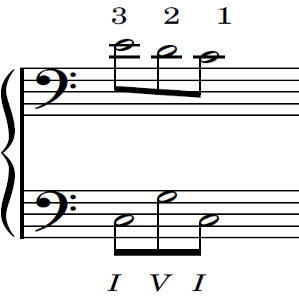
Heinrich Schenker’s Ursatz
Nidaa Abou Mrad then expands on the duality of the tonic-dominant-tonic model and refers to a somewhat cryptic passage by al-Ḥiṣnī, which perhaps holds a key to understanding this entire perspective:
“Each touch [note played on the key of a lute] which falls alone [or in an odd position] on a quiescence gives rise to one of these three focal notes. If an aspirant to the science of modality were to ask: ‘How can it be that each of these two focal notes derived [from rāst] is [considered] a foundation and a beginning, in the same way as the [primordial] focal note that gives them birth?’ we would respond to him: the second focal note derives [from this primordial focal note] by its sharpness, while the other does so by its lowness, knowing that each derives from it. Thus each secondary focal note constitutes both a fundamental and a beginning, jointly with the primordial focal note.”
Abou Mrad interprets the cryptic distinction between derivation by “sharpness” and by “lowness” as two complementary processes: Dugah emerges through melodic differentiation from the primordial degree I, while Segah returns toward it through consonant conjunction. Drawing on Schenkerian terminology, he therefore identifies a principal nucleus α, associated with Rāst and Segah, and a secondary nucleus β, associated with Dugah, which emerges from the passing degree and acquires an autonomous structural jurisdiction.
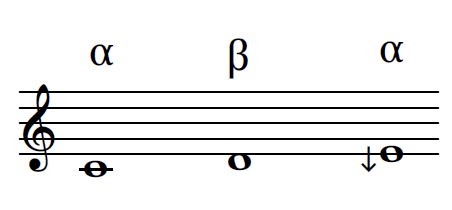
This dualism in the hermeneutical tradition has been taken much further in other medieval writings. As Jean During summarizes it in his preface to Abou Mrad’s book:
“The tree of modes, whose trunk is Rāst ("right, just"), is rooted in a traditional vision of an ordered world in terms of an origin point, roots, verticality, development, hierarchical arborescence, and return to the origin. This theoretical axis may be interpreted as a way to pierce the plane of immanence of practice to elevate itself above the empirical use of modes that by nature tend to extend in a rhizome where one circulates all azimuths, according to lines and connections.
In the inventory of modes, adjusted over the centuries, the maqām Rāst ("right") occupies the first place (yek gāh, Yegāh in Persian), from which proceed a Second mode (Dogāh), a Third (Segāh), a Fourth (Chahārgāh), etc. "The maqām Rāst," says around 1600 a Samarkand expert, "is the father of all usūl, awāzāt, and shu‘ab." According to al-Ḥiṣnī, "it is the source of modes." Other sources also underline at that time that Rāst is the first mode whose "hypostases" always end their development with a return to Rāst. But the “rightness” of Rāst appears to be merely an ideal rather than a consistent musical reality, since the maqām is realized differently from one region to another, in a zalzalian version (neutral third and third in the Arabic world) and in a harmonic version (major third, from Turkey - except for some exceptions - to Kashmir).
This rise of the third, inherited from Pythagoreanism, with all that follows, might correspond to an entry into phase with modernity promoted by the Occident, perhaps through the detour of India and Russia as far as Central Asia is concerned.
As Rāst proves somewhat ambiguous, Eastern masters of the 16th century like Kawkabī, Nasīmī, and Saḍroddī already affirm the supremacy (bartarī) of the Ḥusaynī mode, a sign of a change in perspective or perhaps simply of realism. Indeed, to this day, from Anatolia to Khorasan, this modal type dominates all demotic musics, and in the Persian system "rebooted" at the beginning of the 19th century, under the new name of Shūr (an aspect of Ḥusaynī), it is promoted as "mother of all modes" (umm al-āvāz). From it are supposed to derive many avāz and gushes, typically zalzalien, forming a large part of a modal corpus (radif) organized symbolically into twelve suites. (Consequently, Rāst is relegated to the last position in the series of modes, while learning begins with Shūr and ends with Rāst.)
In fact, rather than being derived from Shūr (mota‘aleqāt), these more or less autonomous modes have been attached to it for theoretical coherence. The rehabilitation of this modal type can be interpreted as a resistance to the dictates of Western equal temperament.”
So, clearly, another type of dualism is also at play: the ideological divide of “East” vs “West”. But, it is also worth paying attention to one detail that maybe doesn’t immediately jump at us: both the sixteenth- and nineteenth-century theorists were reaching for a metaphor to illustrate that one primary, or generative mode. Yet while the in the sixteenth-century they described it as the “father of modes”, the later tradition chose to refer to their main mode as the “mother of modes”. We cannot know why this shift occurred, but it is difficult to imagine that Qajar Iran was a particularly progressive environment in terms of gender politics and feminism. It is therefore reasonable to suspect that the choice of mother was not merely an alternative designation for a dominant mode, but reflected a long-standing semiotic association between Rāst and the masculine, and Husseini and the feminine, which extended far beyond the simple question of which gender was assigned greater authority.
Since Jean During already opened the door to philosophical readings with his Deleuzian references, we might take this a step further and read al-Ḥiṣnī’s enigmatic passage through the lens of C. S. Peirce’s phenomenological categories: the primordial note Rāst represents Firstness: it stands alone, prior to any relation, as a quality simply existing in itself. With Dugāh comes Secondness, the brute encounter of one pitch with another, expressed here through the language of “sharpness”: two pitches now stand in opposition, establishing the first polarity. Yet a mere polarity does not constitute a world, or a system. Thirdness, embodied in Segāh, introduces the mediating relation between the two and thereby completes the triadic structure through which the entire modal system can come into being.
The I>II>III sequence can also be turned around into III>II>I (the Schenkerian way), in order to draw yet another analogy, this time from the mother vs. father observation: Julia Kristeva’s distinction between the semiotic chora and the symbolic order. The Zalzalian interval could be seen as a musical analogue of the chora: unstable, pre-symbolic, and driven by a primordial impulse, through which the “son” Segāh remains bound to Dugāh, its “mother.” We have already encountered this instability in the previous article: in the “mother-mode” of Ḥusseini, Segāh does not occupy a fixed pitch position, but is drawn downward toward Dugāh in cadential contexts. Then, with the appearance of Rāst, the “father”, a world of symbolic order is established. Segāh acquires a more determinate position on the modal tree, separating itself from the maternal Dugāh and entering the principal nucleus α.
One could expand these philosophical associations almost indefinitely, yet it is worth returning back to the strictly structural realm, to the most immediate musical explanation of the duality: the essential dominant-tonic relationship, understood as the fundamental tension between two degrees, with one generating an expectation of movement toward the other. Expanding this line of research in his seminal 2016 book Éléments de sémiotique modale, Abou Mrad connects the dual-nucleus model to Curt Sachs’s theory of contrasting chains of thirds. The modal degrees are organized into two competing chains, the principal nucleus α and the secondary nucleus β, each generated through successive thirds, with one acquiring primacy over the other according to the modal system and its association with the final.
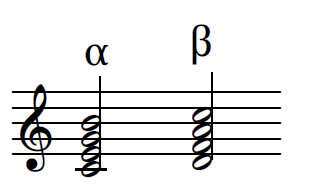
The model of competing thirds
Abou Mrad proposes this dual-nucleus model of contrasting thirds as a generative logic underlying not only maqām in particular, but modal music in general. However, its unnecessary strictness quickly creates problems when accounting for the roles of the VII and VIII degrees, which fall into categories seemingly opposite to where their actual melodic functions would place them. Abou Mrad partially mitigates this through octave inversions, but some inconsistencies in this system remain. A less restrictive model for articulating the overarching dominant–tonic relationship may ultimately be more useful in conceptualizing this particular aspect of modal music, as we shall see in the next section.
Lad model - The Soviet perspective
A third way of looking at the maqām modal structure comes from the Russian concept of lad, a term usually translated as “mode” but with its meaning extending beyond the typical Western understanding of the term. This broader definition of the lad concept was introduced by Boleslav Yavorsky in his 1908 book The Design of Musical Speech, and became deeply embedded in Soviet musical pedagogy throughout the twentieth century. This conception was subsequently adopted and developed by Soviet and post-Soviet researchers of modal music in general, and maqām systems such as the Uzbek Šašmaqom in particular.
Yavorsky was a theorist of classical music closely associated with the modernist tendencies of early twentieth-century Russia (being a close friend and a mentor of Dmitri Shostakovich, among others). He sought to develop an open and all-encompassing analytical system that could be applied beyond classical tonal music, onto the atonal and polytonal experiments of modernist composers, but also to the monodic folk and modal traditions. Maqām was therefore not the specific musical genre Yavorsky had in mind when developing his framework. However, some of the core principals found in his theories lend themselves particularly well here.
Somewhat close to Schenker in the assumption of music’s underlying deep structure but fundamentally different in approach, Yavorskyan framework finds the deep structure in a pattern of tonal relationships unfolding through time, a concept to which he (somewhat confusingly) referred to as ladovy rhythm (ладовый ритм). Here, “rhythm” does not refer to rhythm in the ordinary sense of meter, duration, or rhythmic pattern, but to the temporal unfolding of a musical work on a macro-level through the series of micro-relationships between the tones of the mode. This unfolding is governed by two complementary forces: tyagotenie (тяготение), or gravitational attraction, and sopriazhenie (сопряжение), or coupling.
An interesting side observation: the Russian term sopriazhenie (сопряжение) originally referred to the coupling or joining of railway cars. So, rather than the language of nature, we are now encountering the language of machines and mechanical systems, which was very much part of the intellectual and artistic atmosphere of early Soviet modernism, when artists were to become increasingly fascinated by the aesthetics of industrial technology. It is the world of Dziga Vertov’s Man with a Movie Camera, Alexander Mosolov’s Iron Foundry, and Arseny Avraamov’s Symphony of Sirens, whose 1922 performance in the port of Baku transformed ships, factory sirens, vehicles, artillery, and other industrial and military sounds into a city-wide musical apparatus.
For Yavorsky, the tones of a mode are either gravitating toward another tone or being gravitated toward. The smallest unit of modal structure therefore consists of a completed coupling between a gravitating tone and its gravitational center. This completed movement is called an oborot (оборот), literally a “turnaround” or “turn.”
As ladovy rhythm unfolds in time, a tone that had previously occupied a stable position may become unstable and begin gravitating toward another tone, or vice versa. This makes lad, in its Yavorskyan sense, fundamentally incompatible with the idea of an octave scale whose tonic and dominant occupy fixed structural positions. Still, Yavorsky and the subsequent Soviet theorists do not reject the familiar terminology, and in fact use D and T to designate the gravitating and stable tones respectively, but the crucial difference is that these functions are temporary and relational, emerging and changing through the course of the lad.
The simplest form of an oborot (turnaround) in lad theory is what Yavorsky called the single symmetrical system (edinaya simmetricheskaya sistema, единая симметричная система): a tritone whose two unstable tones move by contrary semitone motion toward two stable tones, forming a stable major third. This basic cell could then be infinitely expanded and combined into more complex configurations.
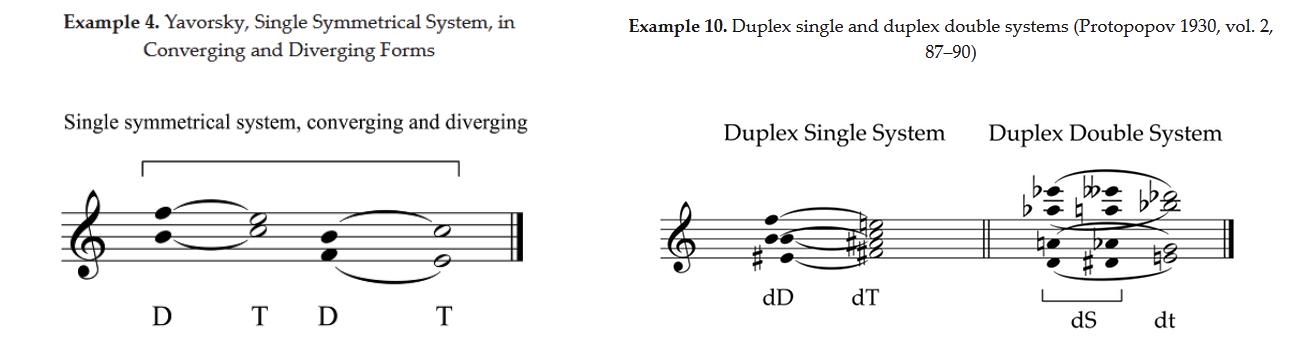
Two examples of lad structures, illustrating the basic symmetrical system and one of the more complex forms. Reproduced from Philip Ewell, “On the Russian Concept of Lād, 1830–1945.”
The harmonic functions represented in these diagrams should not, however, be understood necessarily as chords sounding simultaneously. The same relationships can unfold successively within a melody: what matters is the gravitational connection between tones and its eventual completion. In this sense, lad represents something like a “horizontal harmony,” in which functional relationships are extended through musical time (which is another concept partly shared with Schenkerianism). Philip Ewell notes that in Protopopov’s later analyses, such horizontal connections are explicitly called intonatsii. For Yavorsky, a completed single system constituted the basic unit of musical meaning, which he called intonatsiya (интонация). Boris Asafiev subsequently expanded the concept far beyond this original technical meaning, making intonatsiya a much broader category encompassing virtually any instance of signification and meaning, from a single note, to an entire musical style or era. In that most literal sense of the term, “intonation” would refer to taking any thing, or idea, however abstract, and placing it into a tone.
Another one Asafiev’s contributions to lad theory that can be useful here is his conception of the subdominant. For Asafiev, the subdominant represents the anti-leading tone, the “overcoming of the leading-tone-ness”: the gravity is countered by a force that softens or limits that tendency. This conception of the subdominant may offer an especially apt description of the role of Ḥusseini IV, which can counteract the leading tendency of the preceding degree and redirect melodic motion. As perhaps its main strength, lad theory lends itself particularly well to capturing the kinetic energy between the tones of a monodic melody, which may be one of the crucial aspects of the understanding of maqām. In Sufi philosophy, this existential quality of melodic material is sometimes expressed through the concept of asar, the inner life of the music itself. Of the analytical models considered here, lad theory perhaps comes closest to giving this intuition a theoretical structure.

12 archetypal Flavors represented as symmetrical systems
Rhizomatic model - The (neo)systematist perspective
The fourth model proposed here is what we shall call the rhizomatic model. The concept itself is not new: its practical foundation lies in the familiar idea of constructing modal structures from smaller building blocks, already central to medieval Systematist theory. What is new is to treat this principle explicitly as a counterpoint to the arborescent model. This framing was inspired by Jean During’s commentary above, which itself draws on the non-hierarchical concept of the rhizome developed by Gilles Deleuze and Félix Guattari. Rather than deriving modal structures from a single privileged root, the rhizomatic model understands them as networks of interchangeable elements that can connect, detach, and recombine in different configurations. Taken together with the other two polar opposites, scalar and lad models, this rhizomatic model completes the fourfold analytical field.

Conceived as a natural extension of the concept of “flavors” introduced in the previous article, we can slightly update the Systematist approach by oficially adopting the term flavor for the individual tone-group building block from here on, rather than relying on the somewhat abstract concepts of ajnas or n-chords.
The Turkish term çeşni (“flavor”) is commonly used to describe the constituent tonal structures of makam, including the dörtlü and beşli (tetrachords and pentachords), although in some cases with a somewhat limited meaning: it commonly refers to a short excursion into a building block non-native to the main mode (as when a section in Rast briefly “moves into the flavor of Hicaz”, hereby Hicaz is refered to as a flavor but not Rast itself). Here, the term flavor is instead adopted in its broader meaning, and refers to the tonal-, but also the phenomenological identity of every building block.
A defining structural aspect of a flavor is the varying stability of its degrees and the kinetic energy of unstable degrees gravitating toward the node (a tonal center serving as a point of transfer to another flavor). Therefore, just as in natural rhizomes, growth gravitates toward a node, from which it proceeds into a new offshoot. In the notation, this kinetic energy is represented by an arrow, while the tonal space between the two nodes is marked with a bow, as in scalar representations. Here, however, the bow is colored according to the predetermined color scheme.
This is why the rhizomatic model occupies the space between lad and the scalar model. It incorporates the gravitational principle of lad contained within the flavors while retaining aspects of scalar representation, particularly the more flexible form found in the Tunisian theory described above.

A scale of Ramal al-Maya with colored bows and arrows
The “bow-and-arrow” feature of the proposed flavor representation makes it possible to differentiate between two different degrees of instability. While in the graphical model of lad every black note is equally unstable, in the notation of flavors we can distinguish between a simple passing note, a non-node (an unmarked note within a tone group under a bow), and a heavily gravitating note that is marked with an arrow pointing towards the node (see Flavors).
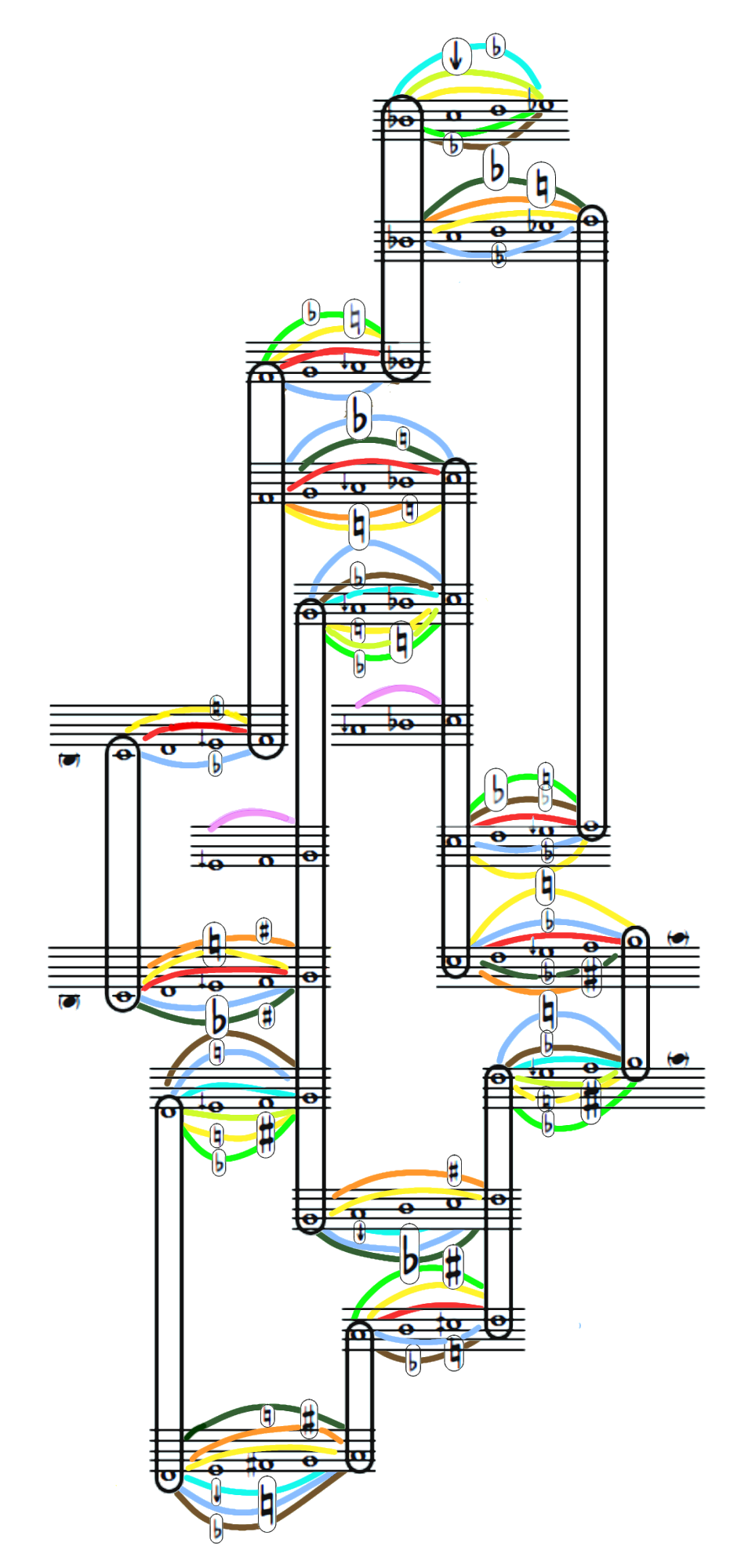
A rhizomatic model showing all available flavors between two nodes, beginning with the F-Rast master scale, with the wusta on E half-flat and A half-flat, and extending four steps down the circle of fourths to incorporate A-Rast, with the wusta on C half-sharp. In an ideal three-dimensional representation, the nodes (notes connected by the ellipse) would occupy the same space.
The network pictured above represents roughly the maximum extent to which maqām might reasonably modulate within a single performance, and even this would be characteristic only of particularly modulation-happy genres such as those found in Turkey and the Balkans. In other genres, such as a Persian traditional performance, the central few blocks would generally be sufficient. Theoretically, however, the network could continue along the circle of fourths until it formed a complete sphere, with all twelve degrees of the twelve-tone scale functioning as nodes. If the Iraq-tetrachord were added as an option, in a downward extension of Segāh, the system would multiply further into a 24-tone scale. A complete network is therefore impossible to represent graphically. Even in the model shown here, there was no room to show the notes extending beyond the nodes, which is why the flavors of Saba and Esfahan aren’t seen on the map.
As everything concerning the content of the building block was already explained in the previous article on “Flavors,” there is not much more to say here. It is important to stress that the rhizomatic model is not intended as a synthesis of the three preceding approaches, combining their supposedly best features into a more complete theory. In fact, it has as many flaws as any of the others, if not more. The four models should therefore be understood as complementary perspectives rather than successive stages toward a single ideal model.
Implications for the Performer
The benefit of having these four models presented side by side is that we can extract what is useful from each of them: where one model leaves out an important aspect, another can bring it into focus. The octave-scale model is obviously the most approachable for the uninitiated, and should not therefore be dismissed. Maqām lore can be overwhelming, with a great deal of gatekeeping and mystification surrounding it, and to see it presented in the familiar form of a regular scale is helpful and reassuring in the beginner’s phase. It gives the performer an immediate grasp of the basic tonal material without requiring an understanding of the larger theoretical system.
Along a learning trajectory, the next most suitable model would be the rhizome, where this basic understanding of tonal structures is expanded, and the principles of tarkīb, or building-block structuring are made clear. The concept of flavors, which complements the rhizomatic model, introduces directionality and the gravitational tendencies of notes toward one another within each building block. This kinetic dimension is then placed at the forefront in the lad model, where the principles of ladovy rhythm offer a particularly useful way of sensing and internalizing what is known as seyr: directionality on the macro level, the ebb and flow of building blocks as they move through the registers, and the deeper structural relationships that emerge through their movement.
The arborescent model takes this one step further, offering a glimpse into the deep structure of this entire semiosphere (in Yuri Lotman’s terms). It allows us to consider not only the structure of the mode we are performing, but also its place within a larger system of modal relations. This is the most philosophical and abstract of the four models, and therefore perhaps the most difficult for a performer to grasp directly. It may consequently be best approached at the final stage. Thus, moving from scale to rhizome to lad to tree, we move from the technical matters of the concrete organization of pitches toward increasingly abstract ways of understanding the relationships that give the modal system its meaning.

Four models and their commonalities