12 archetypal flavors of Maqam
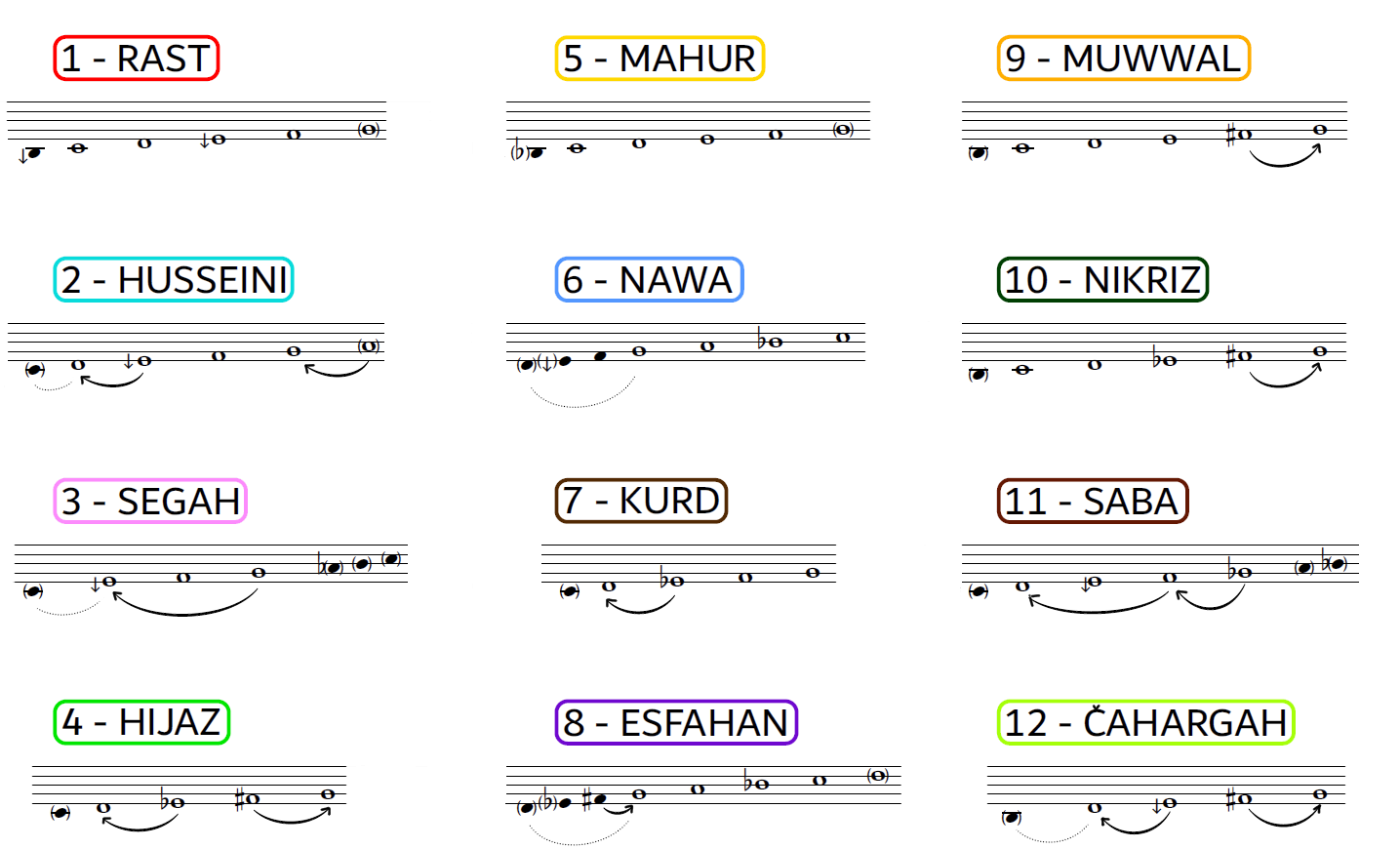
Introduction (Jins vs. Gūše)
"In practice, musicians do not pursue the same aim in all modes: in some their aim is to give prominence to the interval limiting the mode (i.e. tonic and fourth in a tetrachord, tonic and octave in an octave scale, etc.); in others to give prominence to a lesser interval; and in others to give prominence to a single note." (from Qutb al-Din al-Shīrāzī: Durrat al-Tāj - 13th century, as quoted by Owen Wright)
Across the history of maqām scholarship, we can observe two competing views of what should constitute the fundamental unit of analysis. Is it the abstract tri-, tetra-, or pentachord (jins - Arabic “genus”), or the specific melody or motive (gūše - Persian “nook, corner”)? Both concepts are already present in the writings of the Systematists, in the form of “n-chord species” and “tertiary mode,” yet subsequent theoretical traditions have tended to privilege one aspect over the other, creating a false sense of unbridgeable disparity between systems such as Arabic maqām and Persian dastgāh. Both frameworks share the principle of constructing larger modal structures from smaller building blocks, but differ in how a single block is defined and what information it contains.
It is important to note that these are analytical perspectives, neither of which is inherently more correct than the other, but each of which shapes musical thinking in distinct ways. In a jins, the tone group is strictly defined, with its focal note located at either its upper or lower boundary, while melodic contour and rhythm are not prescribed. This allows greater freedom in melodic improvisation: the abstract tone group is fixed by the system, while the specific melodic movement between its tones is learned through practice and intuition. The gūše, by contrast, requires the musician to adhere more closely to prescribed melodic motives, but does not fix the tonal center at the boundary of the tone group, allowing greater freedom and variety in the conceptualization of tonal functions, whether realized or implied. Some stricter approaches prescribe the rhythmic material for each gūše, but for the purposes of this article we will use the term in a broader sense: a set of tones loosely organized in a predetermined order, each assigned a specific role within the structure, together with characteristic melodic archetypes.
The fixed melody approach is more commonly found in the eastern half of the maqām world (east of Iraq), while abstract tetrachords are used as a theoretical unit primarily in Turkish and Arabic theories, though as Scott Marcus notes, the latter is a relatively recent development not widely found in Arabic literature before the Cairo Congress. The theories of Iraqi maqām present a seemingly single exception to this, and treat both approaches simultaneously.
Newer literature explores the possibilities of viewing the eastern traditions through the lens of the jins-approach and western through gūše. Dariush Talai introduced the concept of tetrachordal tonegroups (Pers. "dang") in Dastgāh, Zhou Ji adopts the same approach in his modal analysis of the Uyghur Muqam. Conversely, Sami Abū Shumāys pedagogical YouTube series on maqām teaches the characteristic melodic motives in each jins he presents, and a recent paper by Ertuğrul Bayraktarkatal and Cenk Güray also proposes analyzing Turkish Makam by its melodic nuclei.
In the picture below we can observe what happens if two opposing theories, such as Arabic Maqām and Dastgāh are analyzed in a less strict manner, and sort of meet each other half way: On the left side, the arabic Jins Bayati, as represented by Johnny Farraj of the maqamworld.com, where he does not adhere to the strict tetrachord (D, ↓E, F, G) but includes the leading tones as well as extensions that can be heard during short excursions such as in ornamentation. On the right side is the example from Hormoz Farhat’s book where he introduces a graph marking the tonal material and the central tone group of dastgāh Šur, before going on to notate all the gūšeha (melodic motives) in found in the dastgāh.

Instead of showing just the main tetrachord for the Arabic jins, and an entire notated melody for the Persian gūše, and having it look like two things that have nothing in common, now we can clearly see how similar these two regional versions of the same root mode really are.
Technically, using the term mode here is incorrect, as this is only the first building block of a full mode, but it is customary for the first building block to set the identity of the entire mode. The modes are often named after their root jins, which in turn is often named after its focal note. Just as in classical music where we would have the note “C”, then the “C-major” key (named after the note “C” but containing other notes); and then we would have something like a “Beethoven’s Sonata in C-major” (named after the C-major key but containing many other keys, even though it will typically find a way back to C-major at the end). In maqam we would have the note/function RAST (for example “C”), which is the first note in the jins/tetrachord RAST (C, D, ↓E, F), which is the first building block of the maqam RAST, that will develop through many different ajnas, but ultimately end on the RAST.
However, the semiotical identity of a building block is much more than just a group of notes used in it. The notes are differentiated by the specific functions within the block: some are unstable and gravitate very strongly towards the other more stable ones, some are heavily featured, others almost entirely omitted, except in passing or ornamentation. Some, like the SEGAH trichord, remain infinitely unresolved. While the concrete melodic motives, or gūše, do vary from region to region, those roles and gravitations appear to persist within the motives. Therefore, there is also a very specific extramusical signification or ethos that is tied to each building block, and consistent throughout the regions of the Maqam realm. We can routinely observe same literary themes recurring in the poetry that accompanies certain modes. So, what is proposed here is the unit of analysis suited for the trans-cultural application, which recognizes the mutual recurring features found in the modes throughout the region.
The definition of “Flavor”
The term “jins” typically refers only to the notes used in a building block, but there isn’t a widely accepted terminology that covers both the structural and intuitive/sensual aspects of a maqām building block. Such a term would in itself imply: (1) the notes used, (2) their roles within the tone group, (3) the typical melodic motives, (4) the extra-musical meanings and conceptual load (poetic themes etc).
After weighing all the possibilities, I have settled for a term flavor (from Turkish: çeşni - flavor, flavoring, spice) which is already in use in Turkish Makam theory and comes closest to the wanted meaning.
In this proposed classification, which I created mainly for myself, as a pedagogical tool to help me not just understand but internalize these complex sets of information, I identified 12 archetypal flavors of the transnational maqām. The classification into exactly 12 units is just one of several possible approaches, an argument could have easily been made for any choice between 10 and 15. Nevertheless, 12 seems to be a relatively good compromise and is also a nod to the original 12 maqāms of the systematist school. As for the existing classifications of building blocks, in the book on Turkish Makam, Karl Signell identifies 6 basic and 6 lesser ajnas, Habib Hassan Touma lists 8 main ajnas of the Arabic Maqam, Salah al Mahdi gives 12 ‘uqud of Tunisian Maluf, Dariush Talai lists 4 main dang-ha of Persian Dastgah, and Zhou Ji lists 6 tetrachords of Uyghur Muqam. (see below for the comparison table of these classifications)
In assigning names to the flavors, I drew on widely used nomenclature while avoiding mode names with too many divergent tonal iterations across traditions. Where this was unavoidable, I adhered to the medieval definitions of Urmawi and Shirazi.
The color-number combinations, as used in public transportation maps, are well established as aids to memorization and have proven immensely useful pedagogically. I assigned the colors randomly for the few main flavors, and then chose the rest of the colors to imply the connections. At the time I was unaware of Sami Abu Shumays' color coding and was later pleased to find that we made many similar choices.
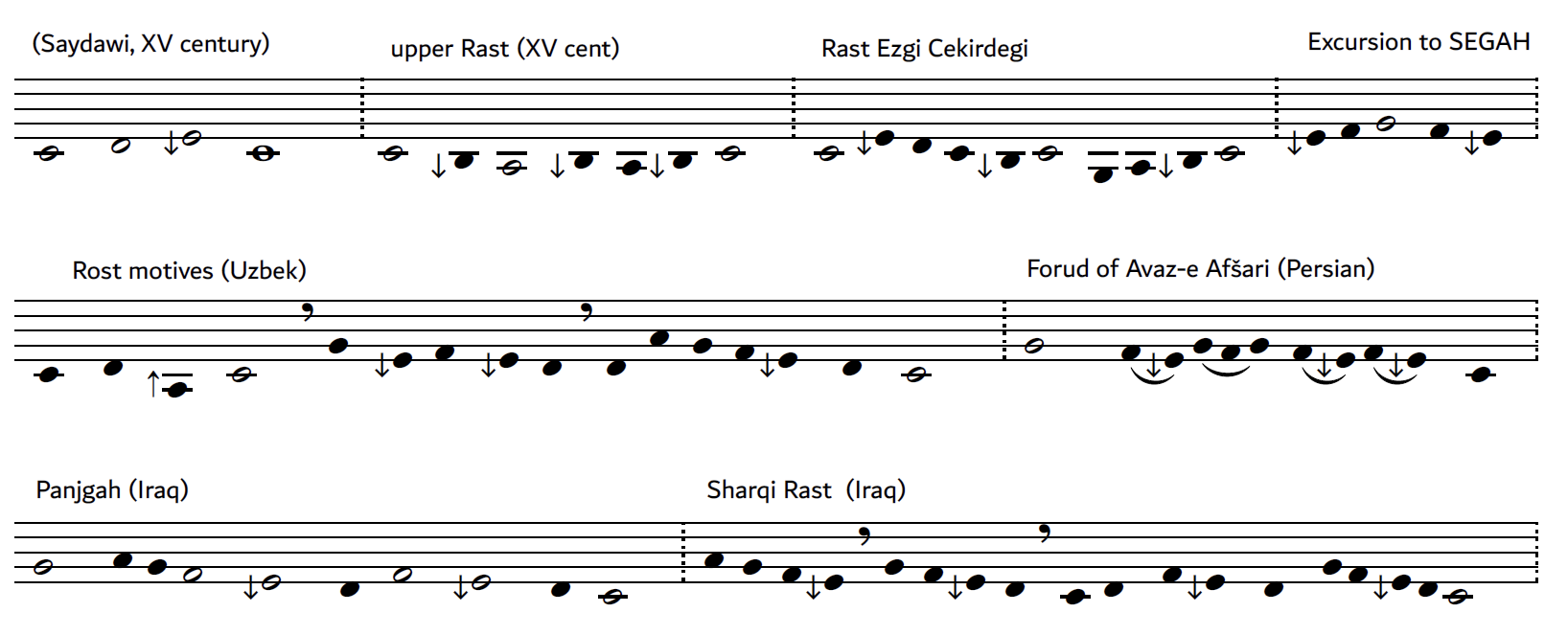
A small selection of motives is given as an illustration of each flavor, and is by no means exhaustive. The author is more than open to suggestions by experienced performers and listeners, in order to expand each one of these lists.


.
Tone Group:
major tetrachord (occasionally pentachord) with a II-III interval smaller than I-II. The I-III interval anywhere between 350 and 386 cents (wusta on III). Clear focal role of the I. II and (LT) gravitate towards the I. Both III and IV relatively stable.
Other Variants:
“upper Rast” - IV as a tonal center, III and V gravitate towards it
“shortened upper Rast” - same, but I no longer present
“Eastern Rast” - Found in Central Asian systems. “Darker” in character, I-III interval lesser than 350 ct. Marked with a dark red color
Prevalence:
Turkish makams featuring this flavor in an opening and/or cadential role include: RAST, SAZKAR, REHAVI, PESENDIDE, YEGAH, NISABURAK. Featured in following common Arabic maqams: RAST, KIRDAN, SUZNAK, SUZDALARA, YEKAH, MAHUR, MAYLIS AFRUZ, Iraqi maqams: RAST, SHARQI RAST and PANJGAH; as well as following common qit’as: KHALILI, MAHURI, ZANBURI. Featured in following Libyan/Tunisian tubu: RASD-AL-DHIL, ASBAHAN, MAYA, DHIL (III in the Tunisian version of DHIL is tuned higher than in other tubu, closer to the 386 ct just intonation third).
In the Persian radif, this flavor is rare, but it could be heard (or at least hinted at) in a cadence in AVAZ-E AFSHARI, with the heavy emphasis on the V, and an extremely sparse usage of the I despite the gravitational pull in its direction.
ROST is one of the 6 maqoms of the Bukharan Šašmaqom tradition, with “Eastern Rast” as its main flavor. This Central Asian version is also featured in the Uyghur Muqam PANJIGAH, as well as in some sections of the Fargana Tashkent Maqom DUGOH HOSAYNI
Some Melodic Archetypes:
History and Symbolism:
Introduced as a tetrachord in Ptolemy’s Harmonies in its 204-182-112 form (natural third). In the arborescent model of the Arab hermeneutic tradition, the trichord of Rast is considered the father of all modes. It stands at the root of a transmodal tree, and all other modes are derived from it. It is named after the note Rast (just, straight) which is the first note on the open string position. It was connected to the zodiac sign of Taurus and concepts of sun, stability, strength, order, masculinity, and comfort.
Links to Audio Examples:
MAQAMWORLD.COM entries for Arabic ajnas RAST, UPPER RAST and JIHARKAH with sound examples
SHARQI RAST (Farida and Iraqi Maqam Ensemble)
GARDUNI ROST (Omnibus Ensemble Tashkent)
DUGOH XOSAYNIY (Shamsiddin Nuriddinov)
AVAZ-e AFŠARI (Eqbal Azar and Abdolhoseyn Shahnazi)
RAST (Vartan Magrosiyan)
KALAJDŽISKO ORO (Sadilovci)
RAST SAZ SEMAI - D. CANTEMIR (Ensemble Hesperion XXI)

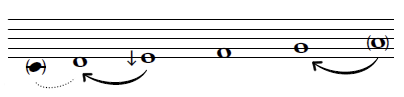
Tone group:
minor tetrachord or pentachord with a I-II interval smaller than III-IV. I-II interval anywhere between 112 and 182 cents (wusta on II). Clear focal role of the I. II and (LT) gravitate towards the I. II is often lower in the cadential descent. III relatively stable. IV can take a focal role, and extend upwards into #6 NAWA. If V (Husseini-note) is present, it gravitates strongly towards IV . Some theories separate Husseini (the pentachord) from Bayati/Uşşak (the tetrachord) into separate flavors.
Theoretical models of the I-II interval tuning:
112 ct (classified as nawruz in al-Risāla al-sharafiyya): darker in color, tonally close to (#7 KURD). Often heard in Kurdish and Turkmen folk music
136 ct (given by H. Farhat as an approximate tuning of šur, D. Talai gives 140 cents): the interval in use in Persian classical and folk music
150 ct (a Zalzalian second, as documented in Kitāb al-mūsīqī al kabīr): today the first interval in Arabic jins bayati
182 ct (a “small” whole tone 10:9, mentioned as husayni in some interpretations al-Risāla al-sharafiyya, possibly erroneously): lighter in color, tonally close to (#6 NAWA). Today the first interval in cins uşşak in Turkish classical music. Turkish folk music uses flexible tuning, that is usually much lower in practice, closer to šur
Prevalence:
Found in the Arabic maqams: BAYATI, HUSAYNI, BAYATI SHURI, MUHAYYAR, BAYATI USHAYRAN, HUSAYNI USHAYRAN, NAHOFT, ISFAHAN, NAWA, ARAZBAR, Turkish makams: UŞŞAK, BAYATI, HÜSEYNI, MUHAYYER, GÜLIZAR, NEVA, NIŞABUR, TAHIR, ACEM, HISAR, ARAZBAR, SIPIHR, and NEVRUZ as well as Iraqi maqams: BAYAT, BHEIRZAWI, IBRAHIMI, JUBURI, MAHMUDI, MISCHIN, MUGABL, NARI, SHARQI DOGAH (bayati tetrachord), HUSSEINI; ARWAH; ORFA; DASHT (husseini pentachord). It is also present in the following common qit’as: QURIYAT, NARI, ABOUSH, ALIZABAR, HIJAZ GHARIB, QARIABASH, QAZAZ, USHIASH, OMAR GALA and ZAZA
It is known as the primary mode of ŠUR in PERSIAN and AZERBAIJANI radif/mugham, and remains the main flavor of PERSIAN DASTGAH-E ŠUR (clear presence of the tonic), AVAZ-E ABUATA (emphasis on the 4th deg.) and AVAZ-E DASHTI (emphasis on the 5th deg.) It is featured in numerous guše-ha.
According to el Mahdi, Tunisian Maluf differentiates between the tuning in Nuba IRAQ (closer to uşşak) and HSIN/RAMAL AL MAYA (closer to bayati). HSIN is also found in Constantine Maluf as well as Gharnati tradition of Tlemcen (there under the name IRAQ MATLUQ). These two are the only documented and classified instance of surviving non-tempered intervals in the Algerian music theory.
It is the opening flavor of the Uyghur Muqam IRAQ of the On-Ikki Muqam tradition, with the “nola” (drifting tone) on II
It is also among the most prevalent flavors in Balkan, Turkish, Ashik, Turkmen and Kurdish folk music.
Some Melodic Archetypes:

History and Symbolism:
Documented as a diatonic tetrachord by Didymus in the 1st Century AD (in the tuning of nawruz). Listed as one of the 12 primary modes in the medieval theories. In the hermeneutic tradition, often named as the mother of modes. Named after the Note Husseini (derived from a personal name of an unknown origin), the 6th degree of the diatonic scale. It was connected to the zodiac sign of Scorpio and concepts of moon, femininity, melancholy, passion, and love.
Links to Audio Examples:
MAQAMWORLD.COM entry for Arabic jins BAYATI with sound examples
ISTIKHBAR ARAQ MATLUQ (Rifat and Anis Khalfat)
SUR TESNIFLERI (Elmira Rahimova)
ARAKA TAROUBAN (Ahmed Ellouz)
KERTAM (Hayk Ghevondyan)
QIYNAMASANGCHI (Abror Zufarov)
MARKIZAT (Ashug Nusret)


Tone group:
a trichord with the dual tonic relationship. I as the “segah tonic”, with VI (I of RAST) as the “implied tonic”. II and IIIgravitate towards I, however I feels incomplete and bound to the implied rast tonic. In Serbian theory, Segah is called Tercni dur (“tertian” major). According to medieval Arab arborescent schema, Segah is derived from Rast. One of the defining characteristics is the distict lack of the note below segah tonic (II of RAST).
There is rarely a tetrachord variant (which is what differentiates it from a Phrygian tetrachord (#7-KURD)), instead, III typically extends upwards to a whole other tetrachord (III-IV-V-VI), which can be (#4-HIJAZ), (#2-HUSSEINI), (#5-MAHUR), (#6-NAWA), (#12-ČAHARGAH) or (#1-RAST).
Tuning of the I-II interval anywhere from 100 to 160 ct (100 in most equal-tempered systems, 112 in Turkish segah, 150 in Arabian sika, 160 in Persian segah,as given by Farhat)
Other variants:
Musta’ar: II is a semi-tone higher (would be F# in the above example). Marked with a salmon color as a cross between Segah (pink) and Muwwal (orange)
Iraq: a tetrachord with a three-quarter tone at I-II, whole tone at II-III and a three-quarter tone at III-IV. It is prominent in the medieval theories but relatively rare in the present. Colored pink as SEGAH when the upper tonal center (node) lies at III; or yellow-green as #12-ČAHARGAH if the node lies at IV
A pentatonic scale of a semi-tone, whole-tone, major-third, semi-tone, major third that is sometimes heard in Central Asian music also exhibits characteristics of Segah
Prevalence:
Specific melodic characteristics of SEGAH are found in Arabic Maqams: HUZZAM, SIKAH, IRAQ, BASTANIGAR, AWJ IRAQ, MUSTA’AR. Iraqi Maqams SEGAH, HAKIMI, AFSHAR, AWJ and BAKHTIARI, Turkish Makams: SEGAH, MÜSTEAR, HÜZZAM, EVIÇ and BESTENIGAR, Tunisian and Algerian tab SIKAH. Main flavor in Azerbaijani Mughams XARIC SEGAH, ZABOL SEGAH and MIRZA HUSEYN SEGAH, as well as in Persian Dastgah SEGAH. Also featured in parts of Avaz-e AFSHARI. It appears in Fergana Tashkent Maqam CHORGOH, and in DUGOH of Bukharan Šašmaqom. Some elements of it are observable in Uyghur Muqams AJEM, BAYAT and NAVA. It is also a common melodic characteristic in Balkan Folk music
Some melodic archetypes:
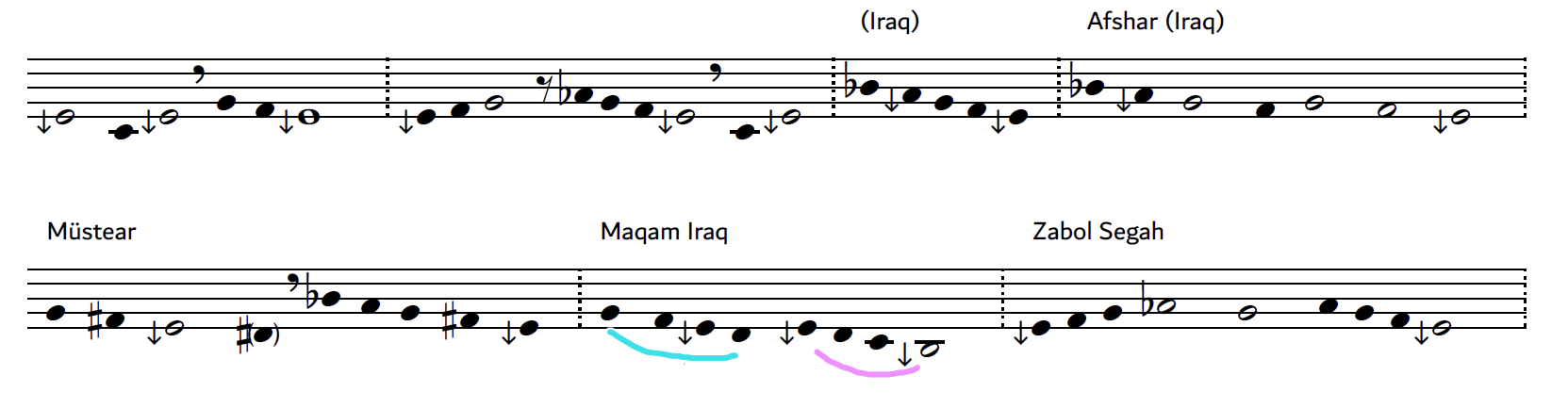
History and Symbolism:
Introduced in the medieval theories as one of 24 sub-modes, while “Iraq” aka “Ruye Iraq”, was given as one of the 12 primary modes. Named after the note Segah (pers: third position), the neutral III of the diatonic scale (with the note Iraq being the neutral VII under I). It was connected to the concepts of nostalghia, yearning, and sorrow culminating in hope. Maqam Iraq was tied to the zodiac sign of Leo.
Links to Audio Examples:
MAQAMWORLD.COM entry for Arabic ajnas SIKAH and MUSTA’AR with sound examples
SEGAH TESNIFI (Teyyar Bayramov)
HÜZZAM SAZ SEMAISI (Murat Salim Tokaç)
CHORGOH (Xorezm Maqom Ensemble)
GOLEMA RIDŽA TI ČINAM (Sadilovci)
MAQAM TIFLIS (Ahmet Necip)
BAKI (Alim Qasimov)
KIŠA BI PALA (Safet Isović)


Tone group:
A harmonic tetrachord. I as the primary total center and IV as the secondary (or vice-versa, in the “Hijaz-Esfahan”). II gravitates towards I, and III towards IV
Rarely a pentachord. Instead, IV often extends into (#8-ESFAHAN) or borders another harmonic tetrachord, the latter combination is known as HIJAZKAR
Other variants:
“Eastern Čahargah” - Tetrachord no. 6 in Zhou Ji’s classification of Uyghur Muqam: nola on III, with a central pitch about a three quarter-tone away from IV, always gravitates towards I, with a typical cadential move of IV-III-II-IV-I. This could also be understood as a form of SEGAH (due to the prominent role of low VI) or a completely independent flavor. Marked with a sage green color as a cross between Hijaz (bright green) and Segah (pink)
“Homayun” - a melodic emphasis on the VII (a whole tone below the I), giving a temporary feeling of (#10-NIKRIZ). Marked with an emerald color as a cross between Hijaz (bright green) and Nikriz (dark green)
Prevalence:
Found in Arabic Maqams: HIJAZ, HIJAZKAR and ZANJARAN, Iraqi Maqams: HIJAZ DIWAN, HIJAZ ATCHOUGH, HIJAZKAR, HOMAYUN, ARAIBUN AJAM, QATAR, MADMI and HUIZAWI, Turkish Makams: HICAZ, UZZAL, ZIRGÜLELI HICAZ, HICAZ HÜMAYUN, HICAZKAR, SUZ-I DIL, ŞEDARABAN and LALEGÜL, Tunisian Tab RAMAL, Algerian tab ZIDAN, Azerbeijani Mughams CAHARGAH, HÜMAYUN, and SUSTER as well as in the ARAM-E JAN section of Makom DUGOH in the Bukharan Šašmakom. Eastern Čahargah is heard in Uyghur Muqams OŠŠAQ and CHARGAH
Some melodic archetypes:
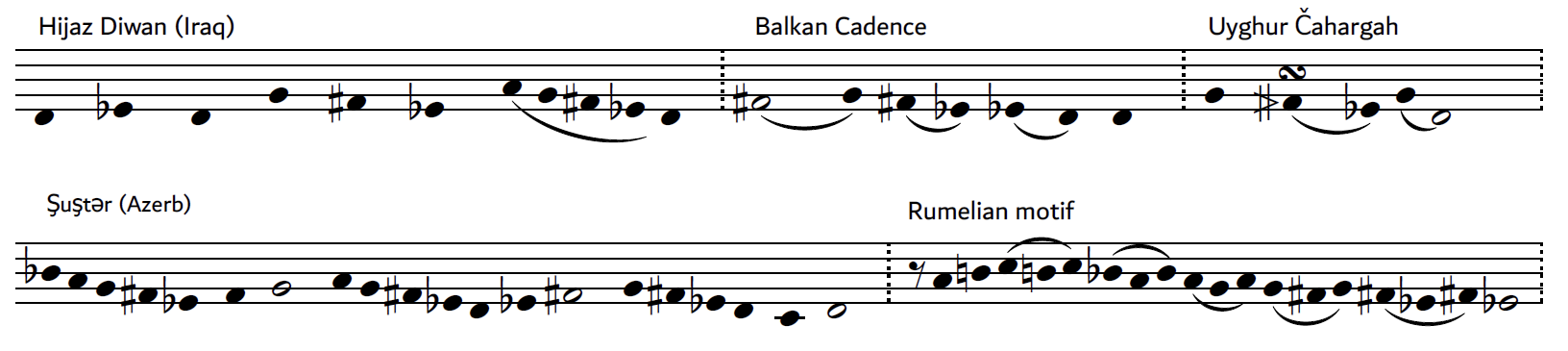
History and Symbolism:
Relatively modern in its current tonal form, for the history of the original flavor, see (#12-ČAHARGAH). Named after the note Hijaz (an augmented 4th degree of the master scale, Hijaz being a historical region around the city of Mecca). It was connected to the concepts of heroism, fighting spirit (Hajibeyov) and distant desert (Touma). North African Nuba Zidan is associated with nobility and grandeur. In Western 19th Century Orientalism, and 20th Century Hollywood it stands as a symbol for the Middle East in general.
Links to Audio Examples:
MAQAMWORLD.COM entry for Arabic ajnas HIJAZ and HIJAZKAR with sound examples
HARRAMT BIK NOUASI (Sheikh Ahmed Al-Lawz)
MAQAM HIJAZ ATCHUGH (Sayyid Salman Al-Musli)
DÖRT GÖZEL (Ostad Sabouhi Music Group)
MUGHAM CHAHARGAH (Alim Qasimov)
PLEVENSKO HORO (Tsvyatko Blagoev band)
SHALAKHO (Levon Madoyan)
UŠŠAQ MUQAM (Theatrical performance by Uyghur Choir and Orchestra)


Tone group:
major tetrachord (occasionally pentachord) with a II-III interval same as I-II. Clear focal role of the I. II and (LT) gravitate towards the I. Both III and IV relatively stable. First tetrachord in the Ionian and Mixolidian modes (on a Pythagorean diatonic scale)
Other variants:
“upper Mahur” - IV as a tonal center, III and V gravitate towards it
“shortened upper Mahur” - same, but I no longer present
A pentatonic scale of a whole-tone, whole-tone, minor third, whole-tone, minor third that is sometimes heard in Central Asian music (mode Buzruk in Uzbek Šašmaqom) also exhibits characteristics of Mahur
Prevalence:
main flavor in Persian Dastgah MAHUR and RAST-PANJGAH, Azeri Mugham RAST (if performed in the 12-TET tuning), MAHUR HINDI, ORTA MAHUR and BAYATI QAJAR, Iraqi Maqam AJAM, JAHARGAH, TAHER and RASHDI, Arabic Maqam AJAM, AJAM USHAYRAN, SHAWQ AFZA and TARZ JADID, Turkish Makam MAHUR, ACEM AŞIRAN, TARZ-I NEVIN, GULDESTE, SUZIDILARA, and BUZURK (but not ÇARGAH: while this exact tone-group and tuning is called ÇARGAH in Turkey, it is not the main flavor of Makam ÇARGAH). Furthermore, it is found in Uzbek Maqom BUZURK and BAYOT, Uyghur Muqam RAK, PANJGAH and CHEBBIYAT, majority of the Sufiyana Kalam modes, Algerian tubu JARKA, MAZMUM and IRAQ MAHSUR, Moroccan tubu IRAQ AL AJAM, USHSHAQ and RAMAL Al-DHIL. As a direct equivalent to the Western major scale, it is also found in a wide variety of popular music genres.
Some melodic archetypes:
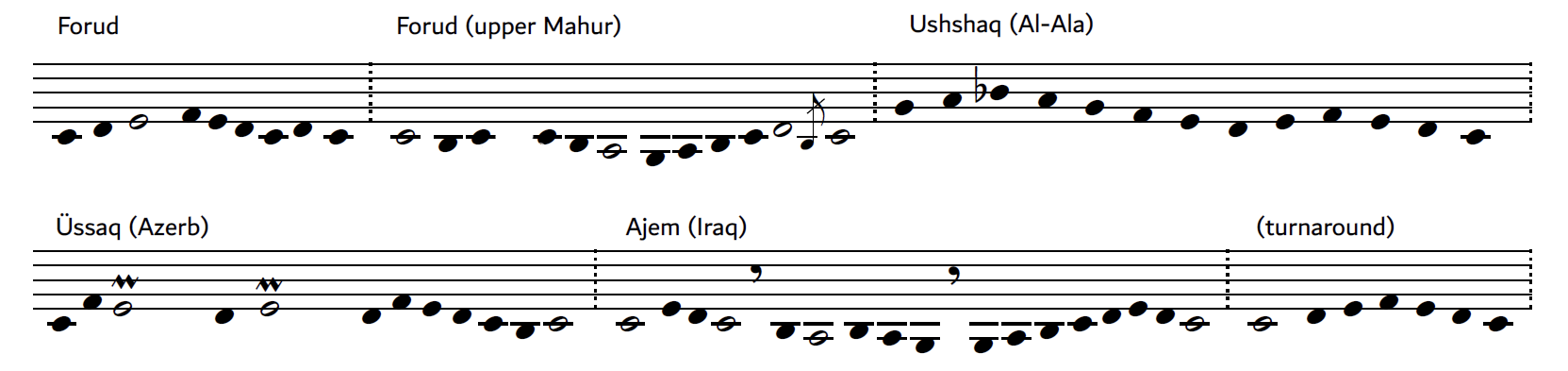
History and Symbolism:
Introduced by Aristoxenus (4th-Century BC). Named as one of the 12 primary maqams in the medieval theories (unter the name Oshshaq). Named after the note Mahur (an auxiliary major 7th degree of the master scale). Persian name Mahur refers to the type of a bright yellow flower. While equivalent to the Western major, its Arabic name Ajam means “from Iran”, and in Persian it is often refered to as Mahur-e Hendi or Rak-e Hendi (“Indian raga”), so if this naming is any clue, this flavor may have reached Middle Eastern music from India, instead of the West. It is connected to the concepts of brightness, laughter and optimism. Oshshaq was tied to the zodiac sign of Pisces.
Links to Audio Examples:
MAQAMWORLD.COM entry for Arabic ajnas AJAM and UPPER AJAM with sound examples
QATAR TESNIFI (Konul Tagiyeva)
NUBA JARKA (Beihdja Rahal)
A VILLAGE WEDDING IN NARDARAN(Alim Qasimov)
BAYOT (Ilyos Arabov)
MUQAM DOGAH (Ustad Ghulam Mohammad Saznavaz)


Tone group:
A minor tetrachord without a strong leading tone (LT). VII-I interval is always a whole tone (a “natural minor”). If no notes below I are present whatsoever, it also counts as NAWA. I-II is not smaller than a whole tone (200 ct in equal temperament or 9:8 / 204 ct in just intonation). First tetrachord in the Dorian and Aeolian modes (on a Pythagorean diatonic scale). There are no strong gravitations among the degrees.
I extends downwards into (#2-HUSSEINI) or another NAWA
Prevalence:
The specific combination of Husseini-Nawa is a main flavor of Persian Dastgah NAVA and Iraqi Maqam NAWA It is also found in Turkish Makam UŞŞAK, BEYATI, Arabic Maqam BEYATI, NAWA, AND RAHAT FAZA, Tunisian tubu HSIN and NAWA. As a simple natural minor, features as main flavor in Uzbek makoms: SEGOH, IROK, GULYAR-SHAHNOZ, NAVO; Uyghur Muqams SEGAH, OZZAL and MUSHAWERAK, Algerian and Morocan tab RAMAL AL MAYA, and Azeri Mughams RAHAB and HAVA-NISAPUR
Some melodic archetypes:

History and Symbolism:
Tetrachord introduced by Aristoxenus (4th-Century BC). Listed as one of the 12 primary maqams in the medieval theories, in its still current form as a compound tone-group. Named after the note NAWA (5th degree of the diatonic scale - Nawa meaning a tune, or melody). It is connected to the concepts of peace, solitude, contemplation, serenity and sacredness, and was tied to the zodiac sign of Aquarius
Links to Audio Examples:
CHAHARMERZAB-E NAVA (Bahram Sadeghian)
YAL-ZARI IL BAZRINGOSH (Yusuf Omar)
FARG’ONACHA SHAHNOZ (Dilorom Abduazimova)
TASNIFI IROQ (uncredited performers)
NEVA NISAPUR (Bahram Mansurov)

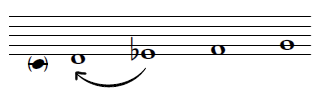
Tone group:
A phrygian tetrachord. I as the primary total center and IV as the secondary (or vice-versa, in the “upper Kurd”). First tetrachord in the Phrygian and Locrian modes (on a Pythagorean master scale). (LT) or VII has no structural importance, but is much more present than in (#3-SEGAH). Many instances of KURD seem like they could be an equal-temperament adaptation of nawruz (which is very common in Kurdish music, while phrygian is not)
Other variants:
“Lami” - a locrian pentachord (IV-V a semitone), found in the Iraqi Maqam LAMI. Marked with a burnished-brown color as a cross between Kurd (brown) and some forms of Segah (pink).
Prevalence:
Turkish Makams KURDILI HICAZKAR. AŞK EFZA, ACEMKURDI, Arabic Maqam KURD, HIJAZKAR KURD, SHAWK TARAB, TARZ NAWIN, Iraqi Maqam KURD, Azeri Mugham BAYATI KURD and DASTI, Persian Avaz BAYATE KORD. SIKA (Segah) in the Constantine Maluf acts more as a KURD in practice (no reference to the VI, and strong presence of the IV). Present in many 12-TET folk music renditions as an approximation of nawruz
Some melodic archetypes:

History and Symbolism:
Introduced by Aristoxenus (4th-Century BC). Named as one of the 12 primary maqams in the medieval theories under the name Busalik (today that name refers to the Turkish Makam in the flavor of (#8-ESFAHAN). Named after the note KURD (an auxiliary minor third degree of the master scale) It is connected to the concepts of passionate romance, heartbreak, longing, and melancholy, and was tied to the zodiac sign of Capricorn. In Western Orientalism and Hollywood it carries a general symbolism of the “Oriental”, less directly tied to the Middle East and Arabia then is the case with HIJAZ
Links to Audio Examples:
MAQAMWORLD.COM entry for Arabic ajnas KURD and LAMI with sound examples
LEYLO (Koma Heray)
KÜRDÜ SHAHNAZ (Alim Qasimov)
ES MI TSAR EM TSIRANI (Ashur Jivani)
JAČE OD OKOVA (Halid Bešlić)

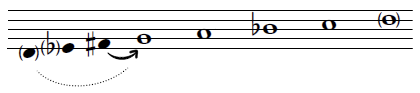
Tone group
A minor tetrachord with a strong leading tone (LT). VII-I interval is always a semitone (a “harmonic minor”), and must be present. I-II is not smaller than a whole tone (200 ct in equal temperament or 9:8 / 204 ct in just intonation). There are no strong gravitations among the degrees of the tetrachord itself. A pentachord variant is possible. This is the only other flavor besides (#3-SEGAH) that is defined by the notes outside the main tone-group.
I extends downwards into (#4-HIJAZ) or (#12-ČAHARGAH).
Other variants:
“Nahawand murassa” - IV extends upwards into (#4-HIJAZ), and temporarily creates a minor pentachord with a lowered V (Db on the example above). Marked with the eggplant color as a cross between Esfahan (purple) and Kurd (brown)
Prevalence:
Main flavor in Azerbaijani Mugham BAYATI SHIRAZ, Persian Dastgah BAYAT-E ESFAHAN, Turkish Makam BUSALIK, NIHAVENDI KEBIR, Arabic Maqams NAHAWAND and SULTANI YAKAH, Iraqi Maqam NAHAWAND, Tunisian and Libyan Nuba ASBAHAN, and Tlemceni Istikhbar SAHLI. Ubiquitous in the Balkan folk music, especially in the HIJAZ-ESFAHAN form (with the cadence on low V). In the less strict sense, present globally in popular music as a harmonic minor.
Some melodic archetypes:

History and Symbolism:
Named as one of the 12 primary maqams in the medieval theories (albeit with somewhat different tuning than in today’s practice). The modal ethos is tied to the feeling of dignity and quiet sadness, it was described as mystical and metaphysical (Savfat) and “bride of music” (Hajibeyov). It was tied to the zodiac sign of Gemini.
Links to Audio Examples:
MAQAMWORLD.COM entry for Arabic ajnas NAHAWAND and NAHAWAND MURASSA with sound examples (note: not all examples apply to this definition of flavor Esfahan)
MUGHAM BAYATI SHIRAZ (Alim and Fergana Qasimova)
TASNIF BOT-E CHIN (Mohammadreza Shajarian)
ISTIKHBAR SAHLI (Anis and Rifat Khalfat)
MAQAM NAHAWAND (Hussein al-A'dhami)
GEL SENINLE YARIN EY SERV-I REVAN (Özdal Orhon)
DUGAMET BAYAWAN (Makit Dolan Troupe)
PENDJELIK MENDJELIK (Agapi Kazarian)
EMINA (Himzo Polovina)
GRANA OD BORA (Safet Isović)


Tone group:
A lidyan pentachord. In case of the downward motion IV sometimes tends to revert back to (#5-MAHUR).
MUWWAL is defined by the motion of the IV and its strong gravitation upwards to V, it almost always built on MAHUR trichord (two equal whole tones), but may be also built on RAST (larger and smaller whole tone), such as the case in Arabic Maqam RAHAWI or Tunisian tab RASD AL-DHIL. If the II-III interval is smaller than a three-quarter tone, this is then classified as a form of (#10-NIKRIZ)
Prevalence:
Found mainly in Algeria where it serves as the primary flavor in the Tubu of MUWWAL, DHIL, RASD-Al-DHIL, MAYA in both Sana’a of Algiers and Gharnati of Tlemcen, as well as tab DHIL, RAML and MUWWAL in Constantine Maluf. Also found in the Turkish Makam PENCGAH, and as AJAM MURASSA, in a short modular excursion of Arabic Maqam AJAM.
Some melodic archetypes:

History and Symbolism:
Unclear historical lineage. Documented in Durrat al-Tāj but not named. Similar tonal content has been tied to a secondary mode Mobarqa. For the same reason we don’t have access to much hermeneutical data. In the Afro-andalusian tradition it was Historically associated with the late-night hours and transitioning into the morning. T. Bestandji notes that the main poetic themes of Nuba Maya are “wine, the beauty of nature, regret at the end of a night of pleasure and sublimation at the first gleams of dawn”. It is also associated with the emotions of extasy and exhilaration and the feeling of awe before the divine light.
Links to Audio Examples:
MAQAMWORLD.COM entry for Arabic jins AJAM MURASSA with sound examples
BACHERAF in Constantine NUBA MAYA (Hadj Mohamed Tahar Fergani)
PENCGAH TAKSIM (Niyazi Sayin)


Tone group:
A minor pentachord with the augmented IV and a semitone between IV-V. IV gravitates towards V, II and VII (LT) towards I
It is the first mode on the harmonic-type scale, with (#4-HIJAZ) or being the second. The tonal center can be ambiguous between I and II (HOMAYUN).
Other variants:
Neyriz: III is higher then a semitone from the II, but smaller than a three-quarter tone. This is the first mode on the medieval Persian harmonic-type scale (#12-ČAHARGAH) would be the second. Marked with the same dark green color, as the exact tuning of the III doesnt define the flavor.
Athar Kurd: Nikriz with the minor II (Db in the example above). Marked with brown olive color as a cross between Nikriz (dark green) and Kurd (brown)
Prevalence:
Turkish Makam NIKRIZ, NEVESER, ŞEVK’ EFZA RENG-I DIL, Arabic Maqam NIKRIZ, NAWA ATHAR, HISAR, BASANDIDA, ATHAR KURD. Some non-cadential motives in Iraqi Maqam RASHDI, Algerian RAML-AL-MAYA as well as the opening motives in Iraqi, Persian and Azeri HUMAYUN. The ambigousness between I and II as the tonal center, which ultimately settles on II, thus turning into (#4HIJAZ) seems to be a defining characteristic of HUMAYUN accross the regions. This is observable in turkish HUMAYUN as well, and is ubiquitous in Balkan Folk music.
Some melodic archetypes:
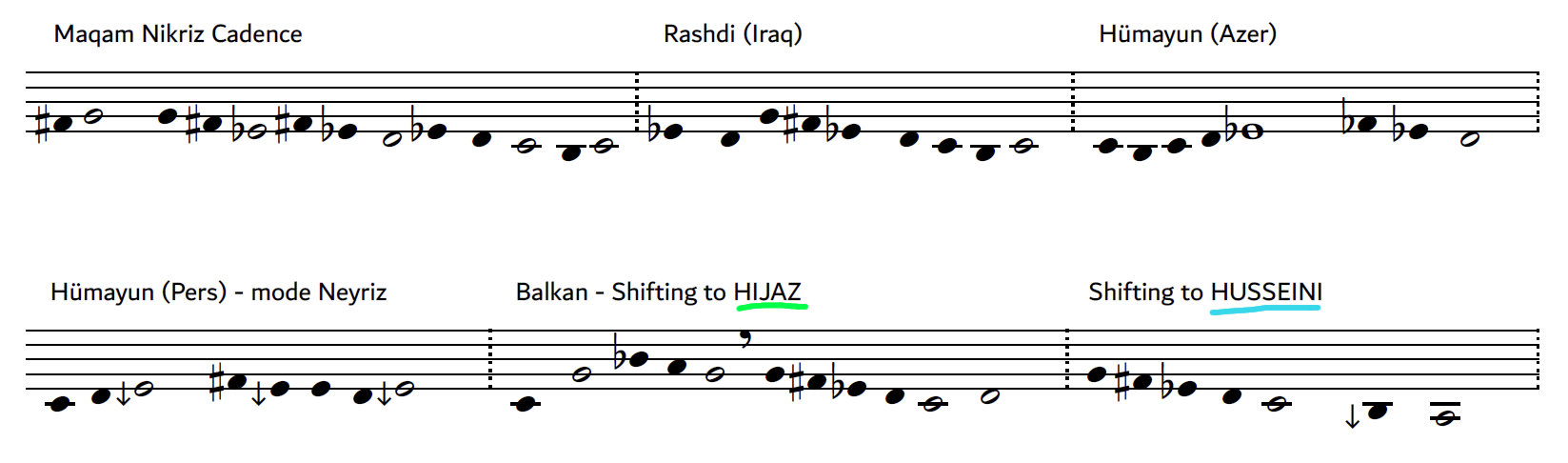
History and Symbolism:
Unclear historical lineage. Neyriz was documented in Durrat al-Tāj as a secondary mode. For the same reason we don’t have access to much hermeneutical data. The modal ethos of Nikriz is described as dramatic, exhilarating, and bitter-sweet. Mugham Hümayun is tied to the feelings of sadness and grief according to U. Hajibeyov
Links to Audio Examples:
MAQAMWORLD.COM entry for Arabic ajnas NIKRIZ and ATHAR KURD with sound examples
ISTIKHBAR RAML-AL-MAYA (Anis and Rifat Khalfat)
MORI, ANO ZAFIROVA (Bojana Nikolić)
HOMAYUN (Malik Mansurov)
HOMAYUN (Alim Qasimov)
DEJ MORI VASE (Raspejani Velešani)

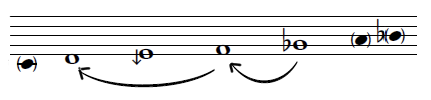
Tone group:
(#2-HUSSEINI), (#6-NAWA) or (#7-KURD) trichord with an added diminished IV. The IV has a distinctly gestural and plaintive character and doesn’t extend into other flavors, instead the III will extend, typically to (4#-HIJAZ).
Other variants:
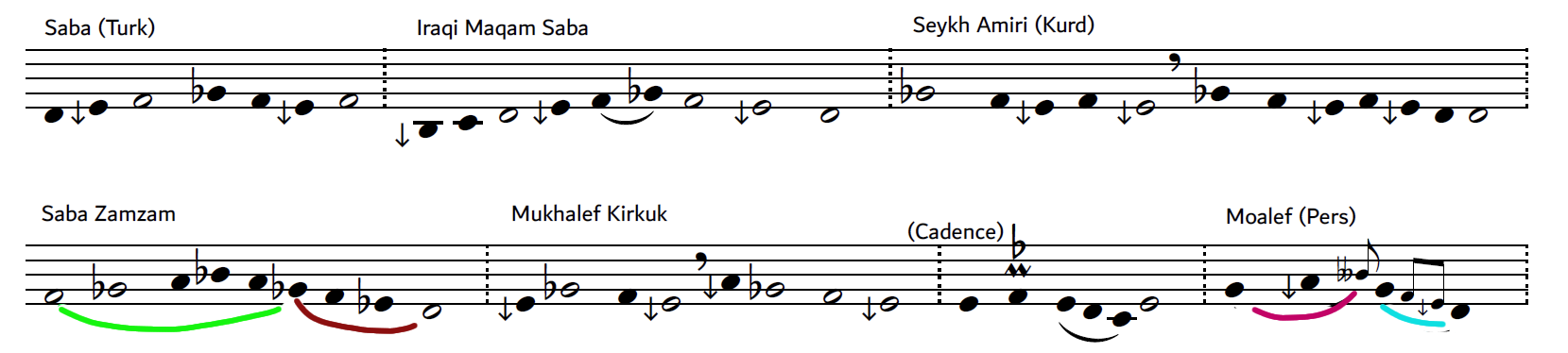
-Mukhalef Kirkuk/Sharqi- (#3-SEGAH) trichord with the diminished III (above example, but without D)
-Mo’alef (Persian) - (#2-HUSSEINI) trichord with a diminished III (above example, but with Fb in place of F).
Both marked in amaranth color, as a cross between Segah (pink) and Saba (maroon)
Prevalence:
Most heavily featured in the Iraqi Maqam, with maqams SABA, HADIDI, TESLIM, MANSURI, MTALATHA classified by Rob Simms as belonging to the “Saba family” and “Mukhalef” and “Mukhalef Kirkuk” to “Segah family”
Also present as a cadential flavor in turkish makams SABA, SABA ZEMZEME, and ZIREFKEND, Arabic Maqams SABA (on Husseini trichord), SABA ZAMZAM (on Kurd trichord) and SABA BUSALIK (on Nawa trichord), Yarsan-Kurdish dastgahs ŠEYKH AMIRI, ABEDINI, YADEGARI, SAHARI and CHAPI, as well as in Ashugh folk music.
Some melodic archetypes:
History and Symbolism:
Medieval maqam ZIRAFKAND (aka KUČAK) was considered one of the 12 primary maqams in the Systematist theory and was based on a variant of the SABA tetrachord with an even lower IV (36:35 ratio, around one quarter-tone). This is the only true micro-tonal interval in maqam; in that form it survives solely in the Persian guše Mo’alef. It is connected to the concepts of pain, deep sorrow and anguish, and tied to the zodiac sign of Cancer.
Links to Audio Examples:
MAQAMWORLD.COM entry for Arabic ajnas SABA, SABA ZAMZAM, and MUKHALIF SHARQI with sound examples
MAQAM HADIDI (Shihab Ahmed al-Adhami)
SEYKH AMIRI (Ostad Elahi)
LJUBAVI SMO VREME DUGO (archive D. Dević)
BEXTÎYARÎ TANBUR SOLO (uncredited performer)


Tone group:
A harmonic tetrachord with a lowered II. I as the primary total center and IV as the secondary (or vice-versa, in the “Čahargah-Esfahan”). II gravitates towards I, and III towards IV
Rarely a pentachord. Instead, IV often extends upwards into (#8-ESFAHAN), downwards, either into another ČAHARGAH, or, as into (#2-HUSSEINI) with a emphasis on VII (HOMAYUN)creating a temporary feeling of old neyriz
Prevalence:
This form survives only in the Persian Dastgah. It is the main flavor in Dastgah ČAHARGAH, (with the downward extension into another ČAHARGAH tetrachord with an emphasis on VI), and heavily featured in Dastgah HOMAYUN (with a downward extension into a HUSSEINI tetrachord with the emphasis on VII). In the upward extension into a minor tetrachord, it forms (#8-ESFAHAN), the main flavor of Avaz BAYAT-E ESFAHAN.
Some melodic archetypes:
see (#4-HIJAZ)
History and Symbolism:
Introduced by Urmawi, although the first inversion with these ratios was documented in Ptolemy’s Harmonies as the “intense diatonic tetrachord”. Given as one of the 12 primary maqams in the medieval theories (unter the name Hijaz). Named after the note Čahargah (a 4th degree of the diatonic scale). It is connected to the concepts of power, heroism, and festivity, and was tied to the zodiac sign of Sagitarius.
Links to Audio Examples:
DASTGAH-E ČAHARGAH (J. Shahnaz-A. Bahari)
YAR KHODA KHODA (M. Zarabi)
DASTGAH-E ČAHARGAH (D. Talai)
Tonal functions, intrinsic- and referential meanings
Within a tone-group of the Flavor, we may identify four main function-types of notes:
NODE - a stable note, usually either a primary or secondary tonal center. In the mode-building (tarkib), this note can serve as a transfer point into the next building block/flavor.
GRAVITATING NOTE - an unstable note with a clear tendency towards the tonal center.
PASSING NOTE - “neither of the above” - a relatively stable note that isn’t heavily featured in the current mode/melody type, and appears mostly in passing. This is not a fixed category, a passing note in one gūše can become a tonal center in another gūše of the same flavor.
GESTURAL NOTE - a type of the unstable note that serves a specific expressive function, and appears in the predetermined spot within the tone group. There are two most obvious examples for this: (1) a glissando-ing lamentative ornament with a pitch scope of up to a semi-tone (“nola” in Uzbek Makom and “drifting tone” in Uyghur Muqam) - found on the III in both Eastern Čahargah and Eastern Rast; (2) a wailing gesture found in Saba IV (III in Mo’alef), accompanied with a volume surge and glissando back to the lower note (Saba III or Mo’alef II), mimicking the anguish and weakness (inability to continue upwards)
SEGAH I has a special semiotic function which doesn’t quite fit into any of the above categories, as it is simultaneously gravitating towards its VI (Rast I) and being a primary tonal center of the Segah cadence. Therefore it may signify a state of “incompleteness” Also, Segah I is never a “node”, all transfers to another building block will always go through Segah III
A Western concept of the SUBDOMINANT function (as introduced by J. Ph. Rameau) has not been refered to in any Middle-Eastern musical theory, as far as I am aware. However, it may be a useful approach to conceptualizing the I-IV-V relationship in some specific situations, such as the Husseini pentachord.
The connection between a tonal structure and referential meaning of Segah is not an isolated case. As we have seen, gravitating notes exhibit varying strength of gravitational pull toward adjacent stable notes, and the direction of this pull may be either upward or downward depending on the flavor. The distribution and strength of these gravitational tendencies appear to correspond to the referential meanings associated with the respective modes: generally, downward gravitational tendencies tend to be connected to negative emotions, while upward tendencies are more often associated with positive ones. The following overview summarizes the most commonly documented modal ethos and extra-musical associations of the 12 flavors, and relates these characteristics to the specific tonal structures and gravitational tendencies in each mode.
RAST: ORDER
In its original Zalzalian tuning, Rast exhibits a high degree of tonal symmetry and balance. Its third degree lies exactly between II and IV, while its pentachord forms a perfect palindrome, 1–¾–¾–1. The gravitational pull of VII toward I is likewise relatively weak, since the interval is either a major or Zalzalian second. This relative equilibrium corresponds closely to the traditional conception of Rast as a mode of stability and order, consistent with the original meaning of the name, “just” or “straight.”
MAHUR: HAPPINESS
In Mahur, a gradual increase in upward gravitational tendency can be observed. Its third degree is slightly raised and begins to exhibit an attraction toward IV, while the relationship between VII and I becomes more directional in variants where the interval is narrowed to a semitone. The mode is correspondingly associated with more uplifting qualities, including optimism and happiness.
MUWWAL: ECSTASY
This tendency is amplified further in Muwwal, where the upward gravitational component is even stronger. The added augmented fourth exerts a particularly forceful upward attraction, corresponding to the mode's associations with ecstatic exhilaration and exposure to divine light.
SABA: DESPAIR
At the opposite end of the spectrum is Saba. Here, II already exerts a moderately strong downward pull toward I, while the movement from IV toward III is exceptionally forceful and highly gestural. These pronounced downward tendencies are consistent with the traditional associations of Saba with hopelessness, pain, anguish, and despair.
SEGAH: LONGING
The specific feeling of incompleteness of the Segah I is mirrored in the poetic themes of nostalghia, longing or yearning for something unreachable - the lost love, childhood, forsaken homeland, etc.
HUSSEINI: PASSION
Husseini and Nawa are relatively similar in their overall character, but differ considerably in the behavior of the second degree. In Husseini, its downward attraction toward I is particularly variable, even volatile, ranging from relatively weak to strong. The mode is associated with passion and intense emotional experiences, particularly those connected with love. Its unstable second degree may therefore contribute to a sense of heightened emotional tension.
NAWA: PEACEFULNESS
Nawa, by contrast, exhibits a relatively weak gravitational profile. The fixed whole-tone interval between I and II limits the downward attraction of the latter, while the absence of a leading tone at VII further reduces directional tension toward I. This corresponds to associations of this mode with serenity, peacefulness, meditation, and solitude.
HIJAZ: TUG-OF-WAR
Hijaz contains two strong gravitational tendencies acting in opposing directions: II pulls toward I, while III pulls toward IV. The simultaneous presence of these competing attractions gives the mode a particular sense of tension and struggle. This corresponds to the frequent association of Hijaz with themes of battle and fighting.
ČAHARGAH: VICTORY
In Čahargah, the downward attraction of II is considerably weaker than the upward attraction of III. From this asymmetry we could therefore speculate a greater tendency toward upward resolution and, by extension, help account for associations with heroism and victory. However, since Hijaz and Čahargah do not occur together within the same tradition, and stem from the same medieval mode Hijazi, there is no well-documented basis for distinguishing their respective associative meanings in this respect. Both are consequently associated with several of the same themes discussed above. One Persian source, however, associates Čahargah specifically with festivity (in addition to heroism); this celebratory aspect is not encountered in the corresponding descriptions of Hijaz in other traditions.
NIKRIZ: BITTERSWEETNESS
Nikriz, which incorporates the characteristic Hijaz intervals within its structure, retains something of the ambivalence associated with Hijaz, while combining it with the more subdued affective character of general sadness associated with its minor-trichord basis. Its traditional descriptions consequently tend toward a notion of bittersweetness: sadness intertwined with the recollection of happiness.
KURD: HEARTBREAK
This is another case where the available information is somewhat scarce. The associations that recur most frequently in the connection to this mode seem to circle around the themes of heartbreak, melancholy, and longing. Since some forms of Kurd can be interpreted as tempered versions of nawruz (a tuning of Husseini with a particularly low II), one might speculate to Kurd signifying a darker counterpart to the Husseini theme of love. If Nawa is connected to the absence of love and passion (itself represented in the volatile II of Husseini) in relatively positive and neutral terms, Kurd may represent its negative flipside: melancholy and emotional loss. The repeated reference to longing also points toward the often unclear boundary between Segah and Kurd, exemplified by North African versions of Sika, which occurs as a tetrachord and would, according to the classification proposed above, correspond to the Kurd flavor.
ESFAHAN: MYSTICAL SOPHISTICATION
The evidence for Esfahan is likewise more limited, with particularly relevant examples including Persian Bayāt-e Esfahan (with a Čahargah tetrachord below I) and Azerbaijani Bayati Shiraz (with a Hijaz tetrachord below I). Again as another type of Hijaz/Minor combination, some of the connotations encountered in Nikriz also appear here, particularly sadness tempered by quiet dignity and interspersed with recollections of happiness. Several Persian sources, however, additionally connect Esfahan with mystical and metaphysical experience. These associations are distinctive in the present comparison, as such explicitly mystical connotations do not appear with the same consistency in descriptions of the other modal flavors.
APPENDIX:
Reasoning behind certain choices and inconsistencies
The RAST-MAHUR issue:
Turkish Rast with a 5:4 natural third sounds closer to Mahur than to Arabic Rast with a zalzalian third. Aditionally: Azeri Rast shares many features with Turkish and Arabic Rast but is grouped with Mahur because of the long tradition of performance in the 12-tone equal temperament.
Urmawi made a clear distiction between jins RAST (204-182-112) and jins USSAK (204-204-90) which were both bases of primary Maqams. This is retained in Turkish theory that keeps these two distinct tone groups as one of the 6 basic tetrachords (medieval Uşşak being renamed to Çargah, while contemporary Turkish Uşşak refers to Urmawi’s Husayni, in a slight “lost in translation” moment).
Also, Rast has a symbolic meaning as the first Primary mode in both Arabic and Turkish theories so the decision was made to keep them together, and leave the exact pitch of the III up to interpretation (it is lower than the III in 12-TET, but how much lower exactly makes no difference in this classification). Azeri Mughams RAST and MAHUR are notated in the 12 TET and in theory differ only in the melodic content and the key. I am not familiar enough in how the new natural-tuning revivalist movement treats the III in Mugham Rast, and does it attempt to make a stronger differentiation, but as it is written in the oficial theory books, it belongs in the flavor of MAHUR. On the other hand, Persian theory recognizes the neutral intervals and uses them in the flavors of ŠUR and ČAHARGAH, yet it still makes no difference between the tuning of the III in MAHUR and RAST. Therefore Persian RAST definitely belongs to (#5-MAHUR)
The HUSSEINI naming issue:
The two tuning variants found on the extreme ends of the spectrum (112-182-204 and 182-112-204) sound different enough that they could warrant being separated into two flavors. These two versions of Nawruz tetrachord and Husayni pentachord using the “small whole tone” both appear in the interpretations of Urmawi’s writings, which have themselves been disputed as not following the neutral tuning actually used the practice. This confusion, together with the demonstrable fact that the II is flexible even in the same melody, have lead to the decision to group all tunings of the II in the same flavor. This is also supported by the fact that there aren’t two separate sets of motives and poetic connotations to be found in connection to this flavor.
A separation of motives does exist along the line of tetrachord vs pentachord, this is most strongly pronounced in the Iraqi Maqam, which considers Husseini Family to be separate from Bayat Family. This particular meaning was also lost in transmission to other regions with North African Hsini (as found in the Constantine Maluf) clearly built around the tetrachord. Therefore, this was also deemed not big enough of a difference to warrant separate flavors.
Choosing the name has been tricky: Bayat would be the official name in Arabic, but this word that means many different things accros maqam regions, Bayat is one of the Four Maqoms of Fergana Tashkent, and would tonally belong to (5#-MAHUR), while Uyghur Muqam Bayat switches between “Mahur” and “Eastern Čahargah”, in Persia, Bayat-e is a prefix, meaning “melody of the” (for exemple, Bayat-e Esfahan, Bayat-e Tork, Bayat-e Kord…), and finally Bayat also means “old”, or “stale” (mainly used in the connection with stale bread) in Serbian, and funnily enough, this is the only homonym of the word bayat that seems to be shared accross the entire maqam world. (all across the Greek, Turkish, Arabic, Armenian, Farsi… “bayat” means stale bread).
Uşşak, or Oshaq, meaning “lovers” is found almost everywhere as a mode or a guše name, but refers to the wide variety of different flavors. In the medieval theories, Oshaq tetrachord was in listed as (204-204-90), and the resulting maqam Oshaq given by Urmawi was equivalent to the Mixolidian mode (Oshaq + Nawa). It is still preserved in that form in the Andallusian style Nuba of Morocco. The use of Šur and Nawruz is localized around Persia and Azerbaijan and aren’t particularly known elsewhere, except in the Arabic Maqam “Bayati Shuri” where the IV transfers into (#4-HIJAZ) instead of the usual (#6-NAWA) of Maqam Bayati.
Dugah would be an appropriate name as the note/function DUGAH is the home note of the flavor, but for some reason that name has never referred to the flavor, even in the medieval books. There generally aren’t many modes using that name today, and of those that exist not a single one is set in this flavor. Dogah is a minor Mugham in Azerbaijan (“minor” in importance, but definitely “major” in its tonality), Dugoh is also one of the 6 primary Bukharan Makoms (Šašmakom), where it is set in the flavors of (#3-SEGAH) and (#4-HIJAZ), while Turkish Makam Dugah combines (#11-SABA) and (#10-NIKRIZ)
For this reason “Husseini” was chosen as it is present in most national classifications and it always refers to this flavor; in spite of the pentachord/tetrachord issue and taking into accunt the irony of having a “Husseini tetrachord” which doesn’t have a Husseini note within itself.
Separation of NAWA and ESFAHAN:
The broader definition of jins, as not referring only to the main tone group (in this case, the minor tetrachord) but also to the leading and ornamentary notes in the immediate surrounding has opened up the possibility to separate the two versions of minors, with and without leading tone. This is a novel concept and isn’t found in any previous theories. Perception is not much of an issue here, as the “harmonic” and “natural” minor sound completely different, it is more about bending the rules of what constitutes a building block, and according to the Turkish/Arabic strict definition of jins, it shouldn’t be possible. Persian theory is much more helpful here as it leaves more leeway for exactly this type of situation. In Persian modes of Nawa and Esfahan, the tone group is extended and has the finalis/tonic in the midle of the group. It looks something like (V)-VI-VII-I-II-III-(IV)
In both cases, VI is a neutral tone (a zalzalian third down from I), but VII in Esfahan is higher than in Nawa. So we have the equivalent of melodic and harmonic minor, only with the neutral VI.
This is only defined that way in Persian theory, but these two archetypes are observable in many other regions, and often belong to the most important/popular modes. In jins-based theories we can observe maqams where the minor tetrachord (arab: Nahawand, turk: Buselik) extends downwards into Husseini tetrachord (arab: Bayati, turk: Uşşak). Turkish makams Uşşak, Beyati, or Arabic Bayati, Nawa, and Ushaq Masri, Tunisian Hsin, etc. Likewise, Arabic Maqams Hijaz, Nikriz, Nahawand, as well as Turkish Buselik, Humayun, all repeat the situation where the minor extends downwards into Hijaz.
From there came the idea that the minor flavor is defined by its (lack of) leading tone, as well as by the flavor attached below.
This also means that these two pairs of flavors (HUSSEINI-NAWA) and (HIJAZ/ČAHARGAH-ESFAHAN) will be interlinked and it will often be difficult to tell them apart until the cadence.
Here the tuning of the VII is much more crucial than the VI, so the tuning of the VI doesn’t change the meaning of the flavor. In case of the HUSSEINI-NAWA pairing, the Persian neutral VI is maintained in aforementioned Turkish, Arabic and Tunisian maqams, but is lost in some other modes such as Tlemceni Raml-al-Maya, which has two consecutive minor tetrachords. In the ČAHARGAH-ESFAHAN pairing, Čahargah (Persian version with the neutral VI) is turned to Hijaz (minor VI) virtually everywhere outside Iran. This pairing is probably the most prevalent mode of Balkan folk ballads such as the Sevdah genre.
This separation creates another problem: the forms which center on the notes above I, and extend upwards. These typically come in form of a pentachord (Buselik and Nahawand are good examples), and would look like (VII)-I-II-III-IV-V. This could have been a separate flavor but since they share the exact same tonality, it was decided to keep it as a form of ESFAHAN wherever the major VII is clearly heard (as in the cases of Buselik, Nahawand and Iraqi Nawa), and as a form of NAWA wherever it isn’t (Ramal al Maya, Uzbek Segah, etc). with the acknowledgement that this may sound counterintuitive to someone familiar with Persian theory where Esfahan is defined by the presence of it’s lower, Čahargah, part.
ČAHARGAH vs. NEYRIZ/NIKRIZ:
As stated above (#12-ČAHARGAH) is basically a more traditional tuning of (#4-HIJAZ) that is only kept in and around Persia. They were separated in spite of the shared history and poetic connotations, because they give a very different tonal impression, with Čahargah being much brighter (reflected in the choice of “tennis-ball yellow” color, half way between Hijaz and Mahur). However same difference is heard in the related flavor: Nikriz with a minor III sounds quite different from Neyriz with the neutral III. By the same logic, Neyriz should have been a separate flavor as well. Things are further complicated by Tunisian RASD-Al-DHIL that is still considered a form of MUWWAL even though its III lies almost on the quarter-tone (even slightly underneath) in some tuning practices, in which case it becomes practically indistinguishable from NEYRIZ.
So, why is ČAHARGAH a separate flavor and NEYRIZ isn’t? While Neyriz is indeed the main flavor in the Daramad of Dastgah Homayun, in most other gušeha, the tonal center shifts one tone above, into (#12-ČAHARGAH), on the other hand, most of Dastgah Čahargah stays in (#12-ČAHARGAH). Therefore it was decided that Čahargah has a bigger claim to an own flavor than Neyriz, as it dominates 2 of the main 7 Persian Dastgahs and is sometimes heard in the revivalist performances of Makom Dugoh of the Uzbek Šašmakom.
Also, this seemed to be the only possible name for the flavor, as it is only really classified in the Persian music and only by that name. This is somewhat unfortunate because its direct equivalent Azeri Čahargah has been modernized into the flavor of (#4-HIJAZ), its close cognates Arabic Jiharkah and Turkish Cargah/Algerian Jarka are found in the flavors of (#1-RAST) and (#5-MAHUR) respectively, while Uyghur Čahargah has its own distinct flavor with the nola on III (which we have classified as a form of Hijaz because of the characteristic semitone between I-II).
ON COMPOUND FLAVORS:
HUSSEINI-NAVA and HIJAZ-ESFAHAN (as well as its Persian eqivalent ČAHARGAH-ESFAHAN) center around the I, but by definition include the notes under it. From the Western theoretical point of view, these two compounds would be called “plagal natural-” and “plagal harmonic minor” with a neutral VI.
SEGAH’s “true” (implied) tonal center is it’s low VI, and in most forms it is compounded with the (III-IV-V-VI) tetrachord, which can come in many flavors. Sometimes only the diminished IV is heard alongside the Segah trichord for a while, before the ascent occurs (as is the case in ZABOL SEGAH) - which then could also be seen as a form of SABA tetrachord.
NIKRIZ is often exists in co-dependent relationship with another flavor. In the mode of HUMAYUN, it shares, and ultimately yields space to HIJAZ, in other cases the augmented IV is just a temporary excursion from the regular IV of a minor pentachord (RAMAL AL MAYA). MUWWAL has a similar role in major Maghreb modes (MAYA and DHIL), as well as SABA with HUSSEINI (and sometimes NAWA). The instances in which these three flavors appear independently are much rarer than those when they are compounded with other flavors.
If all these issues were to be addressed there would have to be an extended classification where trichords, tetrachords, pentachords, dual character pentachords (with the temporary augmentations of the IV) and compound tone-groups (with the tonal center in the middle) are all counted separately, which would bring the total to around 30 flavors. For our current purpose, such an expansion seems unnecessary.
Comparisons
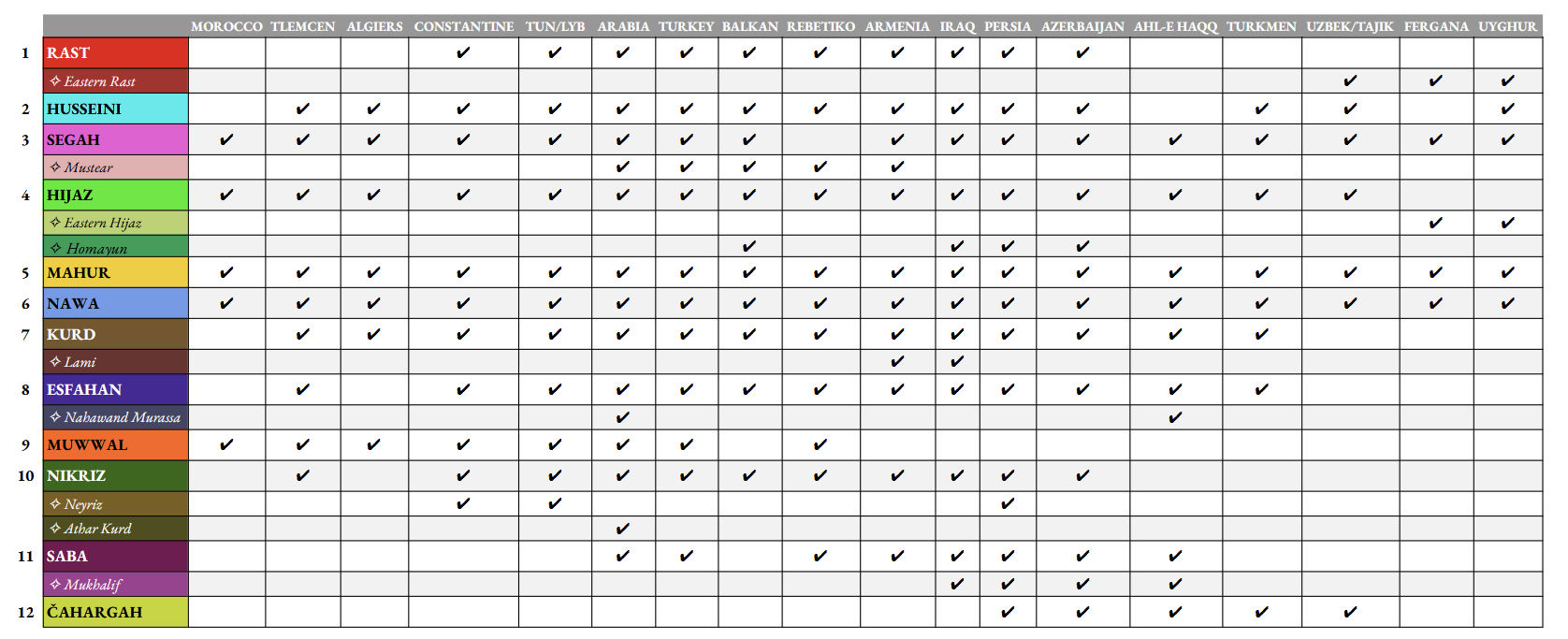
Several theory books give their classifications of ajnas/tetrachords, here is a table to compare all of them with the colors of the 12 flavor system.
Karl Signell gives ÇARGAH (Mahur), KURDI, HICAZ, BUSELIK (Nawa), UŞŞAK (Husseini) and RAST as 6 main tetrachords of Turkish Makam, followed by SABA, SEGAH, NIKRIZ, PENÇGAH (Muwwal), HUZZAM (close to iraq) and FERAHNAK (could be seen as a form of KURD) as 6 auxilliary tetrachords.
Habib Hassan Touma lists the 8 main ajnas of Arabic Maqam as RAST, BAYATI (Husseini), SIKA (Segah), NAHAWAND (Nawa), HIJAZ, NIKRIZ, AJAM (Mahur) and KURD, with SABA mentioned not as independent but a form of BAYATI
Salah el Mahdi gives the 12 uqud of Tunisian Maluf as RAST (tuned closer to Arabic Rast), NAHAWAND (Nawa), RAST AL DIL (Nikriz or Nayriz), DIL (tuned closer to Turkish Rast), MAHUR, BAYATI (Husseini), HIJAZ, IRAQ (tuned closer to Turkish Uşşak), KURDI, SIKA (Segah), AJAM (Mahur on minor VII) and MAZMUM (Mahur on IV)
Dariush Talai classifies the 4 main dang-ha as ŠUR (Husseini), DASHTI (Nawa), ČAHARGAH and MAHUR
Zhou Ji gives the 6 main tetrachords of Uyghur Muqam only in Roman numerals: I (Mahur), II (Nawa), III (Kurd), IV (Mahur with a nola on augmented II), V (Rast) and VI (Eastern Čahargah)
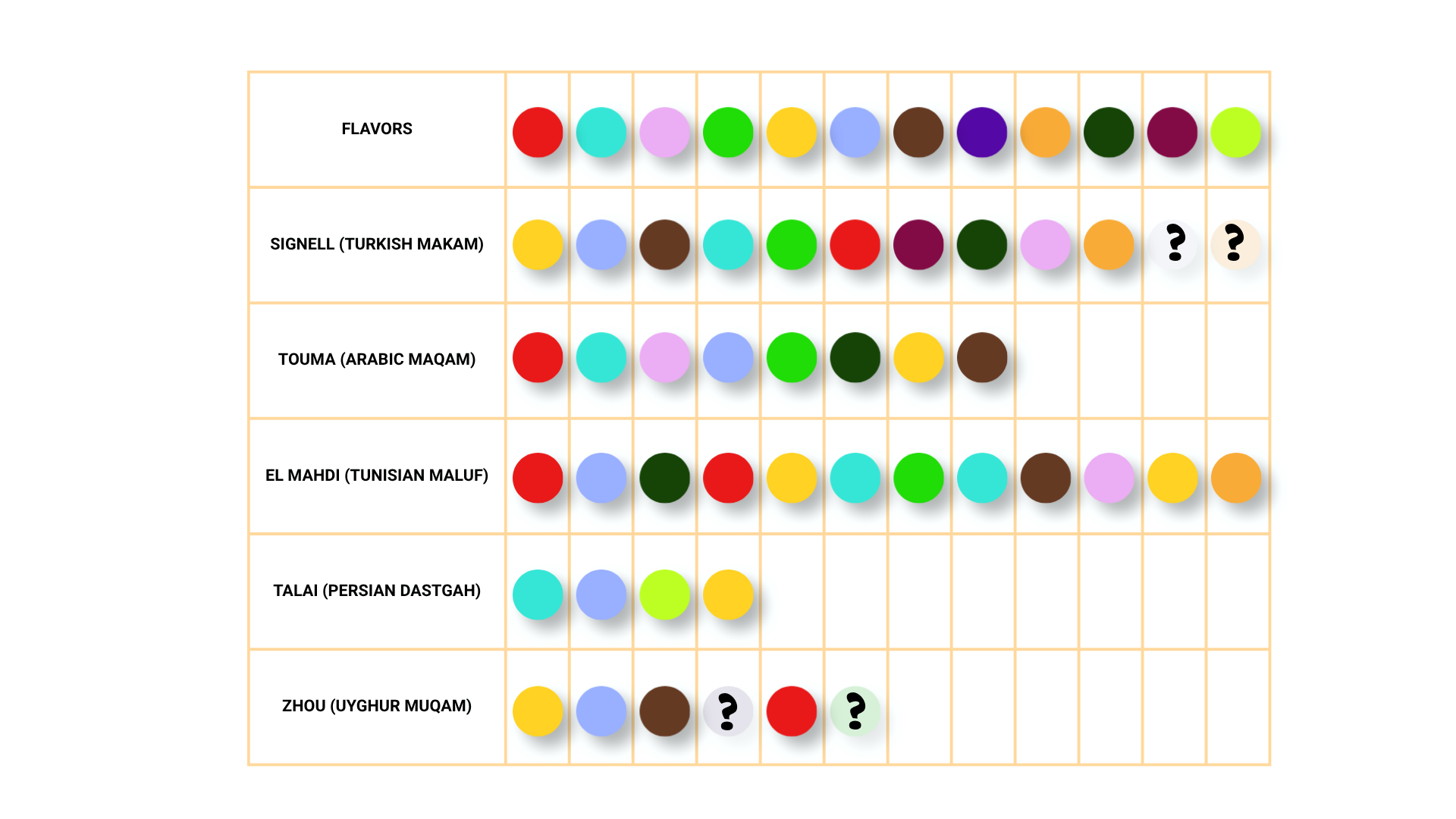
This is a table showing the distribution of 12 flavors and their sub-groups across the regions commonly accepted to belong to the maqam world.