Trumpet tuning and Maqam
In the recent years it has become somewhat fashionable to use a specially built quarter-tone valve in order to get those “weird, oriental intervals” on the trumpet. Here we will attempt to show how that may not be entirely necessary, and is even a little bit missing the point. As the maqām history has always gone hand-in-hand with the ancient Greek musical tradition that was based on natural harmonics (the same ones that we already have on our instrument), with the right choice of key, one can perfectly replicate all Middle Eastern modes on a regular trumpet without any modifications.
In the historical survey we were able to trace the origins of maqām back to the developments in 8th-10th century Baghdad, during the so-called Islamic Golden Age. What quickly becomes clear is how much influence the shape of the human hand and its positioning on the musical instrument Oud have had on what we now know as “maqām scales” and the ”maqām principle” of the tone-group building blocks.
The note/function “RAST”, the root of the scale (equivalent to the “DO” function in the Western movable-Do system), was found on the mutlaq or open-string position. Sabbaba (index finger) is placed one whole tone above the open string, producing the note/function “DUGAH” (“RE” in the movable-Do system).
Now, on the fundamental diatonic scale that all of the earliest modes were extracted from, the wusta or middle finger would have a variable position, somewhere between the minor and the major 3rd in relation to the open string and RAST.
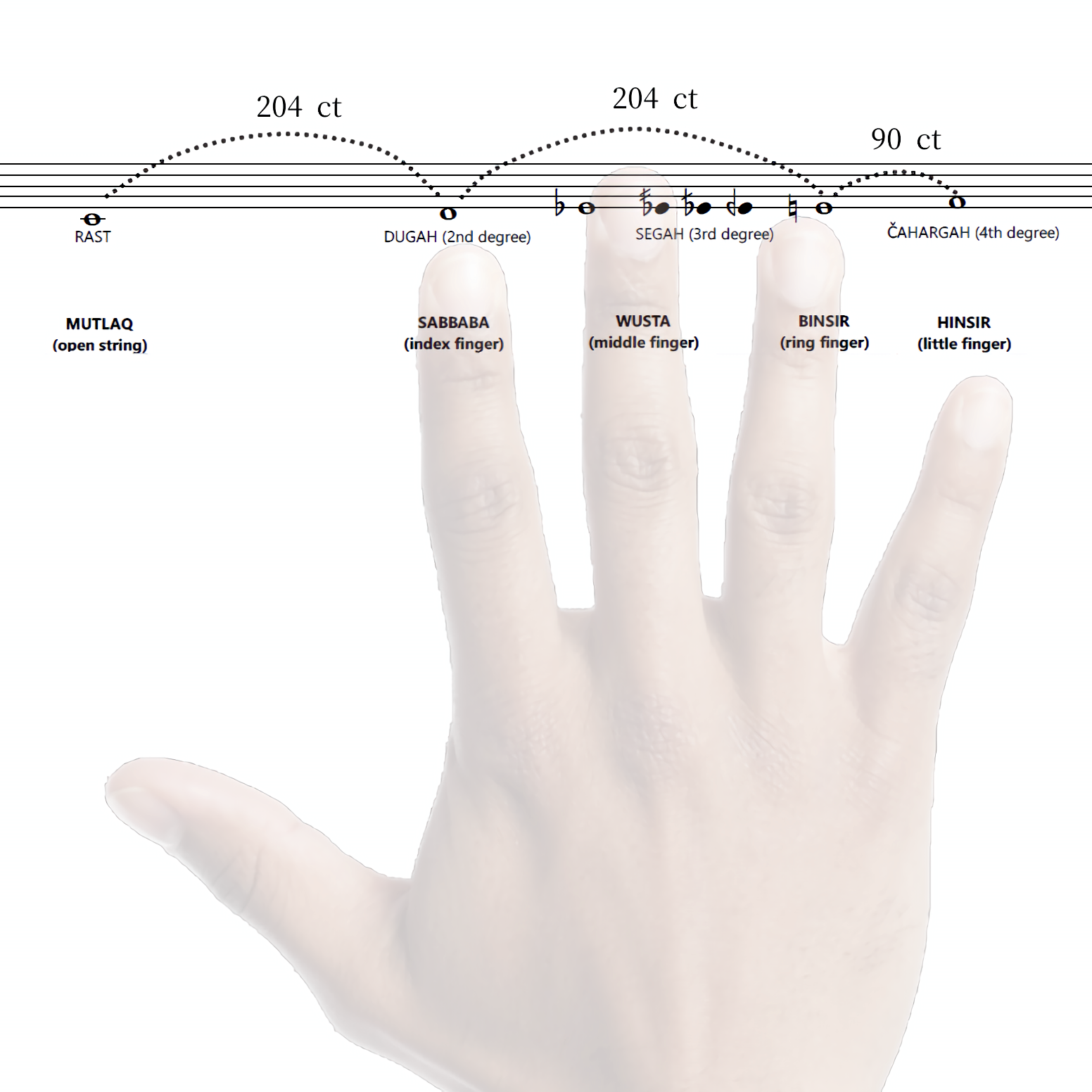
So we had wusta al-Furs (the Persian-style wusta) very slightly above the minor third (Farabi puts it at 302 cents, with the minor third being at 294 cents - the combination of a 204 cent Pythagorean whole tone and the 90 cent limma). Then there is the famous wusta al-Zalzal right in the middle (354 cents according to Farabi), and later we have Urmawi who placed it on the just-intonation major third (384 cents above the open string). Each of these tunings was favored by different regional traditions (Persian, Arabic, Turkish), however the exact pitch of the wusta is often variable even within the same composition, and would typically be lower in a downward cadential function.
The true major third (the binsir position) isn’t found on the fundamental diatonic scale, but belonged to the so called arabat/ansaf, or “complementary tones”, which were used in some derived modes. Finally, the perfect fourth is placed at the little finger position, just a limma (a small semitone) away from the ring finger, which makes sense anatomically. At the same time, this note is found on the open string position of the next, higher string, so the whole cycle can continue. Therefore there will typically be two wusta positions within one octave.
A case could be made that the finger positions and the resulting scale degrees are found in the place where each finger rests most naturally. As this music has often had meditative elements and was performed for a very long stretches of time in search of the ecstatic, out-of-body experience, the maximum bodily comfort was surely a factor.
This is a criteria that we could also be guided by when choosing the right key on the trumpet. As we already know, with a good ear, all microtones are possible on the regular trumpet with the help of extendable valve slides, and (if nothing else) lip bending. However, there is a varying degree of comfort involved. Most comfortable microtonal fingerings are those that can be found on a natural harmonic scale itself (5th and 7th overtones), followed by the positions in which the 3rd valve slide is extended by up to a half-way out. So, we should stick to those two, and try to avoid 1st-valve slide extensions, 3rd-valve slide extensions all the way out, and lip bendings. Therefore, an ideal equivalent for the wusta on trumpet would be the 3rd valve, which can be comfortably extended almost up to a semitone lower without straining the extending hand.
Here we should take a step back to clarify a specific technical trait of the trumpet that will prove to be incredibly useful: on brass instruments, the pitch of each harmonic partial is lowered by the extension of the tube length (by means of either valves or slide positions). The valves add fixed increments of tubing (in theory: 1st valve by a whole tone, 2nd valve by a semitone, and the 3rd valve by 1.5 tones) that are calculated for the open instrument and therefore become insufficient in combinations, as the base pitch is already lower and more tubing is needed to produce each subsequent semitone. A slide instrument such as the trombone has the freedom to pitch-correct by extending the slide to the necessary length, but the trumpet must adjust using the 3rd valve slide, which can be pulled out to correct the pitch, typically only in the 6th [1+3] and 7th [1+2+3] positions. However, due to the manufacturing (possibly to facilitate the tuning of the fifth [2+3] position), it is practically evident that the [3] as the alternative fingering of the 4th position [1+2] itself already produces a tone that is about one comma lower than the common [1+2] fingering, and as such perfectly reproduces the comma difference between binsir position (408 ct above mutlaq) and Urmawi’s wusta (384 ct above mutlaq). This is especially important in Turkish Makam theory, which adheres to Urmawi’s tuning paradigm.

This is how the fingerings of the first tetrachord would look like if RAST was placed on C:binsir on [1+2] position, and wusta on [3], with following variables: Urmawi’s wusta with the slide all the way in, wusta al-Zalzal with the slide about 1cm out, and wusta al-Furs about 2 cm out. There is a plenty of room for deviations, for example: if we are in the “Šur” or “Husseini” mode, where DUGAH is the finalis and SEGAH has the strong gravitation towards it in the cadence, SEGAH would be played lower in descent than in ascent. These small differences can be easily replicated with the valve slide (if we played SEGAH on E half-flat with 1 cm out in the rest of the mode, it would be 1,5 cm out in the final cadence). This is where a fixed quarter-tone valve wouldn’t be of much help.
Now, in order to have access to all modes of the system, we need to identify the so-called “master-scale”, which includes all possible tones we may be using during the performance. This includes the fundamental diatonic scale (7 notes per octave, with two wustas - neutral tones on the 3rd and 7th degrees), arabat/ansaf (major/minor degree around the wusta as well as some other notes of the chromatic scale - these are complementary tones and will appear in some modes of the system). Not pictured below are nimat/tikat (other neutral tones/quartertones, which typically only exist in theory). So, in order to play maqam on trumpet, we don’t need a full 24-tone scale with all the quarter-tones, as the only neutral degrees in use are those two wustas per octave. The task is therefore to find the key in which as many of them as possible are playable on the [3] position
The pitch range of a maqam performance typically only spans about an octave and a half, with rare cases where it extends to full two octaves. The note/function names only exist for that maximum span of two octaves. Here is how a typical “master-scale” would look like with the RAST on C, with trumpet fingerings:
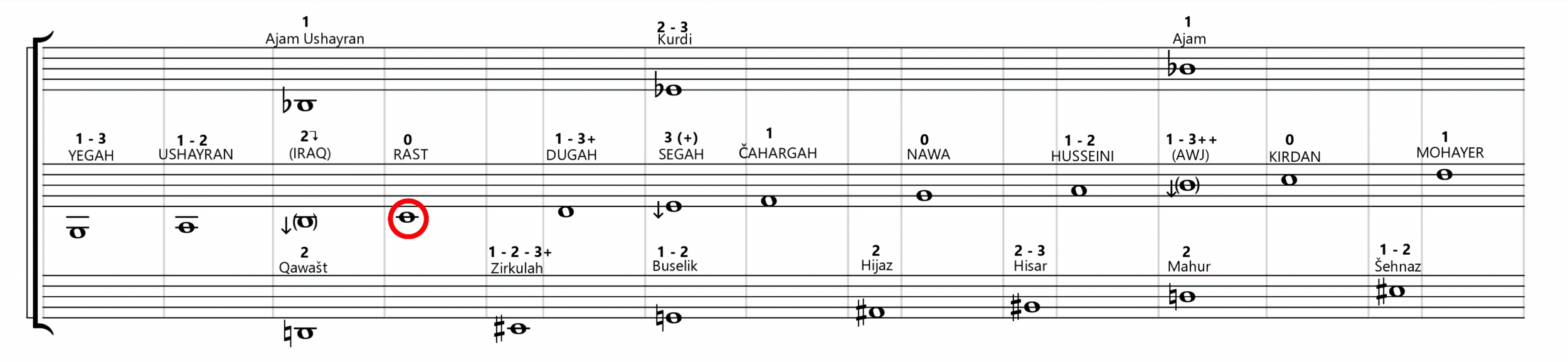
C-RAST FUNDAMENTAL DIATONIC SCALE (MIDDLE ROW) WITH ARABAT/ANSAF (TOP AND BOTTOM ROWS)
Here we see that the fingerings are comfortable for the E half-flat, but less so for the B half-flat which would need to be bent in the low register, and the slide extended almost all way out in the middle register. Still, there is a vast range of maqams that can be played in this tuning that wouldn’t have a B half-flat. Another advantage of the RAST on C is that this is a fairly standard tuning in Arabic music, and it is how it is always notated (Turkish theory notates the RAST on G, while Persian doesn’t seem to have a fixed preference as far as I’ve noticed). Staying close to the standard tuning matters when playing together with fixed-tuning instruments such as qanun, santur etc.
However, if we wanted a perfect tuning for the trumpet, that would have to be RAST on F:
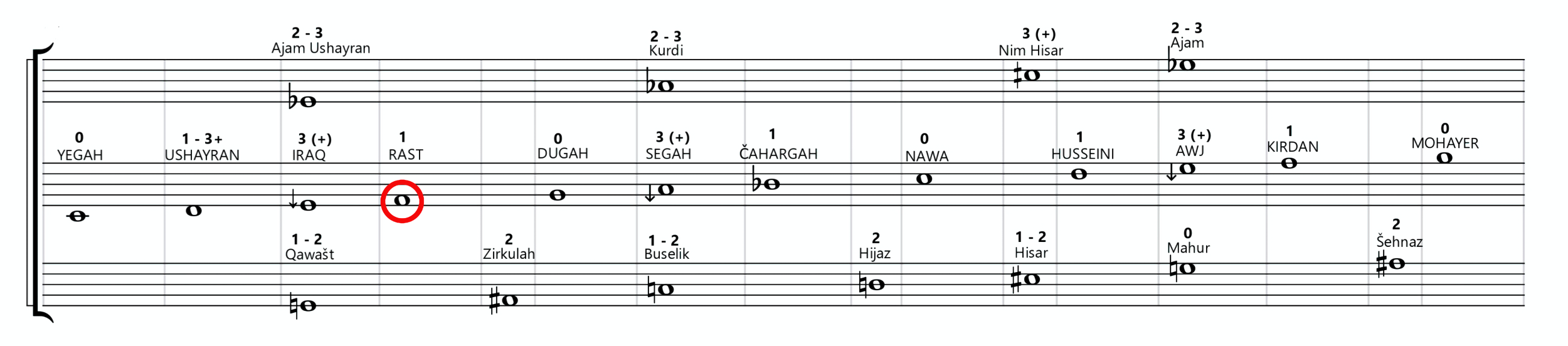
F-RAST FUNDAMENTAL DIATONIC SCALE (MIDDLE ROW) WITH ARABAT/ANSAF (TOP AND BOTTOM ROWS) AND AN ADDITIONAL WUSTA ON C HALF SHARP
Now we have all wustas of the diatonic scale available on the 3rd valve, even if we were to extend the tessitura to the very top register (not pictured here), we would have the A half-flat available on the [3+] as well as [2] (courtesy of the 7th harmonic). Additionally, we have the possibility to add an extra wusta on the 5th harmonic (C half-sharp - the note/function NIM HISAR (lowered HISAR), which, as mentioned, until now only existed in theory as one of the nimat notes). A maqam performance typically doesn’t modulate that far up the circle of fourths, but this constraint is also partly imposed by the availability of pitches on a fixed-tuned instrument. A trumpeter with a good grasp on maqam functions could plan a large scale performance with a seyr that will modulate far enough, or simply have a shorter performance with RAST on A as the base tuning, which is another convenient variant.
To understand all the implications, one would naturally need to be familiar with the principles of tarqib and modal improvisation. A RAST-F masterscale contains the rast-mode on F and C, bayati/husseini/šur mode on G and D, hijaz/čahargah mode on G and D, segah mode on E half-flat and A half-flat, nawa/busalik mode on G, D and C, and so much more.
Here is how the derived modes would lie on a RAST-F masterscale:

As for the other possibilities, I mentioned the A-RAST (wusta on G♯4 on 2-3, C♯5 on 3 in the main register, low wusta C♯4 on 1-2-3+ and high wusta G♯5 on 2-3 or 1) being another good alternative, the same would be true with the E-RAST. (wusta on G♯4 on 2-3, D♯5 on 2-3 in the main register, low wusta D♯4 on 2-3 and high wusta G♯5 on 2-3 or 1).
Already more problematic but still interesting would be A♭-RAST (wusta on G4 on 0 or 1-3+ and C5 on 0 or 2-3 in the main register, low wusta C4 on 0 (+bend - not great) and high wusta G5 on 0, 1-2, 3 or 1-3+)
If playing together with other instruments, a trumpeter may plan accordingly and alternate between C and Bb trumpet. If playing with a Turkish traditional group that is tuned on a G rast, one may pick a Bb trumpet and have the much more convenient A-rast.
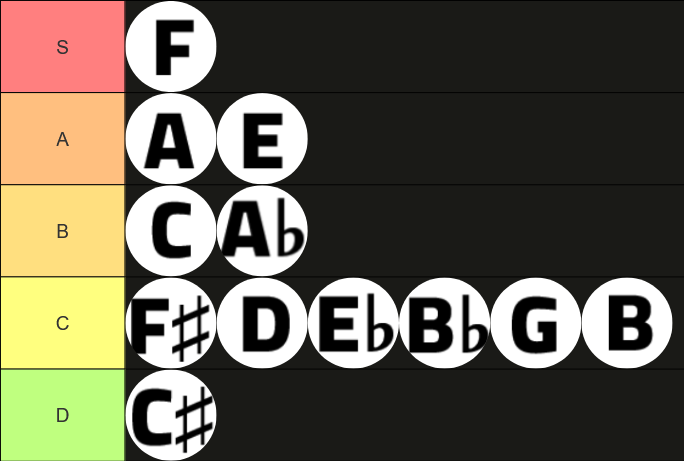
Here is a handy chart of all possible RAST key choices for the trumpet, made with the online tier-list maker: