Maqam as a trans-cultural phenomenon
As stated in the introduction, the research project Specters of Maqām is based on the presupposition of the Maqām as a trans-cultural phenomenon. In this artice we shall review the existing scholarship on the history of Middle Eastern traditional music and its trans-cultural aspects. Here, the focus lies primarily on the elements of melody, modal structures and tuning; as opposed to the other aspects such as the rhythmical structures and formal genres (suites and cycles), or various interdisciplinary ties to poetry, dance, prayer, etc; all of which are equally important factors in Middle Eastern music but lie beyond the scope of this research.
A terminological note is necessary at the outset: the term maqām (مقام - station, place). used in Arabic, and in various cognate forms across the region, carries different meanings in different musical and scholarly contexts. It may refer to a specific mode or a scale in the Arabic and Turkish modal systems, to the system itself, to a particular cyclical form of musical composition, or, in Sufi contexts, to a station, or stage in the path toward spiritual transcendence. In this article, maqām refers to the broader framework of melodic organization shared across North Africa, Western and Central Asia, and the Balkans, following the theoretical principles systematized by the International Council for Traditional Music’s Study Group on maqām (see Section 3, where this set of criteria is elaborated).
The survey is organized in three parts: the first section traces the origins of maqām in the medieval Islamic Empires, while the second one examines the fragmentation of this shared theoretical heritage into competing national(ist) canons during the nineteenth and twentieth centuries. Section 3 turns to the comparative scholarship that has worked to reassemble a transnational picture and whose theoretical concepts and critical perspectives form the basis of the present research project.
l. Medieval Theory and Practice
1.1 Islamic Golden Age and the birth of maqām theory
All historical inquiries into the foundations of maqām scholarship trace back to the developments in 9th century Baghdad, widely considered a global center of scientific, intellectual and cultural activity of that time period, nowadays commonly referred to as the Islamic Golden Age (Saliba 2007). The capital of the Abbasid Empire was home to a vibrant scene of poets, singers and exceptional musicians, stylistically split between the conservative school of the venerable teacher Ibrahim al-Mawsili (d. 804) and his son Ishāq (d. 850), who strived to preserve the traditions of pre-Islamic Arab performance practice; and the progressive school, formed around prince Ibrahim ibn al-Mahdi (d.839), virtuoso singer and master of vocal improvisations. Al-Mahdi’s sister, composer and poet Ulaya (d.825), represented one of the many celebrated female musicians which played an important role in the cultural life of that period (Bencheikh 1975, Sawa 2019). Around the same time, Baghdad became the center of a large-scale translation project, sponsored by the caliphal court and carried out in connection with the public academy Bayt al-Ḥikma (House of Wisdom), in which philosophers and polymaths such as Al-Kindi (d. 873) gathered from many parts of the Empire in order to study, translate and comment on philosophical and scientific works from the earlier Old World civilizations, most notably of ancient Greece (Gutas 1998). Through this movement, Muslim scholars gained access to writings on music theory by Pythagoras, Aristoxenus, Euclid, and Ptolemy, forming the basis of a new theoretical discipline they called ʿilm al-mūsīqā (science of music), conceived within the Aristotelian framework of the four mathematical sciences (Neubauer 2002, 367).
A foundational theoretical treatise that followed this cohabitation was produced by the prominent philosopher Abū Naṣr Muḥammad al-Fārābī (d. 950) in his Kitāb al-mūsīqī al kabīr (the Great Book of Music). In the book he synthesized the Aristotelian peripatetic approach with the mathematical/harmonic tetrachordal framework of Aristoxenus and Ptolemy and presented an extended modal classification that introduced tetrachords with intervals from the Baghdad performance practice. A most notable addition is the inclusion of a characteristic middle finger fret position (wusta al-zalzal) championed by al-Mawṣilī’s brother-in-law, a lutenist Manṣūr Zalzal (d. 842), which produces an interval of a neutral third (27:22) in relation to the open string - the sum of a major tone (9:8) and a three-quarter tone (12:11) (Sawa 1989). Resulting neutral intervals have since been commonly referred to as zalzalian intervals.
Ishāq al-Mawṣilī, who was widely considered a foremost musician of the entire era, had previously developed his own systematization of eight finger-modes (asubi), modeled after the Byzantine octoechos and named around two courses, majri al-bansir (the course of the ring finger) and majri al-wusta (the course of the middle finger) each encompassing four modes (Wright 1966, Neubauer 1994). Mawṣilī’s classification aimed to keep the traditional Arab tuning practice was preserved by his follower Yahya Ibn al-Munajjim (d.912) in his Risāla fīʼl-mūsīqā (Treatise on Music) (Sawa 1989). Meanwhile, another student of al-Mawṣilī, a freed black slave nicknamed Ziryāb (Abu al-Hasan 'Ali Ibn Nafi', d. 857) is credited with starting the Andalusian school, after being exiled from Baghdad to Cordoba where he joined the court of ‘Abd al-Rahman II (Guettat 2002, 442). Although the exact nature of Ziryāb’s contributions lack a reliable written source (Wright 1992a, Reynolds 2021), this medieval Andalusian practice, Nūba, has been a direct and major influence on the musical practice of Northwestern Africa, where most of the Andalusian Muslim population resettled after Spanish reconquista. This lineage is directly traceable in the modern-day music theories in the Maghreb.
Much of the detailed information regarding Abbasid musicians discussed here, their repertoires, stylistic practices, and personal lives is available to us thanks to the Kitāb al-Aghānī ("Book of Songs"), a monumental 10th-century anthology of songs, poets, and musicians compiled by the musicologist Abu al-Faraj al-Isfahani (d.967). This book compliments the two theoretical treatises of Fārābī and Munajjim to give a comprehensive insight into the music of 9th century Baghdad, and highlight the relationship between the ahl al-musiqi (the advocates of the scientific doctrine of music) represented by al-Fārābī versus the ahl al-ghina (the advocates of the empirical doctrine of music) represented by Ishāq al-Mawṣilī (Neubauer 1989, xi), helping us understand the underlying mechanics behind the formation of this entire field of study (Sawa 2019).
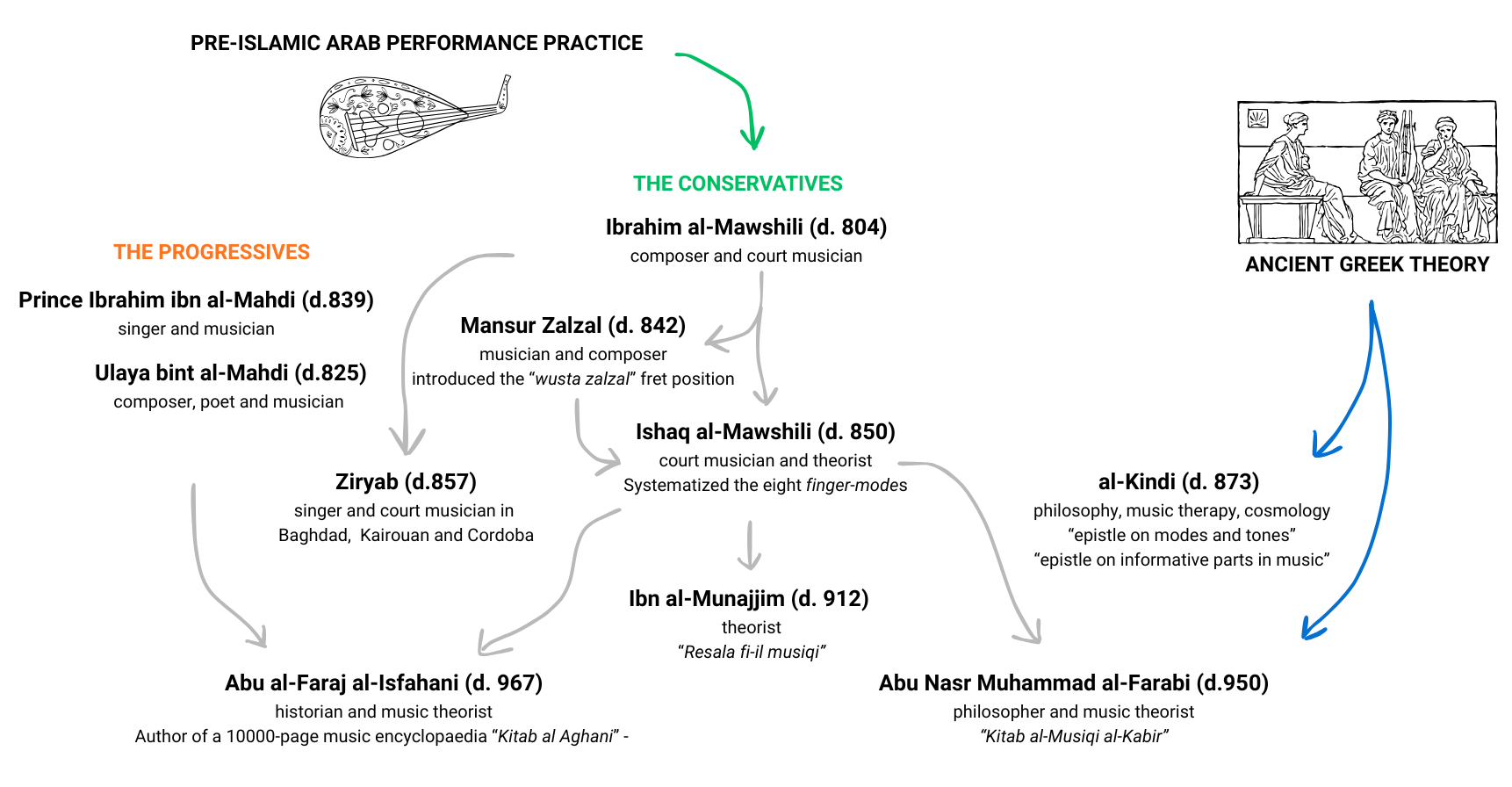
Fig 1. Connections and influences in the Baghdad music "scene"
1.2. al-Urmawī and the Systematists
Historians typically consider the 1258 fall of Baghdad to the Mongol conqueror Hulegu Khan as a symbolic ending of the Islamic Golden Age. This period is a symbolic turning point in the maqām theory as well, represented in the life and work of Ṣafī al-Dīn al-Urmawī (d. 1294), a theorist and court musician in Baghdad, initially at the court of the last Abbasid Caliph, and subsequently under the Mongol rule. Urmawī’s first-hand accounts providing insights on the systematic and meticulous sacking of Baghdad were documented by a historian al-ʿIzz al-Irbilī (Biran 2016). In his revolutionary musical treatise, the 1233-37 Kitāb al-adwār (a "book of circles", completed at the early age of 21), he developed a modal system built upon the Pythagorean tradition of mathematically proportionate intervals and introduces a 17-tone division of the octave built from two intervallic increments: the limma (90 cents) and the comma (24 cents), with 2 limmas and 1 comma producing a Pythagorean whole tone (9:8, or 204 cents).
His later book, the 1267 al-Risāla al-sharafiyya expands on the systems introduced in Kitāb al-adwār to include more interval ratios from the performance practice, following Fārābī’s example. Most notably he reintroduced the idea of the zalzalian third, but documented it as a ratio of 5:4 (a "just", or "pure major" third), instead of Fārābī’s neutral third in 27:22 (Wright 1978), thereby laying foundation to a schism in tuning practices that continues until the present day. In his treatises, Urmawī also lists a set of n-chord species (seven tetrachords and twelve pentachords), and codifies a modal system of twelve principal octave modes (shadd, from Arabic: شدّ - binding, tightening) and six auxiliary modes (awāz, from Persian: آواز - voice, song, air), built as combinations of the n-chord species, manifesting a phenomenon that will some time later become known as tarkīb (from Arabic: تركيب - combining, putting together), or a building-block approach to melodic structure. Persian mode names first recorded in Urmawī’s treatises remain in common use across traditions from North Africa to Kashmir and Xinjiang, and have with time replaced al-Mawṣilī’s finger-mode nomenclature (Neubauer 2002, 365). In contrast to the writings of the Baghdad era, Kitāb al-adwār included enough notated examples to give us a clearer picture of the melodic content of the music in Urmawi’s time
Fig. 2 A page from Kitāb al-Adwār (courtesy of University of Pennsylvania Library)
The work of subsequent theorists typically cites Urmawī’s treatises as the primary source of modal vocabulary; however, it is the treatise Durrat al-Tāj, written by Urmawī’s follower Quṭb al-Dīn al-Shīrāzī (d. 1310) that most closely reflects actual performance practice of the time (Wright 1978). Shīrāzī, whose career moved across several scholarly centers in modern day Iran, Turkey, Iraq, Syria, and Egypt, incorporates further intervals and modes he documented across the wider geographical area. In his extended concept of building blocks we can now encounter trichords and hexachords. In addition to primary and secondary modes, Shīrāzī identifies the concept of the tertiary mode, shu’ba (from Arabic: شعبة - branch) defined by a characteristic, short melodic motif or movement instead of a set of pitches (Wright 1978). Durrat al-Tāj also marks the first documented (re-)appearance of the widely used fingering-derived mode names dugāh, segāh, čahārgāh, and panjgāh (Persian for: second, third, fourth, and fifth position), remnants of the ancient Persian modal system Khosravānī.
The most prominent theorist of the generation that followed was ʿAbd al-Qādir al-Marāghī (d. 1435), born in southern Azerbaijan, who later worked in the major Timurid cultural centers of Herat and Samarkand. Author of treatises Jāmiʿ al-alhān (Compendium of Melodies) and Maqāṣid al-alhān (Aims of Melodies), Al-Marāghī is the first theorist to introduce the sufist term maqām for a primary mode. He returned to a system of cyclical numerical symmetry and classified a fully organized canon of 12 maqāmāt, 6 āvāzāt and 24 shu’ab. He is also among the earliest to include musical notation of the entire compositions (Wright 1992b). His treatises also introduced the, now common, term ajnas (sg. jins, from Arabic: جنس - genus, type) as a unifying term for all n-chord species. Even though Marāghī spent most of his life in Central Asia, his writings have soon reached the Ottoman empire where they were further elaborated by theorists such as Muhammad ibn 'Abd al-Hamid al-Ladhiqi (d.1495) in his treatise Risalat al-fathiya fi'l-musiqi dedicated to Sultan Beyazit II (d'Erlanger 1939)
Urmawī and the scholars who built upon his work are collectively referred to as the Systematist school. Formulated within the cosmopolitan intellectual networks of large medieval empires, their theoretical models circulated widely and provided the conceptual framework for subsequent maqām systematizations across the medieval Islamic world.
2. The Genesis of National Canons
The next period of big changes came in the 19th and 20th centuries which saw the decline of the Ottoman Empire, the rise of nationalist movements, and the emergence of independent nation-states. The impulse to define a national musical identity was inseparable from the broader project of cultural self-definition that accompanied political independence, and in several cases was actively encouraged by state institutions. This produced a wave of canonizations of national music theories (Blum 2023)
2.1. The Ottoman - Persian split
An early precursor of the national canons, Dimitrie Cantemir (1673–1723), a Moldavian prince and virtuoso tanbur player at the Constantinople court, produced Kitābu ʿIlmiʼl-Mūsīkī ʿalā Vechiʼl-Hurūfāt (The Book of the Science of Music According to the Alphabetic Notation, c. 1700), the most comprehensive treatise combining theory and notated material, focused specifically on the classification of Ottoman Makam practice. Although he didn’t yet make a distinction between the musical practice of the ethnicities within the Ottoman Empire (primarily Turks, Arabs and Greeks), he did establish a clear theoretical separation from Persian music (Feldman 2023), presenting a break from the transnational aspect of the systematist theories the Ottoman makam was based on, and limiting it to the borders of the empire. The treatise comprises detailed theoretical material in its first volume, and in its second volume a notation of over 350 written compositions across 48 makam modes, as performed in Constantinople, preserved in an alphabetical-numerical notation system Cantemir himself developed.
As for Persia, a propagation of the national canon happened gradually under the Qajar dynasty (1789-1925) in the general atmosphere of revival of Persian national identity (Ashraf 2006). Mirzā ʻAbdollāh Farāhānī (1843-1918) played a central role in compiling the radif (from Persian: ردیف - rank, series), a corpus of measured and unmeasured melodic segments, gūše-hā (sg. gūše, from Persian:گوشه - nook, corner) grouped into seven principal dastgāh-hā (sg. dastgāh, from Persian: دستگاه - system, organization) and five subsidiary āvāz-hā. The Dastgāh melodic content has exhibited a larger influence of the rhythmical folk music motives from Iran, in comparison to the earlier courtly forms of shudd/maqām. Initially, each master musician would complete their own radif, within the common formal structure but with a personal selection and order of gūše-hā, which also served a pedagogical purpose where all traditional modes and rhythms and melodic motives were categorized into a coherent system, which masters would then transmit to their disciples (Nettl 1987). This established gūše, a defined melodic unit, as the primary analytical unit of Persian theory, as opposed to a jins, the abstract tone group the Ottoman theories were based on. The motives of each gūše could be varied and improvised on, while preserving some essential defining features. The notion of a single "canonical" radif has developed progressively as a product of early 20th‑century efforts to document the exact melodic content using Western notation. Mirzā ʻAbdollāh’s radif was first transcribed by ʻAli Naqi Vaziri in 1910, an army colonel, tar player, and a student of Western music theory who also established the first music conservatory in Tehran in 1923 (During 2019a, Talai 2002, 865). Even after the radif’s consolidation, divergences between schools and individual masters have persisted, as have debates over the completeness or authenticity of any given transmission. In parallel, Iranian minority ethnic groups such as the Baluchis, Turkmen, and the Kurds have transmitted their own traditional repertoires mirroring the Persian dastgāh (During 1997, 1998b; Massoudieh 1992, 1997)
2.2 Turkish Makam and its influences in the Balkans
The canonizations of the late Ottoman and early Turkish Republic periods focused on the attempts to synthesize with Western music theory. Haşim Bey’s Mecmua-i Kârhâ ve Nakışhâ ve Şarkiyât (1864) first notated the makams in the Western notation and key signatures. The theorist Rauf Yekta (1871–1935), wrote some of the first modern Turkish makam textbooks, which he claimed were based on "the most recent methods of science" (Öztürk 2018). In his theories, he formalized a scale‑oriented approach according to the Western understanding of tonic and dominant. During the 1930s‑50s, Saadeddin Arel, Suphi Ezgi, and Salih Zeki Uzdilek consolidated these modernization efforts into the Arel‑Ezgi‑Uzdilek (AEU) system, which remains the dominant theoretical framework in Turkish conservatories today (Öztürk 2018; Signell 1977) . The AEU textbooks drew on Cantemir’s classifications and the interval ratios such as Urmawī’s “just” third, introducing a system of accidentals built around the tuning framework of nine commas per whole tone, producing a 53-tone octave. However, only the degrees close to the degrees of the 12-tone equal temperament (12-TET) were given an accidental, effectively dismissing the less "Western" sounding intervals.

Fig 3: Arel-Ezgi Uzdilek 9-comma division with accidentals for 1 comma, small semitone (4 c), large semitone (5 c) and a small tone ( 8c) (Image by SZC 03 on Wikipedia)
Alternative theories such as those from Mildan Niyazi Ayomak and Kemal İlerici developed a microtonal notation where every degree of 9-comma-tone division, had either a dedicated accidental (Ayomak 1933-1934) or a numbered +/- mark (İlerici 1981) haven’t found wide acceptance in the music pedagogy (Aksoy 1997). Another unique aspect of the music-theoretical developments in 20th century Turkey is that parallel to the modernization efforts of classical Makam, there was an entirely separate canonization of the folk music, Ayak. Mahmut Ragip Gazimhal’s 1928 volume Anadolu Türküleri ve Musıkî İstikbâlimiz (Anatolian Folk Songs and the Future of Our Music) notes the differences and parallels between the folk music modes and their Makam counterparts. Kemal İlerici’s tuning theories have found more resonance in Ayak scholarship which recognizes the variable neutral second degree of the most prevalent folk mode Kerem, which İlerici has designated as the "mother mode" of all folk music (Markoff 2002, 83).
In the newly formed slavic Balkan countries the exact reach of maqām influence was already not always easy to discern as it was mixed with Central European and Romani influences as well as old indigenous styles found in the areas such as the western Greece, Albania and the rest of the Dinaric Alps (Samson 2013), although numerous parallels to the maqām traditions are difficult to ignore. Melodic content of local folk music was studied by composers and musicologists trained in the Western musical traditions and the 12-TET tuning framework. Ethnomusicologist Franjo Kuhač presented years of comprehensive research in his 1881 volume Južnoslavenske narodne popjevke (Southslavic folk songs), a vast volume of 1600 songs he had collected across the Balkans and transcribed in a Western manner, with a piano accompaniment, a practice which was later criticized by Bela Bartok (Bartok 1951). The melodies in the aforementioned Kerem mode, similarly ubiquitous across the peninsula, were typically changed to dorian mode in the ascending motion and a phrygian in the descent. In a lengthy article on the question of Turkish (which he sometimes calls Arabic, in a denial of the mere existence of any meaningful Turkish contribution) influence on Serbian, Croatian and Bulgarian music, Kuhač provides a relatively well-informed overview on the development of maqām history from Fārābī onwards, but diminishes its impact on the local traditions, citing the "Turko-Arab" music’s "complete lack of direction and sense", while repeatedly using such formulations as: "their so-called singing" and "savage noises" (Kuhač 1898)
2.3 Developments in the Arab world and the 24-tone scale
Across the Arab-speaking territories and emerging countries, a wide variety of regional styles and traditions developed alongside the mainstream classical repertoire of the Arabic maqām - as practiced in urban centers of the Mashriq region, such as Cairo, Damascus, Aleppo, or Beirut. These included the Iraqi Maqām (here the term maqām refers not only to the modal structures but also to the repertoire itself, somewhat similar to Iranian radif), the several surviving descendants of the classical Arab-Andalusian Nuba in the coastal Northern African cities: Maʾlūf in Tunisia, Libya and Algerian Constantine (Arabic: مألوف - customary), Sana’a in Algiers (Arabic: صنعة - artistic), Gharnati in the West-Algerian city of Tlemcen (Arabic: غرناطي - “from Granada”, following the resettlement patterns after the reconquista), and Al’ala in Morocco (Arabic: آلة - instrumental), as well as a wide variety of folk music genres (Touma 1975, Guettat 2002, 449; Lambert 2002, 649; Saidani 2006). Notably, the melodic language of Arabic maqām is also found in the musical traditions of non-muslim populations from the region, such as levantine Jews and Christians (Kligman 2009, Moufarrej 2010). A significant theoretical development in the service of strengthening Arab cultural identity was the push for adoption of the 24-tone equal temperament (24-TET) scale, intended to accommodate the zalzalian intervals that have been dismissed by dominant Ottoman theories in their orientation toward the West (Abou Mrad 2016). The system was proposed in Mikhāʿīl Mashāqa’s al-Risāla al-shihābiyya fīʼl-ṣināʿa al-mūsīqiyya (Essay on the Art of Music for Prince Shihāb, c. 1840), which drew on an earlier proposal by Muhammad al-ʿAttār, but did not gain full prominence until the 1932 Cairo Congress of Arab Music. Sponsored by King Fuʿād I and organized by Ahmad al-Qabbānī and Baron Rodolphe d’Erlanger, this congress is widely regarded as a major event in Arab music history and was attended by foremost traditional performers from the Arab world but also by musical figures such as Bela Bartok, Paul Hindemith and Alois Haba, one of the pioneers of Western microtonal composition, who even brought his own quarter-tone piano for the occasion (Racy 1991). The 24-TET solution was widely discussed and largely adopted as a compromise during the sessions at the Cairo Congress, even though discrepancies with actual tuning practices were immediately apparent, as the musicians who tried tuning their instruments to a tempered system, considered it to be unacceptably out of tune (Abū Shumāys 2009)
Ali Naqi Vaziri has proposed a similar system in Iran in his 1934 treatise Musiqi-e naẓari, which introduced the quarter-tone accidentals koron (half-flat) and sori (half-sharp). The reform was criticized on theoretical grounds by later scholars (Farhat 1990), but the accidentals themselves have become widely accepted and remain in standard use in Persian written music and pedagogical literature, even if they rarely imply a mathematically pure quarter tone, and the exact tuning is left to the performer’s preference (Farhat gives an acceptable range of 20 cents for each neutral tone)
In the aftermath of the Cairo Congress, the first systematic “national” canonization in the Arab world took place in Tunisia with the establishment of the Rachidia Institute, dedicated to the preservation and institutionalization of the Tunisian Maʾlūf. The musical material of the Ma’luf repertoire codified at the Rachidia institute survives in the published transcriptions of Salah el-Mahdi, a musician, theorist and the head of music at the cultural ministry founded after Tunisian independence. In his notations el-Mahdi introduced a more nuanced alternative to the 24-TET system, employing three different half-flat signs to differentiate between the intervals that define the modal identity of a particular Nūba (suite) (Davis 2004).
2.4 Tribulations of maqām traditions in Soviet Union and China
After the collapse of the Russian Empire, several Muslim-majority lands gained a short-lived independence before being assimilated into the newly formed Soviet Union. This was a period of intense construction of ethno-national identity narratives, often done through music and other arts, as the Soviet cultural policy promoted the development of national arts based on local folk traditions as long as they fit within the ideological framework (Hirsch 2005). In Azerbaijan, home to an already well established Mugham repertoire (in many structural and modal aspects similar to Persian Dastgāh), composer Uzeyir Hajibeyov (1885–1948) merged Mugham with Western classical forms writing several Mugham-Operas, he also founded the Baku Music Conservatory and wrote the first Azerbaijani music theory texts in the 1920s, with his most well-known theory book, the Principles of Azerbaijan Folk Music published in 1945. There he effectively canonized his modernized version of Mugham modes which was transposed into the 12-tone equal temperament, claiming the westernized intervals represented a true nature of Azerbaijani music, freed from Eastern influences (Desniatchanko 2017). This opened Mugham to a wide variety of modern instrumentations and crossover genres such as symphonic mugham or jazz mugham, but came at the price of the traditional tuning of the national instrument tar (see Fig. 5 below). The old 17-tone-octave system the tar was tuned in precedes Urmawī’s scale, and may even have partly influenced it (Wright 1978). Tar frets were laid out in specific irregular intervals custom made to accommodate the specific tonal identity of each Mugham mode (During 2009a). After the shift, old instruments had to be reconstructed and musicians singing and performing in non-tempered tuning were banned from recording contracts (During 2019c).

Fig. 5: 17-tone fret system of the Azerbaijani tar, documented after the instrument of Sadiq Əsədoğlu, late 19th century. Jean During (2019c)
Another form of traditional repertoire that resists codifications on the basis of nationality is the Ashug or Aşık, a shared folk tradition of traveling bards, present across the southern Caucasus, northwestern Iran and eastern Turkey (Albright 2002, 843). The melodic content of the Ashug/Aşık repertoire mirrors the maqām modes and is sometimes studied using the nomenclature of the maqām theory of the respective country (Naroditskaya 2002, Albright 2002, Madilian 2017). The folk instrumental repertoire of Turkmenistan is typically performed by a single Bakshi performer on a traditional instrument dutar, or in a duo with ghijak (a type of fiddle), and is known as Turkmen Mukam (Gullyev 1997). A somewhat similar instrumental style, Kyui, is found in Kyrgyzstan and Kazakhstan (Czekanowska 1989)
In the courts of Central Asia, the legacy of Maraghi and the Timurid era was continued after the dissolution into smaller khanates; several classical repertoires took shape in the framework of suite cycles with increasingly fixed melodic material. The maqām nomenclature persisted but referred primarily to the suite as a form, and only secondarily to the tonal material. Four such repertoires are known to us today: the Šašmaqom (six maqāms) repertoire of the multicultural city of Bukhara, the Altiyarim Maqom which was developed in Khorezm in mid 19th century under Emir Muhammad Rahim-khôn II and modeled after the Šašmaqom; the Fergana-Taškent Čormaqom (four maqāms); and perhaps the most elaborate of all, the Uyghur On-Ikki-Muqam (12-Muqam), which is considered to be an uninterrupted tradition traceable back to the 16th-century Yärkänd khanate, with a direct lineage of the current canon leading to 19th century performer Halim Salim (During 1998a). The twelve Uyghur Muqams were first documented in writing by Wan Tongshu in the 1950s, based on the recordings of a master performer Turdi Akhun from Kashgar. Since the cultural revolution, the Uyghur Muqam scholarship in the Chinese Xinjiang has significantly slowed down, but the sizable Uyghur community in Soviet Central Asia has continued the tradition (Harris 2008). Beside the classical form of the On-Ikki Muqam there is an entirely separate Muqam repertoire performed by the folk musicians of the minority Dolan tribes (Rehman 2006)
The "modernization" of Šašmaqom, a shared tradition of Tajik, Uzbek, and Jewish people of Bukhara, represents a particularly telling example: In 1920, Abdurrauf Fitrat, a music theorist and a high ranking statesman in the newly formed Bukharan People’s Soviet Republic commissioned a Russian musicologist Viktor Uspenski to transcribe the entire Šašmaqom musical material, using the 12-tone equal temperament, and omitting the Persian/Tajik texts the vocal parts were traditionally sung in, replacing them instead with Uzbek lyrics. This re-canonization was accompanied by his 1927 book O‘zbek klassik musiqasi va uning tarixi. (Uzbek Classical music and its History). During the Stalinist purges, Fitrat fell out of favor and was executed in 1938, and the Uzbek Šašmaqom, associated with him, was effectively forbidden until the mid 1950s, when it reappeared in new transcriptions as two separate "Uzbek" and "Tajik" entities (Levin 1993). The suite transcriptions were typically performed by large student orchestras playing in unison. After the 1991 independence, the Tajik cultural policy turned from Šašmakom to Falak, the southern, folk music repertoire as a new marker of national identity (with Šašmaqom having too much of an Uzbek connotation); whereas in Uzbekistan, the Fergana-Taškent style became the preferred repertoire: native to the most populous eastern part of the country, less courtly and canonical and more in touch with folk music (During 1998a), leaving Šašmakom no longer a suitable “national canon” for either nation.
2.5 The case of Kurdistan
Having never had a nation-state on their own, the Kurds have lacked both the political apparatus and the institutional infrastructure that drove canonization everywhere else in the region.
To date, the first and only systematic account of Kurdish musical genres and their structural characteristics across the entire territory of Kurdistan (parts of Turkey, Iran, Iraq, and Syria) within the Western scholarship is given in Jalil Asid's 2007 dissertation Kurdische Musik: Gattungen und Struktur, defended at the University of Zurich. Asid, himself a musician and musicologist from Erbil in Iraqi Kurdistan, draws on the Iraqi maqām system as his principal framework for modal classification.
The most consequential documentation of a specifically Kurdish modal repertoire has come through Jean During’s documentation on the sacred music of the Ahl-e Haqq, a syncretic Kurdish religious order centered in the Kermanshah and Lorestan regions of Iran. Ahl-e Haqq repertoire for tanbur (considered a sacred instrument) is presented within the dastgāh framework shared with Iran and Azerbaijan. During’s principal source was found in the family estate of the celebrated tanbur master and philosopher Ostad Elahi (Nūr ʿAlī Ilāhī, 1895 - 1974), a descendant of the Ahl-e Haqq religious leaders who pursued a secular career as a judge, rising to a position of Chief Justice at the Court of Appeals of the Mazandaran province. Throughout his life, Elahi has cultivated this almost extinct traditional repertoire, performing only within the confines of his own house, being categorically opposed to public performance and commercial recording. The fifteen-CD collection The Art of Ostad Elahi consists of home recordings made between 1964 and 1972 by his children, sometimes in secret, and may have saved this entire musical tradition from oblivion
3. Toward a Transnational Approach
The modern comparative study of the maqām phenomenon formally began with the formation of the ICTM (International Council for Traditional Music) Maqām Study Group, founded in 1988 by the East-German musicologist Jürgen Elsner. The Study Group convened a series of symposia over the following decades, bringing together scholars working across the full geographical range of maqām traditions. Its proceedings constitute the primary body of comparative scholarship in the field. As the Study Group’s activity has diminished in recent years, its work has been continued by the Maqām Beyond Nation research project, led by Rachel Harris at SOAS University of London and funded by UK Research and Innovation. The project’s most recent symposium, co-designated as the 12th Symposium of the ICTM Study Group on Maqām, was held at the Azerbaijan National Conservatory in Baku in April 2026. The institutional continuity between these two projects and the convergence of their scholarly agendas allow them to be treated as successive phases of a single ongoing research program.

Fig. 6: Five key processes that form the basis of comparative musicological analysis (Savage and Brown 2013)
3.1. Establishing the criteria
Because the scope of the Maqām Study Group and related scholarship is extremely broad; addressing, among other things, rhythmic organization, poetic texts, instrument construction, performance contexts, and systems of transmission and education, the present survey limits itself to aspects directly relevant to the current project. Further filtering is necessary to determine which aspects of this doctoral project lend themselves to a transnational perspective and which don’t: matters of style and ornamentation, for example, tend to be highly localized and dialectal, so that the search for transcultural similarities would not offer much insight. The survey will therefore focus principally on the aspect of modes, but not before considering a few of the fundamental precursory texts that deal with the transcultural dimensions of modal music in general:
In the 1968 article on musical modes in the Encyclopaedia Universalis, Trần Văn Khê proposes four principal characteristics that define a mode in cross-cultural perspective. These are: (1) a specific pitch collection or modal scale, (2) a hierarchy among the degrees of that scale, in which certain tones function as principal or focal notes, (3) characteristic melodic formulas associated with the mode, and (4) a distinct expressive character or modal ethos. Trần presents these criteria in order to distinguish the concept of mode from that of a mere scale and to provide a framework applicable to diverse modal traditions such as those found in Asian and Middle Eastern music (Trần 1968).
Howard Powers’s more extensive treatment of mode, in the Grove Dictionary of Music and Musicians (first appearing in the 1980 edition) introduces additional comparative perspectives and addresses a conceptual gap in the Western understanding and inability to conceptualize the gray area between the "melody type" and "scale type" (a gap that was already somewhat bridged in the Soviet Maqām scholarship using the russian theoretical concept of lad, which will be given closer examination in the later stages of this project) In his entry, Powers also already notes the overarching existence of some kind of "modal nucleus" across the Western Asian systems and points to some crucial difference between them and the South Asian modes, separating the two into the "concept maqām" and the "concept raga" (Powers 2001).
3.2 The Maqām principle
The founding theoretical contribution of the ICTM Maqām Study Group which established a working definition of the phenomenon under study was provided by Jurgen Elsner with the opening text: On the Maqām Principle. Tone-Group Melodics as Foundation and Building Block of Musical Production, where he defines the tone-groups (ajnas) as the nucleus of melody development, and the modular, "building-block" principle (tarkīb) by which the tone-groups are combined into larger melodic units (Elsner 1989). Elsner insists that this is a universal theoretical concept that should be severed from cultural connotations and leaves the geographical and typological scope of the maqām principle rather open in his first study (with the commonly adopted boundaries of the maqām realm extending from Morocco to Xinjiang being first proposed by Harold Powers, who was another founding member of the study group). Although Elsner himself does conform to these boundaries in some of his later writings (Elsner 2013).
The color coded visualisation as a pedagogical resource for better understanding of the tarkīb was first introduced by Sami Abū Shumāys, on a pedagogical website maqamlessons.com made to accompany his article on maqām analysis (Fig. 7). This approach was later expanded in the book Inside Arabic maqām co-written with Johnny Farraj as well as that book's own companion website maqamworld.com created by Farraj.
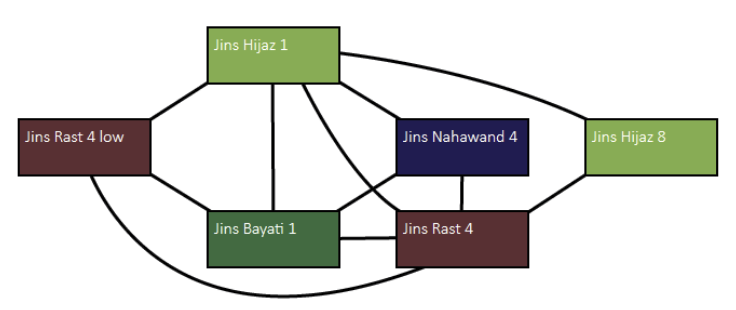
Fig. 7: Sami Abū Shumāys (2013): A simplified modal structure of the maqām Hijaz (maqāmlessons.com)
Understanding of the maqām principle shows us the shortcomings of analyzing Middle Eastern music through the Western conception of an octave-scale (Elsner 1989). Two adjunct building blocks of a mode may form an octave with a repeating "tonic", and often do, but in the case of maqām, that is an option and not a rule (see fig 8 below). This distinguishes maqām from both Western and Indian theories where the repetition of a "tonic"/fundamental an octave higher is always present. Conversely, if the maqām principle is to be seen as a rule in the melody building in Middle Eastern traditional music, it still exists as an option in any other musical idiom as well, and can be routinely observed in a vast range of genres. Furthermore, the melody in maqām, by definition of the maqām principle, always develops only within the boundaries of the single building block before moving on to the next one, which is a limitation not seen in either Western or Raga music, where the melody will typically flow freely throughout and beyond the scope of the octave (Powers 1988).

Fig. 8: Diagrams of the modal structures in maqām Rast and Saba, demonstrating the octave-equivalence in one case and its absence in another (Farraj and Abū Shumāys 2019)
3.3 The nomenclature
Another methodology in transcultural study of modal structures is the following of the traces of Systematist nomenclature and the comparative study of the modes of the same name. At the first Study Group meeting, Harold Powers inaugurated this research area with an article "International Segah and its nominal equivalents in Central Asia and Kashmir" which examines this very specific trichord that is present in every maqām tradition, usually in the co-dependent relationship with the conjoined tetrachord above. Powers notes a discrepancy that the modes named Segah in the central asian canons have entirely different properties, and lack the characteristic "sega-ness" as he calls it (Powers 1989). The Segah-problem is retraced by Elsner in "System shifting reflected in Sikah - Some remarks on the history of the maqām system" (Elsner 1997) and then again in great detail in his synthetic and seminal article "maqām in Raum und Zeit - Zur interregionalen Dimension des maqām-Prinzips" (Elsner 2013). Meanwhile, During finds the missing "sega-ness" in another Central Asian mode of Dugah (During 2009b). Other tracings of mode names across the traditions are During's own article on Rast (During 2019b) and Owen Wright's Peregrinations of Panjgāh (Wright 2019). The increasing methodological coherence of the later articles clearly demonstrates how far ahead collective knowledge within the transnational approach has developed after 30 years of sustained research. This area of study shares many similarities with comparative linguistics. It traces the mechanisms by which meanings have shifted over time, ranging from simple cases of "false friends" and "lost in translation" phenomena, to more complex situations where different national theories have emphasized different aspects of an ambiguous systematist modal classification. In some instances, this has resulted in completely different modes sharing the same name, while both remain directly traceable to the medieval sources.
Below is a chart of Urmawī’s 12 principal mode names plus the names of the first five Khosravani positions, with their distribution across the different regional practices of our times (the first Khosravani position, Yekgāh, is rare because many theories understand it as synonymous with Rast). The modal content is color-coded according to the 12-Flavor system proposed by myself (more on that in future posts). The repertoire of the Sufyana Kalam preserved in the Sufi lodges of Kashmir represents a curious case where the systematist canon has been perfectly preserved in the name, however, although some slight melodic similarities to other maqām traditions are present (mostly with the Uyghur Muqam), its melodic development has diverged from the maqām principle and instead exhibits clear characteristics of Raga, such as the fundamental drone and the free melodic movement. Sufyana Kalam modes were documented by Józef Pacholczyk (Pacholczyk, 1996), who also provided several articles on comparative research.
Traditional dastgāh repertoires of Iranian minority groups (the Turkmen, Balochi, and Ahl-e Haqq Kurdish traditions) are classified in their respective vernaculars rather than the systematist nomenclature, and are therefore not represented in this chart. On the other hand, the chart also includes the Greek urban music style of Rebetiko, which has developed across the Aegean port cities of the late Ottoman Empire, and is typically theoretized on the basis of Turkish makam nomenclature (Pagiatis 1992), with some noteworthy differences.
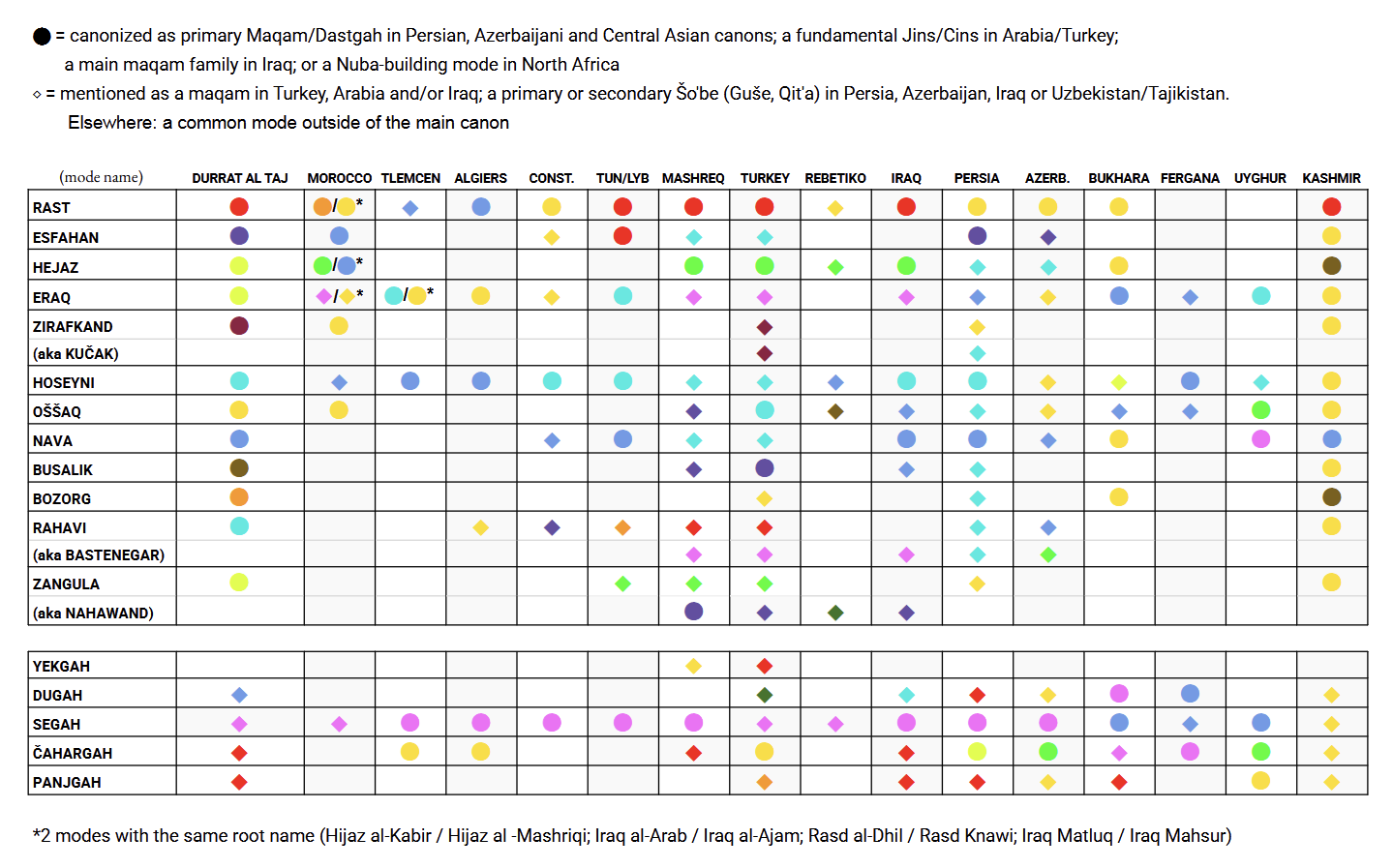
Fig. 9: Distribution of mode names across the Maqām realm
3.4 Critical Perspectives
Contemporary scholarship has taken a critical stance towards the often unethical and disruptive effects of political projects to intervene into the traditional music practice, outlined in Section 3. A good introduction to these critical perspectives is found in Stephen Blum’s "Music Theory in Ethnomusicology", which outlines the similarities in the creation of national music schools, helping to clarify the underlying mechanisms that lead to this phenomenon while also providing an overview of the available scholarly literature on national canons (Blum 2023).
In the introduction to her book "The Making of a Musical Canon in Chinese Central Asia", Rachel Harris expands on William Weber’s critical interrogation of the ideological backgrounds behind canon building in classical music (Weber 2001) and Philip Bohlman’s notion of canons as products of bricolage: multiple agents making multiple choices, selecting and revising according to contested criteria ("models of the past are important, and where real models are not present, surrogates and imaginary models will do just fine" - Bohlman 1992). She then offers a synthetic typology of twentieth-century canons, identifying shared features that distinguish them from earlier models. Finally, she argues that the degree to which canonising projects are fought over from within by musicians, scholars, and audiences, rather than imposed unilaterally, is a main feature that distinguishes maqām canonizations from those found elsewhere (Harris 2006). The writings of Rachel Harris are also an important source on the socio-political analysis of systemic cultural repression found across Central Asia and particularly in Xinjiang.
Another poignant and insightful critical voice within the maqām scholarship is that of Jean During. In a series of articles, he writes from his long standing background in the field of urgent ethnomusicology, documenting critically endangered practices he encountered throughout many years of field work in Iran and Uzbekistan. In "Territorialité et territorialisation de l’espace musical musulman", anchored in the Deleuzian–Guattarian framework, he explores the deterritorialisation, embodied in the millennia of cosmopolitanism and migratory influences, viewing the (inevitably) consequent reterritorialisation and search for the authenticity and "roots" not as a nation-state project, but through the Sufi principle of spiritual inner home, referring to a Rumi verse "my place is nowhere, my sign is no sign, I am neither of the West nor of the East, neither of land nor sea, neither of the realm of Iraq nor of the land of Khorasan" and ultimately also pointing out that entire musical traditions were often indebted to a single performer of a transcending talent and their inner circle of collaborators and followers, and that such individuals (whether of Persian, Turkic, Arab, or ancient Greek culture) were for a long time considered to belong to the same "prophetic" lineage tracing back to the divine origin of music (During 1996).
A particular focus of Jean During’s writings lies in the technical and ideological aspects of changes in tuning practices. In "The loss of the maqâmic sense in Central Asia" (During 2009b) he analyzes the consequences of several generations of Central Asian musicians being trained under the Soviet Union’s modernization doctrine, documenting the losses of the essential identity of the modes which is often found in the intonation of certain degrees, he also notes how some parts of the suite are transposed for trivial technical reasons losing the sense of the home key and modal unity of the suite, which is one of the basic tenets of a musical form, far beyond maqām. In "Sur les traces de Zalzal: soviet maqâm vs qadim maqâm" he follows the subversive practices of some musicians of the younger generation, such as Abror Zufarov, a grandson of Turgun Alimatov, a celebrated Uzbek tanbur player of the Soviet Era, reconstructing the zalzalian intervals in the traditional Bukharan Šašmaqom, and maintaining two parallel tuning systems: the "official" and the "authentic" one (During 2019c)
Numerous theorists have pointed out the shortcomings of the 24-tone system used in Arabic canon (Touma 1975, Marcus 1989). Nidaa Abou Mrad observes how the system, initially adopted as a resistance strategy against the westernizing Turkish theory, later became the "Trojan horse" of Westernisation at the 1932 Cairo Congress of Arab Music (Abou Mrad 2016). The Turkish westernization project itself has its critics within Turkey, in "The Conception of ‘Contemporizing Music’ in the Founding Ideology of Early Republican Turkey" Okan Öztürk underlines the ideological background behind this process, shaped by a fictive and totalitarian perspective rather than by concrete facts and analyses; and notes how the authorities even went as far as using repressive state apparatuses to impose prohibitions where required (Öztürk 2015)
The ideas of which version of "the West" one was supposed to imitate vary from country to country depending on which colonizing power exerts the most influence, but are similar in their basic premise. Frantz Fanon wrote about the mechanisms by which the colonized subject internalizes the colonizer's culture as superior and then seeks recognition through assimilation (Fanon 1952). In a 2024 lecture titled "The Politics of Maqām Scales and the Decolonization of Music Studies," delivered at the "Western and World" symposium in Toronto, Sami Abū Shumāys analyzes the colonial power dynamics underlying the events of the Cairo Congress and the modernization projects in general. He identifies a hegemony of mathematics that functions both as a tool of gatekeeping, shifting the discourse into a scientific and theoretical register where practitioners have no say, and as a subtle colonization strategy; to present mathematically "logical" intervals as universal natural law, which the West merely (re)discovered. The drive to regularize and "fix" scale tuning, he argues, directly parallels colonial efforts to erase indigenous languages: the standardization of modes into equal temperament renders them legible to the colonizer, reshaping them to fit the colonizers’ theoretical preconceptions. Abū Shumāys draws a parallel to Plato’s writings, in which mathematical purity is equated with aesthetics and political correctness: the fact that Plato wrote negatively of complex, enharmonic and ornamental music confirms that such practices already existed in his time; thus, even in ancient Greece, imagined as the ideal model of mathematical purity in music, the actual performance practice had not in fact followed those mathematical rules (Abū Shumāys 2024)
The ideal of a pure, ancient Greek tradition to which one must return also persisted in the Balkans. An important and widely cited source on Balkanism (a local “answer” to Orientalism) is Risto Pekka Pennanen's article "Lost in Scales," presented in the 2008 issue of the Serbian Musicology Journal. Pennanen identifies several overlapping practices that together constitute Balkanism in music: a denial of Turkish influence; the invention of more preferable ancient Roman, Greek, or even Indian origins (whereby "exotic" elements are explained as having been brought from India by migrating Romani people); and, in the rare cases where Turkish theory is seriously engaged, a reliance exclusively on written sources, accompanied by accidental or deliberate misinterpretations of the concepts of finalis and focal notes in order to prove difference (Pennanen 2008). Nidaa Abou Mrad analyzes how Chrysanthos of Madytos, as part of a lineage of Greek ecclesiastical musicographers, appropriated the zalzalian genus into an ancient Greek mythological anchorage for Orthodox liturgical music, distancing it from Turkish and Arab cultures, and how this typological reference was musicologically anachronistic and allotopic, yet ideologically approved because it answered the aspiration for national emancipation (Abou Mrad 2016). This is paralleled in Franjo Kuhač’s later claim that Hijaz (the chromatic tetrachord, also widely called “the Arab tetrachord” across the slavic Balkans) was not in fact a Maqām influence, but indigenous to the Balkans (Pennanen 2008).
Another aspect of Balkanism is the deliberate political decision to separate one's own tradition from those of neighboring countries in service of fabricating a distinct national identity. This phenomenon was already documented in Bela Bartok’s early essays (Bartok 1992) and is evident across former Yugoslavia not only in the music theories of but also in the newly constructed languages (Bugarski 2012). At the same time, it illustrates a broader recurring pattern: in "Musique, nation et territoire en Asie intérieure," Jean During recounts a conversation with an Iranian master musician, who complained that traditional Persian melodies are routinely "stolen" by Turks and Arabs, and insisted on purging foreign Arabic elements from the radif. Yet the same master raised no objection to including equally (or even more) foreign-sounding elements from the repertoires of Iranian minority groups such as the Baloch or Turkmen into the national Persian radif (During 1993). One might speak of a fundamental hypocrisy in the nationalistic mindset, which operates simultaneously as a decolonizing force (freeing and "purifying"one's own culture from the influence of the “Big Other”) and as a colonizing one (appropriating and assimilating the minority cultures into the dominant "national" one).
Literature:
Abou Mrad, Nidaa. 2005. "Musique de l’époque abbasside: Le legs de Ṣafī al-Dīn al-Urmawī (d. 1294)." Liner notes to Musique de l’époque abbasside: Le legs de Ṣafī al-Dīn al-Urmawī. Ensemble de musique classique arabe de l’Université Antonine (Liban). Paris: Maison des Cultures du Monde.
Abou Mrad, Nidaa. 2016. Eléments de sémiotique modale: Essai d’une grammaire musicale pour les traditions monodiques. Paris: Geuthner.
Abu Shumays, Sami. 2009. "The Fuzzy Boundaries of Intonation in Maqam: Cognitive and Linguistic Approaches." Paper presented at the annual meeting of the Society for Ethnomusicology, Mexico City, November 22.http://www.maqamlessons.com/analysis/FuzzyBoundaries_MaqamIntonation2009.pdf.
Abu Shumays, Sami. 2024. "The Politics of Maqām Scales and the Decolonization of Music Studies." "Western-and-World" Symposium, Labyrinth, Ontario. Video posted August 19, 2024. YouTube.https://www.youtube.com/watch?v=DsLLgKDfaOo&t
Aksoy, Bülent. 1997. "Towards the Definition of the Makam." In The Structure and Idea of Maqām, Historical Approaches: Proceedings of the Third Meeting of the ICTM Maqām Study Group, edited by J. Elsner and R. P. Pennanen, 24:39–63. Tampere: University of Tampere.
Albright, Charlotte F. 2002. "The Asiq and His Music in Northwest Iran." In The Garland Encyclopedia of World Music, vol. 6, The Middle East, edited by Virginia Danielson, Scott Marcus, and Dwight Reynolds, 843–52. New York: Routledge.
Asid, Jalil. 2007. "Kurdische Musik: Gattungen und Struktur." PhD diss., Philosophische Fakultät der Universität Zürich.
Ashraf, Ahmad. 2006. "Iranian Identity iv. 19th–20th Centuries." Encyclopaedia Iranica. Last updated March 30, 2012. https://www.iranicaonline.org/articles/iranian-identity-iv-19th-20th-centuries.
Ayomak, Mildan Niyazi, ed. 1933–1934. Nota: Music Journal (Nota Musiki Mecmuası), nos. 1–31. Istanbul.
Bartók, Béla, and Albert B. Lord. 1951. Serbo-Croatian Folk Songs: Texts and Transcriptions of Seventy-Five Folk Songs from the Milman Parry Collection and a Morphology of Serbo-Croatian Folk Melodies. New York: Columbia University Press.
Bartók, Béla. 1992. Béla Bartók Essays. Edited by Benjamin Suchoff. Lincoln: University of Nebraska Press.
Bayraktarkatal, Ertuğrul, and Cenk Güray. 2023. "Proposing a Makâm Model Based on Melodic Nuclei." Analytical Approaches to World Musics 11 (1).https://journal.iftawm.org/previous/2023-volume-11-no-1/.
Bencheikh, J. E. 1975. "Les Musiciens et La Poésie: Les Écoles d’Isḥāq al-Mawṣilī (m. 225 H.) et d’Ibrāhīm Ibn al-Mahdī (m. 224 H.)." Arabica 22 (2): 114–52.
Biran, Michal. 2016. "Music in the Mongol Conquest of Baghdad: Ṣafī al-Dīn Urmawī and the Ilkhanid Circle of Musicians." In The Mongols’ Middle East, 131–154. Leiden: Brill.
Blum, Stephen. 2023. Music Theory in Ethnomusicology. Oxford: Oxford University Press.
Bohlman, Philip. 1992. "Epilogue: Music and Canons." In Disciplining Music: Musicology and Its Canons, edited by Katherine Bergeron and Philip Bohlman, 197–210. Chicago: University of Chicago Press.
Bugarski, Ranko. 2012. "Language, Identity and Borders in the Former Serbo-Croatian Area." Journal of Multilingual and Multicultural Development 33 (3): 219–35.
Čičakovski, Temko. 2022. "Muzičkiot instrument kanun kako del od gradskata tradicija vo Makedonija." PhD diss., St. Kiril University, Skopje.
Czekanowska, Anna. 1989. "Kjuj or Maqām: Toward an Extension of the Concept of Maqām." In Maqām–Rāga–Zeilenmelodik: Konzeptionen und Prinzipien der Musikproduktion, edited by Jürgen Elsner. Berlin: ICTM Study Group "Maqām."
Davis, Ruth. 2004. Maʿlūf: Reflections on the Arab-Andalusian Music of Tunisia. London: Bloomsbury Academic.
Dessiatnitchenko, Polina. 2017. "Musical and Ontological Possibilities of Mugham Creativity." PhD diss., University of Toronto.
During, Jean. 1988. La musique traditionnelle de l’Azerbayjan et la science des muqâms. Baden-Baden: V. Koerner.
During, Jean. 1993. "Musique, Nation & Territoire en Asie Intérieure." Yearbook for Traditional Music 25: 29–42.
During, Jean. 1996. "Territorialité et territorialisation de l’espace musical musulman." In Lieux d’islam, edited by M.-A. Amir Moezzi, 321–31. Paris: Autrement.
During, Jean. 1997. "The Baluchi Zahirig as a Modal Landscape and the Emergence of a Classical Music." In The Structure and Idea of Maqām, Historical Approaches: Proceedings of the Third Meeting of the ICTM Maqām Study Group, edited by J. Elsner and R. P. Pennanen, 39–63. Tampere: University of Tampere.
During, Jean. 1998a. Musiques d’Asie Centrale: L’esprit d’une tradition. Paris: Actes Sud.
During, Jean. 1998b. "A Critical Survey on Ahl-e Haqq Studies in Europe and Iran." In Religion, Cultural Identity, and Social Organization among Alevi in Ottoman and Modern Turkey, edited by E. Ozdalga, 105–25. Istanbul: Swedish Research Institute.
During, Jean. 2009a. "Favâsel-e maqām-e azerbaijâni: Bâzgasht be sar-cheshmehâ (Les intervalles des maqām azerbaïdjanais: Retour aux sources)." Mahoor Music Quarterly 45: 9–17.
During, Jean. 2009b. "The Loss of the Maqāmic Sense, a Critical Approach of the Central Asian Maqāms." In Muqam in and outside of Xinjiang/China, edited by Jürgen Elsner and Gisa Jähnichen, 91–102. Urumqi: Xinjiang Art Photography Publishing House.
During, Jean. 2019a. "Introduction au Répertoire Canonique de la Musique Persane." In The Radif of Mirzâ ‘Abdollâh. The Canonic Persian Repertoire as Recorded by Nur ‘Ali Borumand, 1–28. Tehran: Mahoor.
During, Jean. 2019b. "Râst: Approche encyclopédique." In Dâʾerat-ol-maʾâref-e bozorg-e eslâmi. Tehran.
During, Jean. 2019c. "Sur les traces de Zalzal: Soviet Maqām vs Qadim Maqām." In La modalité au prisme de la modernité, edited by Fériel Bouhadiba, 217–40. Tunis: Sotumedia.
During, Jean. 2023. "The Persian Tahrir as Glottal Technique and Melismatic Form." In Proceedings of the Scientific Symposium Held in the Framework of "Space of Mugam" 6th International Music Festival. Baku. hal-04385596.
During, Jean. 2025. "Dastgahs sacrés de l’Ahl-e Haqq." Self-published.https://www.academia.edu/128948457/.
During, Jean, and Sabine Trebinjac. 1991. Introduction au Muqam Ouïghour. Bloomington: Indiana University, Research Institute for Inner Asian Studies.
Elsner, Jürgen. 1989. "The Maqām Principle." In Maqām–Rāga–Zeilenmelodik: Konzeptionen und Prinzipien der Musikproduktion, edited by Jürgen Elsner, 7–25. Berlin.
Elsner, Jürgen. 1997. "System Shifting Reflected in Sikah: Some Remarks on the History of the Maqām System." In The Structure and Idea of Maqām, Historical Approaches, edited by J. Elsner and R. P. Pennanen, 76–85. Tampere: University of Tampere.
Elsner, Jürgen. 2013. "Maqām in Raum und Zeit." Paper presented at the International Seminar "Synthesis of Raga and Maqām in Kashmiri Musical Culture," Srinagar
Erlanger, Rodolphe d’. 1939. La musique arabe. Tome quatrième: I. Traité anonyme dédié au Sultan Osmanli Muhammad II (XVe s.); II. Al-Ladhiqi: Traité al-Fathiyah (XVIe s.). Paris: Librairie Orientaliste Paul Geuthner. Reprinted 2001.
Fanon, Frantz. 1952. Peau noire, masques blancs. Paris: Éditions de Seuil.
Farhat, Hormoz. 1990. The Dastgah Concept in Persian Music. Cambridge: Cambridge University Press.
Farraj, Johnny, and Sami Abu Shumays. 2019. Inside Arabic Music. Oxford: Oxford University Press.
Feldman, Walter. 2024. Music of the Ottoman Court: Makam, Composition and the Early Ottoman Instrumental Repertoire. Leiden: Brill.
Guettat, Mahmoud. 1980. La musique classique du Maghreb. Paris: Éditions Sindbad.
Guettat, Mahmoud. 2002. "The Andalusian Musical Heritage." In The Garland Encyclopedia of World Music, vol. 6, The Middle East, edited by Virginia Danielson, Scott Marcus, and Dwight Reynolds, 441–54. New York: Routledge.
Gullyev, Şahym. 1992. "Der Begriff Mukam in der turkmenischen Musik." Translated by Jürgen Elsner. In Regionale Maqām-Traditionen in Geschichte und Gegenwart, edited by Jürgen Elsner and Gisa Jähnichen. Berlin.
Gutas, Dimitri. 1998. Greek Thought, Arab Culture: The Graeco-Arabic Translation Movement in Baghdad and Early 'Abbāsid Society (2nd-4th/8th-10th centuries). London: Routledge.
Harizanov, Gueorgui. 2014. "The Makam System as a Metatheory for Interpreting Bulgarian Traditional Songs." In Maqām: Historical Traces and Present Practice in South European Music Traditions, edited by Jürgen Elsner, Gisa Jähnichen, and Jasmina Talam. Cambridge: Cambridge Scholars Publishing.
Harris, Rachel. 2008. The Making of a Musical Canon in Chinese Central Asia. Aldershot: Ashgate.
Hirsch, Francine. 2005. Empire of Nations: Ethnographic Knowledge and the Making of the Soviet Union. Ithaca: Cornell University Press.
İlerici, Kemal. 1981. Yayınları Bestecilik Bakımından Türk Müziği ve Armonisi. Istanbul: Milli Eğitim Basımevi.
Kligman, Mark L. 2009. Maqam and Liturgy: Ritual, Music, and Aesthetics of Syrian Jews in Brooklyn. Detroit: Wayne State University Press.
Kuhač, Franjo Xaver. 1898. "Turski živalj u pučkoj glazbi Hrvata, Srba i Bugara." Glasnik Zemaljskog muzeja Bosne i Hercegovine 10: 175–218.
Lambert, Jean. 2002. "Arabian Peninsula: Overview." In The Garland Encyclopedia of World Music, vol. 6, The Middle East, edited by Virginia Danielson, Scott Marcus, and Dwight Reynolds, 649–62. New York: Routledge.
Levin, Theodore. 1993. "The Reterritorialization of Culture in the New Central Asian States: A Report from Uzbekistan." Yearbook for Traditional Music 25: 51–59.
Levin, Theodore. 1996. The Hundred Thousand Fools of God: Musical Travels in Central Asia (and Queens, New York). Bloomington: Indiana University Press.
Lucas, Ann E. 2019. Music of a Thousand Years: A New History of Persian Musical Traditions. Oakland: University of California Press.
Madilian, Gérard. 2017. Traditional Armenian Instrumental Music. armentrad.org.
Marcus, Scott L. 1989. "Arab Music Theory in the Modern Period." PhD diss., University of California, Los Angeles.
Markoff, Irene. 2002. "Aspects of Turkish Folk Music Theory." In The Garland Encyclopedia of World Music, vol. 6, The Middle East, edited by Virginia Danielson, Scott Marcus, and Dwight Reynolds, 77–88. New York: Routledge.
Massoudieh, Mohammad Taghi. 1992. "Die Begriffe maqām und Dastgāh in der turkmenischen Musik des Iran." In The Structure and Idea of Maqām, Historical Approaches, edited by J. Elsner and R. P. Pennanen. Tampere: University of Tampere.
Massoudieh, Mohammad Taghi. 1997. "Der Begriff maqām in der Musik der Kormang."In Regionale Maqām-Traditionen in Geschichte und Gegenwart, edited by Jürgen Elsner and Gisa Jähnichen. Berlin.
Matyakubov, Otanazar. 1989. "Шашмаком в 20 веке. К вопросу эволюции." In Maqām–Rāga–Zeilenmelodik: Konzeptionen und Prinzipien der Musikproduktion, edited by Jürgen Elsner, 161–96. Berlin.
Matyakubov, Otanazar. 1992. "Lad and Rhythmic System of the Shashmaqām." In Regionale Maqām-Traditionen in Geschichte und Gegenwart, edited by Jürgen Elsner and Gisa Jähnichen, 398–406. Berlin.
Moufarrej, Guilnard. 2010. "Maronite Music: History, Transmission, and Performance Practice." Review of Middle East Studies 44: 196–215.
Naroditskaya Inna. 2002. Song from the Land of Fire. Continuity and Change in Azerbaijanian Mugham, New York: Routledge
Nettl, Bruno. 1987. The Radif of Persian Music: Studies of Structure and Cultural Context. Champaign, IL: Elephant & Cat.
Neubauer, Eckhard. 1989. Foreword to Music Performance Practice in the Early ʿAbbāsid Era, 132–320 AH / 750–932 AD, by George Dimitri Sawa, xi–xii. Toronto: Pontifical Institute of Mediaeval Studies.
Neubauer, Eckhard. 1994. "Die acht ‘Wege’ der Musiklehre und der Oktoechos." Zeitschrift für Geschichte der Arabisch-Islamischen Wissenschaften 6: 373–414.
Neubauer, Eckhard. 2002. "Arabic Writings on Music: Eighth to Nineteenth Centuries." In The Garland Encyclopedia of World Music, vol. 6, The Middle East, edited by Virginia Danielson, Scott Marcus, and Dwight Reynolds, 363–85. New York: Routledge.
Öztürk, Okan. 2015. "The Conception of Contemporizing Music in the Founding Ideology of Early Republican Turkey: A Critical Approach." In In Which Direction Is the Music Heading? Cultural and Cognitive Studies in Turkey, edited by Firat Kutluk and Ugur Turkmen. Cambridge: Cambridge Scholars Publishing.
Öztürk, Okan. 2018. "How Was the Traditional Makam Theory Westernized for the Sake of Modernization?" Rast Müzikoloji Dergisi 6 (1): 1769–87.
Öztürk, Okan, Şehvar Beşiroğlu, and Ertuğrul Bayraktarkatal. 2014. "Makamı Anlamak: Makam Nazariye Tarihinde Başlıca Modeller." Theory in Music 10.
Pacholczyk, Józef M. 1996. Sūfyāna Mūsīqī: The Classical Music of Kashmir. Berlin: Verlag für Wissenschaft und Bildung (VWB).
Pagiatis, Haralambos. 1992. Greek Folk Scales. Athens: Fagotto Books.
Pennanen, Risto Pekka. 2008. "Lost in Scales: Balkan Folk Music Research and the Ottoman Legacy." Muzikologija 8: 127–47.
Powers, Harold. 1988. "First Meeting of the ICTM Study Group on Maqam." Yearbook for Traditional Music 20: 199–218.
Powers, Harold. 1989. "International Segah and its nominal equivalents in Central Asia and Kashmir." In Maqām–Rāga–Zeilenmelodik: Konzeptionen und Prinzipien der Musikproduktion, edited by Jürgen Elsner. Berlin.
Powers, Harold. 2001. "Mode." In The New Grove Dictionary of Music and Musicians, 2nd ed., edited by Stanley Sadie. London: Macmillan.
Racy, Ali Jihad. 1991. "Historical Worldviews of Early Ethnomusicologists: An East-West Encounter in Cairo, 1932." In Ethnomusicology and Modern Music History, edited by Stephen Blum, Philip V. Bohlman, and Daniel M. Neuman, 68–91. Urbana: University of Illinois Press.
Rehman, Abdukerim. 2006. "A Comparative Study of the Twelve Muqam: Uyghur Musical Classic and the Dolan Muqam" In Muqam in and outside of Xinjiang/China, edited by Jürgen Elsner and Gisa Jähnichen, 1–15. Urumqi: Xinjiang Art Photography Publishing House
Reynolds, Dwight. 2021. The Musical Heritage of Al-Andalus. SOAS Studies in Music. London: Routledge.
Saidani, Maya. 2006. La musique du Constantinois. Algiers: Casbah Éditions.
Saliba, George. 2007. Islamic Science and the Making of the European Renaissance. Cambridge, MA: MIT Press.
Samson, Jim. 2013. Music in the Balkans. Leiden: Brill.
Savage, Patrick E., and Steven Brown. 2013. "Toward a New Comparative Musicology." Analytical Approaches to World Music 2 (2): 148–97.
Sawa, George Dimitri. 1989. Music Performance Practice in the Early ʿAbbāsid Era, 132–320 AH / 750–932 AD. Ottawa: Institute for Medieval Music.
Sawa, George Dimitri. 2019. Musical and Socio-Cultural Anecdotes from Kitāb al-Aghānī al-Kabīr. Leiden: Brill.
Signell, Karl. 1977. Makam: Modal Practice in Turkish Art Music. Seattle: Asian Music Publications.
Simms, Rob. 2004. The Repertoire of Iraqi Maqam. London: Bloomsbury Academic.
Talai, Dariush. 2002. "A New Approach to the Theory of Persian Art Music." In The Garland Encyclopedia of World Music, vol. 6, The Middle East, edited by Virginia Danielson, Scott Marcus, and Dwight Reynolds, 865–74. New York: Routledge.
Touma, Habib Hassan. 1975. Die Musik der Araber. Wilhelmshaven: Heinrichshofen.
Trần Văn Khê. 1968. "Modes musicaux." In Encyclopaedia Universalis, vol. 11, 148–53. Paris.
Weber, William. 2001. "The History of Musical Canon." In Rethinking Music, edited by Nicolas Cook and Mark Everist, 336–55. New York: Oxford University Press.
Wright, Owen. 1966. "Ibn Munajjim and the Early Arabian Modes." Galpin Society Journal 19: 27–48.
Wright, Owen. 1978. The Modal System of Arabian and Persian Music, A.D. 1250–1300. London: Oxford University Press.
Wright, Owen. 1992a. "Music in Muslim Spain." In The Legacy of Muslim Spain, edited by Salma Khadra Jayyusi, 555–79. Leiden: Brill.
Wright, Owen. 1992b. Words Without Songs: A Musicological Study of an Early Ottoman Anthology and Its Precursors. London: SOAS, University of London.
Wright, Owen. 2014. Music Theory in Mamluk Cairo: The Ġāyat al-Maṭlūb fī 'Ilm al-Adwār wa-'l-Ḍurūb by Ibn Kurr. Farnham: Ashgate.
Wright, Owen. 2018. Music Theory in the Safavid Era: The Taqsīm al-Naġamāt. 1st ed. London: Routledge.
Wright, Owen. 2019. "The Peregrinations of Panjgāh." Annali di Ca’ Foscari: Serie Orientale 55: 73–120.
Zhou Ji. 2009. "A Study of the Tonal System of the Uyghur Muqam." In Muqam in and outside of Xinjiang/China, edited by Jürgen Elsner and Gisa Jähnichen, 423–42. Urumqi: Xinjiang Art Photography Publishing House