Iranski rastanak
In 1995, during the Bosnian War and the Siege of Sarajevo, a celebrated Bosnian Sevdah singer Safet Isović (1936-2007) released Šehidski rastanak, (Farewell of the martyrs) a vocal version of the folk melody known as Nizamski rastanak (Farewell of the nizams), which was to become one of the best known songs in the genre of Sevdah. The lyrics were written by Isović’s son, Benjamin Isović, who also introduced the recording with an account of the melody’s history:
“The instrumental composition Nizamski rastanak was arranged by an unknown folk author at the beginning of the nineteenth century. The elegiac melody, written for violin, according to fragmentary information, accompanied warriors, the “nizams”, on their departure for war. Although bearing a recognizable imprint of the Orient, it has been subjected to numerous attempts at appropriation by Serbian falsificationist propaganda and has been presented to the uninformed as a ‘Serbian song’, which is, of course, absurd.
Over many decades there were numerous attempts to turn this melody into a vocal song, but, as far as is known, no suitable text was ever written. Today, when Bosniaks are once again being sent off from Bosnia and Herzegovina, but now, for the first time, into battle for their own state, this is an appropriate opportunity to update this usurped “farewell” with a suitable text and return it to the corpus and corpora to which it actually belongs by virtue of its style and origin. We dedicate this song, which we have named Šehidski rastanak, to all the martyrs, in honour of their courage and nobility. Let us always be conscious of their heroic sacrifice, as well as of the fact that the cultivation of one’s own culture and tradition is one of the first barricades of freedom.”
On the other side of the fence, the version of Nizamski rastanak established in Serbian musical culture has been closely associated with the violinist Vlastimir Pavlović Carevac (1895–1965), founder and first leader of the Radio Belgrade Folk Orchestra. From the its establishment in 1929, Carevac and his ensemble performed the melody extensively. Since such group performances required a written transcription, Carevac’s rendition of the melody was written down and subsequently served as the basis for later Serbian performances. An earlier surviving recording, made in 1918 in New York by the Serbian emigré violinist Steva Zerbes presents a substantially different melodic form from the subsequent version popularized by Carevac. By contrast, the melody performed by Safet Isović as Šehidski rastanak corresponds very closely to the Carevac version, as does every other performance by Serbian performers in the past 50 years. Thus, we may speak of the Carevac version as the canonized form of the Nizamski rastanak melody in the Balkan performance tradition, regardless of the melody’s earlier history or provenance.
In Serbia, this melody has acquired a number of historical and cultural associations, primarily relating to the withdrawal of Ottoman troops from Belgrade in 1867, from which the name Nizamski rastanak is commonly said to derive. (“Farewell of the Nizams”, refers to the Ottoman regular infantry, nizam, and is used interchangeably with Turski rastanak or “Turkish farewell” the other known name for the same melody). It later became linked to the Serbian military experience of the First World War (with Carevac himself being a WW1 veteran and a Habsburg prisoner of war).
A Bosniak historian Fikret Karčić dates the melody to a slightly earlier Ottoman military context in Sarajevo. According to his account, in 1864, Ahmed Cevdet Pasha had a ceremonial text set to music by Fuad Aga, the regiment’s military-band leader. The composition was intended for performance at the ceremonial raising of the Sancak-ı Hümayun (the imperial standard), marking the inauguration of the new nizam regiment in Bosnia. Karčić connects this composition with the melody subsequently known as Nizamski/Turski rastanak.
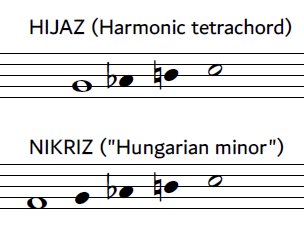
With biographical information about the supposed composer, Fuad Aga, remaining sparse, it is impossible to determine whether the choice of the mode Homayun (“royal, imperial”) was deliberately made to suit the occasion. This compound mode is found in the musical systems of numerous Middle Eastern maqam traditions, which share certain basic characteristics while also exhibiting significant regional differences. One of its primary tonal characteristics is a temporary ambiguity of the tonal center between two adjacent degrees, which can appear as either the first and second degrees in the jins Nikriz (“Hungarian minor”), or the seventh and first degrees in the jins Hijaz (“harmonic scale”), with the cadence ultimately confirming HIJAZ as the primary jins of the mode.
This ambiguous flavor is ubiquitous in Balkan folk music and is clearly apparent in the opening phrase of Nizamski rastanak, as well as in the cadences of the subsequent phrases. However, if the melody is indeed connected with the Ottoman military-band tradition, we might reasonably expect some closer parallels to the melodic motives of the Turkish makam repertoire of the period, which was comparatively well documented and preserved in notation. No such parallels can be identified in the notated compositions set in Turkish makam Hümayun (a.k.a. Hicaz Hümayun), apart from another basic shared characteristic: the fourth degree of the Hijaz tetrachord becoming the first degree of the minor pentachord as the mode shifts into the higher register. Nor are such parallels apparent in other related Turkish makams such as Hicaz, Nikriz, and Neveser.
However, a comparison with geographically more distant modes of the same name, found in the classical musical traditions of Iran and Iraq, reveals a number of similarities that are unlikely to all be purely coincidental. We shall therefore closely examine the modal and melodic structures of Dastgāh-e Homāyun in Persian classical music and Maqām Hūmayūn of the Iraqi maqām tradition, and compare their respective melodic characteristics with those found in Nizamski rastanak.
For the following analysis, we will draw on Hormoz Farhat’s theoretical description of Dastgāh-e Homāyun in The Dastgah Concept in Persian Music (1990) as a primary source on the Persian version of the mode, and Rob Simms’ analysis of Maqām Hūmayūn in The Repertoire of Iraqi Maqam (2004) as a source for the Iraqi version. We will additionally refer to Kioumars Poorhaydari’s “Historical Examination and Theoretical Analysis of Maqām Humāyūn in Persian Art Music,” published in Music Theory Spectrum 47/2 (2025), and consult four representative audio recordings, two from each country:
Mahmoud Karimi (1927–1984), Avaz Course: Vocal Radif of Persian Classical Music, Vol. 4, Mahoor Institute of Culture & Arts, 2003;
Mohammad Reza Shajarian (1940–2020), “Avaz No. 5: Saz-o Avaz Homayun – Agar Morad-e To Ey Dust Namoradi-ye Mast,” a 2011 live performance at Sheikh Rashid Hall in Dubai, with the Shahnaz Ensemble;
Farida Mohammad Ali (b. 1963), “Maqam Hamayoun & Pastah Min Farktak Lel Youm,” with the Iraqi Maqam Ensemble, La Voix de la Mésopotamie, 2003;
Abdul Rahman Khader (1925–1984), Maqam Hamyoun, an archival recording later reissued on Iraqi Maqamat, Vol. 2.
Here, a brief introduction into the basics of maqām/dastgāh theory may be necessary: Both the Persian dastgāh and the Iraqi maqām are systems in which performance is based on a combination of established melodic structures and improvisation. Rather than prescribing a fixed sequence of notes or a complete composition, they provide a repertoire of short and extended melodic patterns that performers use as the basis for interpretation and improvisation. In Iran, these patterns are known as guše, while in Iraqi maqām they are commonly referred to as qitʿa (plural qitʿāt). Performers navigate between these established melodic units, developing, extending, and connecting them according to the conventions of the particular dastgāh or maqām, so that each performance combines recognizable melodic material with considerable freedom in its realization.
At the structural level, both these systems adhere to the so-called maqām principle, where small groups of tones serve as the basic building blocks of the larger modal system. These tone-groups are commonly referred to by the Arabic term jins, pl. ajnas (or its Farsi equivalent dang, pl. dang-ha), a concept that is functionally very close to the tetrachord in Western music theory (except that it is not restricted to four-note units and also comprises trichords and pentachords). Individual melodic units (guše or qitʿa) may employ these tone groups over different tonal ranges and with different distributions of melodic importance among their constituent tones. Persian theory makes these distinctions particularly explicit, identifying: Š (Šāhed, “witness”), the most prominent tone; I (Ist), a temporary point of tonal rest, or “false” finalis; Ā (Āqāz, “initialis”), the tone from which the melody begins but to which it rarely returns later; M (motaghayer), a variable tone whose pitch may change according to the direction of melodic movement (sharp when leaning upwards, flat in descent); and F (finalis), the cadential or ending tone (more common marking would be K for Khātimih, but Farhat opts for the latin term here). Thus, the same group of pitches can assume different melodic functions depending on the particular guše or qitʿa in which it occurs.
The melodic development begins with the section called Daramad (or Tahrir in Iraq, not to be confused with the type of vocal ornament also known as tahrir in Iranian music). In Daramad/Tahrir, the principal tonal and emotional content of the mode is introduced through the tone group of the main jins/dang. Here are the tones and functions given by Farhat for Daramad-e Homāyun (the letters under the staff signify the interval size: whole- and semi-tone, large and small neutral tone, and a neutral tone-and-a-half):

Meanwhile, Simms identifies F, G, and B♮ as the primary focal tones of Hūmayūn’s Tahrir, with A♭ occurring frequently as a passing tone. He also notes that the sequence E–F–G–A♭ appears in the instrumental accompaniment as a direct reference to, and quotation of, the Persian Homāyun. The same sequence of tones is heard in rapid succession at the opening of the Persian Daramad in each of the recordings, after which the Aqad (note E) is never heard again. Its highly characteristic profile, together with the fact that it is recognizable enough to be explicitly quoted in the Iraqi tradition, makes it reasonable to speak of this 4-note sequence as a kind of leitmotif: a distinctive melodic marker of Daramad-e Homāyun.
At the conclusion of Daramad/Tahrir, G is established as the tonal center, approached in the cadence through F and A♭. The main difference in the Persian version is the greater prominence of A♭, making the eventual cadence on G more of a surprise than in the Iraqi version.
Now that G has been established as the tonal center and the base of the Hijaz tetrachord, the first development usually shifts the tonal focus to C, the upper pole of the tetrachord (G-A♭-B-C), as heard in the qitʿa Hijaz Gharib and the guše Čakavak, which further leads to C becoming the tonal center of a compound tone group formed by a Hijaz tetrachord on G and a minor tetrachord on C. This is how the melody shifts into the higher register. This combination is called Esfahan in Persian theory and Hijaz Diwan in the Iraqi maqām (note: the example is transposed one octave lower in the book than the previous one)

Another characteristic Persian guše found in practically every Homāyun rendition is the so-called Bīdād, which occurs after the tonal center has shifted to the fourth degree (C) and temporarily emphasizes the note above it (D), as if to give it a dominant function. Here is how Farhat defines the functions within Bīdād, with the āqāz (initialis) on B♮, the ist (temporary finalis) on C, and the šāhed (witness) or dominant on D

Apart from this main tonal material of ESFAHAN/HIJAZ DIWAN, further short excursions into other ajnas/dang-hā will typically occur throughout the performance. A map of the tones and modulations commonly found within Homāyun may therefore be represented as follows:
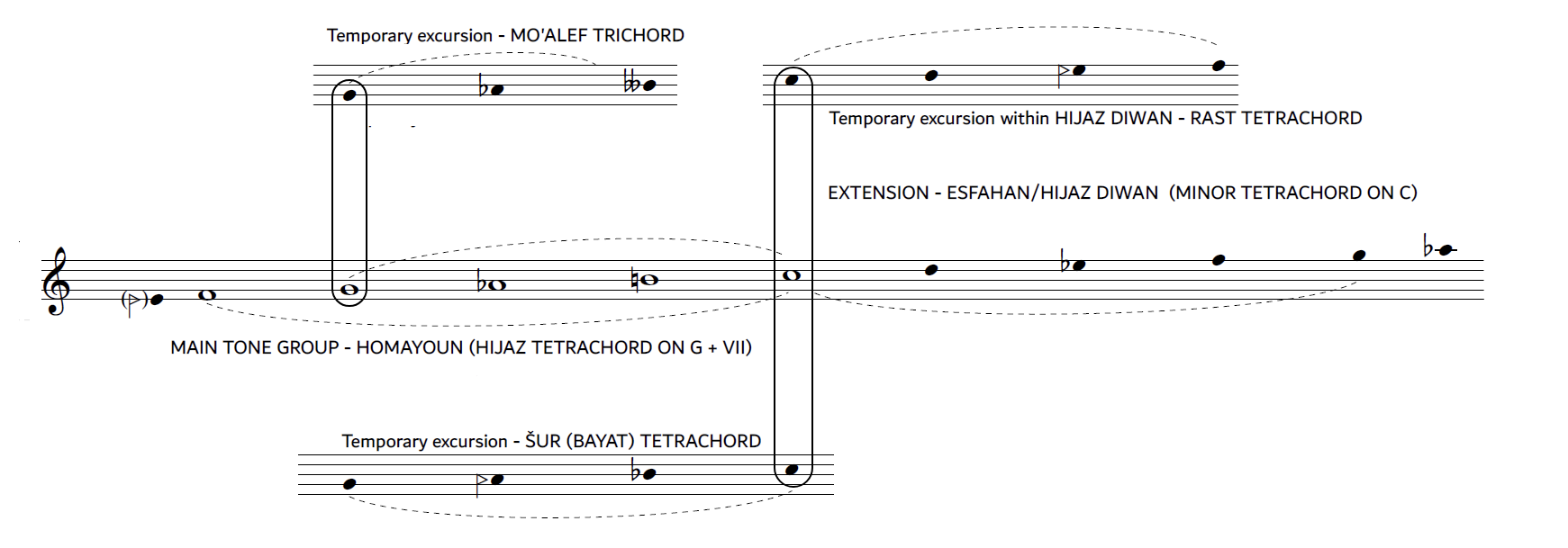
Note on tuning: while Persian theoretical sources prescribe a neutral interval (closer to a three-quarter tone) between the first and second degrees (G-A♭), in practice, at least in the vocal performance examined here, this interval is only slightly larger than a semitone and is closer to the Turkish küçük mücennep (ca. 112 cents). Consequently, A♭ is notated in the same way as in Iraqi maqām. This note would be played considerably higher when forming part of an excursion into Bayāt, which does occur in Iraqi maqām. However, since no such situation is to be found in Nizamski rastanak, this distinction is not relevant to the present analysis.
Now, let’s return and take a look at the melody of Nizamski rastanak and trace some of the defining melodic characteristics of Persian and Iraqi Homayun:
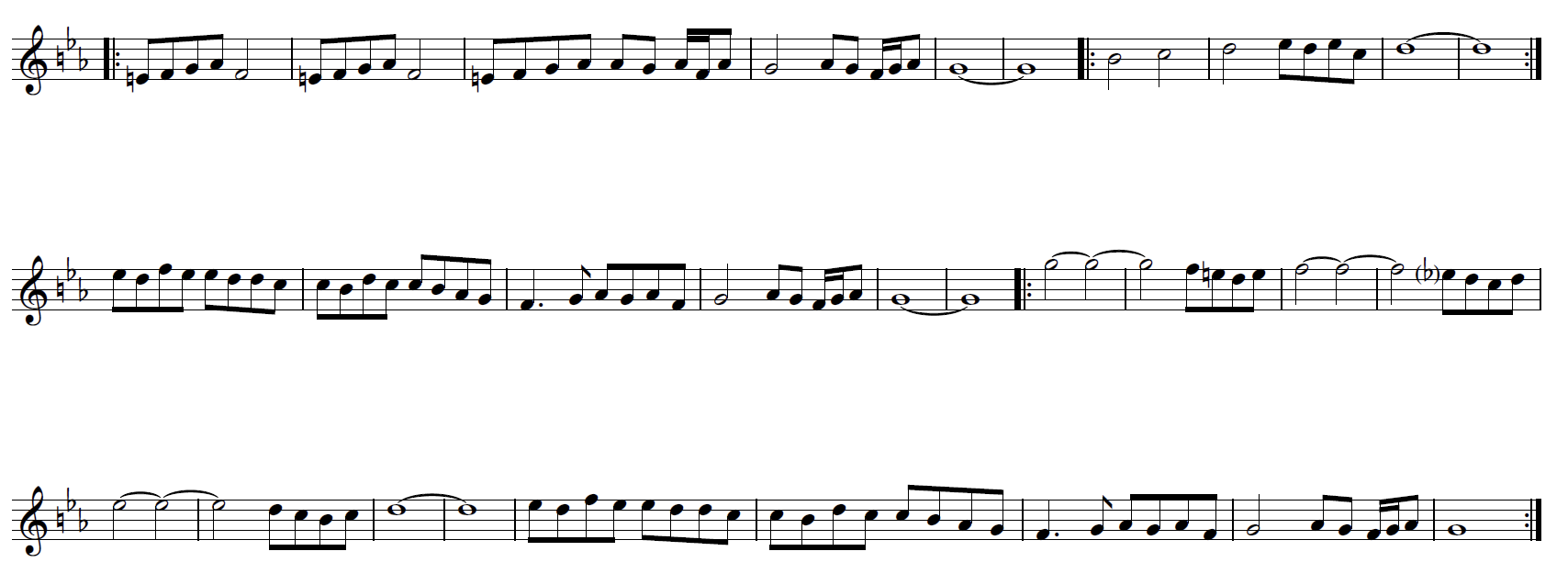
As a metered composition that is set to follow a text (at least according to some accounts), Nizamski rastanak naturally contains a number of rhythmic repetitions and recurring patterns that can obscure the underlying melodic structures. These repetitions should not necessarily be understood as distinct melodic events. For the purposes of this analysis, it is therefore necessary to look beyond this surface-level repetition and focus instead on the deeper structure of the recurring melodic archetypes.
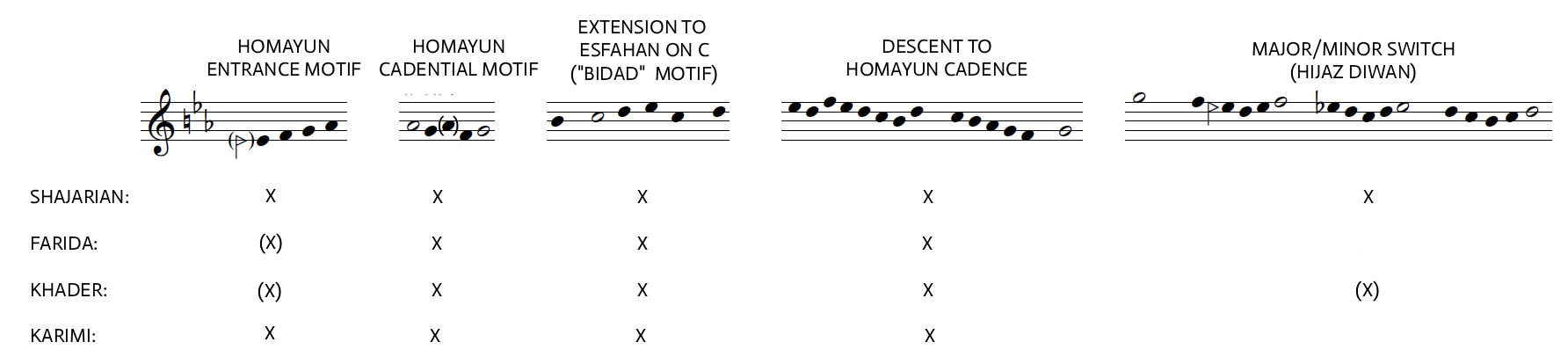
Several such archetypes can be identified as meaningful and structurally significant: To begin, the opening sequence E-F-G-A♭ establishes a characteristic Daramad pattern, after which the low E does not reappear in another melodic function until the conclusion of the piece. The Homayun cadence on G, approached through F and A♭, is then established at the end of the first section and re-established after each subsequent section. In the second section, we find a close representation of the guše Bīdād, with B as initialis and D as the principal focal tone, while C still retains the feeling of the tonal center.
From the highest register of the tessitura, which in maqām practice is generally reserved for the emotional climax of the performance (awj), we find a characteristic stepwise descent down a full octave, reminescent of the Persian guše Rāje, however here we also encounter the foreign tone E♮, appearing in a passing-tone function. This closely resembles a feature of the Iraqi qitʿa Hijaz Diwan, in which the minor pentachord (Nahawand) occasionally shifts to a neutral-major pentachord (Rast). In equal-tempered approximations of maqām, such as those found across the Balkans and the former Soviet republics, the neutral third of Rast is generally rendered as a major third. Consequently, when Hijaz Diwan is rendered in twelve-tone equal temperament, this shift produces precisely the E♮ found in Nizamski rastanak. While Farhat’s description of Dastgāh-e Homāyun doesn’t mention the possibility of raising the minor third during such descent from G, traces of E♮ can nevertheless be heard in a similar ornamental function (coming from- and returning to F) at around the 10:00 mark in the Shajarian recording. This is supported by Poorhaydari’s comparative overview of theoretical models and performance transcriptions of Humāyun. According to his analysis, the sixth degree (E♭ or E𝄳/E♮) functions as an M - motaghayer, with its intonation varying according to its position relative to the tonal center: it is lowered when occurring above the tonal center and raised when occurring below it (it is given as E𝄳/E♮ because the exact tuning of the raised version seems to be open to interpretation: it is either a neutral, just, or major third above C). Thus, with G as the tonal center, the sixth degree would be rendered as E𝄳/E♮, whereas if the tonal center is C, it would be rendered as E♭. In this sense, the reappearance of E♭ in the 5th measure can be understood as a sign that the tonal center is shifting from the awj on G back toward the middle register around C
Here is a side-by-side comparison of the five mode-defining melodic archetypes identified in the song and their presence in the Iranian and Iraqi recordings. Markings in parentheses (X) indicate that the archetype is heard in the instrumental accompaniment but not in the vocal part:
Another foreign tone heard in some renditions of Nizamski rastanak is B♭, appearing as a neighbor tone to A♭ in the first section. Carevac remains on A♭ in his solo recording, which is also replicated in this recording by the Svilen Konac ensemble, while the written transcription performed by the Radio Belgrade Folk Orchestra includes the B♭, as does Safet Isović’s Sevdah version. Another commonly heard variant is a short grace note on B♭ followed immediately by a re-establishment of the jins Hijaz (C-B-A♭-G), as heard in this recording by the Fejat Sejdić Brass Band.
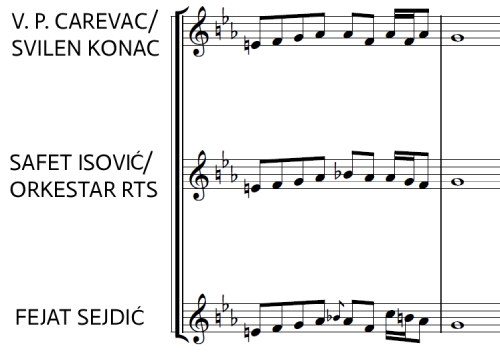
In neither of these versions does the variation challenge the primacy of the Homāyun cadential sequence. A transcription of Tahrir Homāyun featured in Simms’ book, as performed by Shaʿoubi Ibrahim, one of the foremost pedagogues of Iraqi maqām, likewise notes the possibility of replacing B♮ with B♭ on its very first appearance (where it functions as a neighbor tone to A♭). A♭, F, and G nevertheless remain the central tones of the opening section.
While we were able to demonstrate some striking parallels in the examples above, it is still hard to tell what conclusions can be drawn from this, as every answer seems to raise additional questions.
From a strictly tribalist perspective that is often adopted in these inquiries, one may be tempted to ask questions such as: Was Fuad Aga actually an Iraqi or Iranian expat in Sarajevo who snuck in references to the Homayun mode from his homeland as a nod to the Imperial flag-raising occasion? Or, first of all: how can we be sure that the melody we know today via Carevac is at all similar to the supposed original composed in 1864, when even the Zerbes’ version from 1918 was so fundamentally different? Perhaps Carevac was the Iranian? Or was there a 19th-century Balkan musician who traveled to Iran and fathered the maqam Homayun as it is known today? These sorts of pseudo-historical inventions tend to get particularly popular around here
That whole line of thinking, however, rests on a fundamentally flawed premise. The melodic language of Maqām emerged through more than a millennium of exchange and coexistence among different musical cultures, and its historical development predates most of the modern nation-states that now seek to break it up into pieces and claim particular elements as their own. Being unaware of this basic fact (or: choosing to ignore it deliberately) can only lead to more toxic debates and pseudohistorical interpretations.
Still, these exchanges do usually tend to take place linearly, from neighbor to neighbor, so how do we account for the huge geographical gap, the size of the entire country of Turkey? (not Bulgaria, though; since the melodies based around the similar ambiguous Nikriz/Hijaz cadence are just as widespread there as they are across the Western Balkans)
How did it come to the examples found in the historical and modern Turkish makam being so different from the Balkan and West Asian examples discussed here? We could look for clues at the mutual origin of both traditions, the medieval maqam, as documented by the (predominantly) Persian Systematist theorists. Poorhaydari documents a significant difference between the conception of maqām Humāyūn , and its later form within the relatively modern dastgāh system, which took shape in the nineteenth century as part of a broader reorientation toward a distinctly Iranian musical identity, incorporating a wider range of indigenous and regional musical materials alongside the older Arab-influenced courtly repertoire. The problem stems from the substantial gap in theoretical documentation of Persian modal practice during the several centuries of the Safavid rule. Ottoman musical theory, however, represents a comparatively continuous lineage from the medieval Systematist times, while preserving a substantial body of written musical material, including notated compositions in Hicaz Hümayun. Given this difference, could the Turkish version present a preserved modal structure of the earlier “classical maqām” that is no longer apparent in the modern Persian dastgāh?
(note: The Turkish TDV İslâm Ansiklopedisi entry on “Hümâyun” explicitly states that the makam is “also called Hicaz Hümâyun,” indicating that these are two interchangeable names for the same makam)
Looking at the tarākīb (combinations of jins) described in the medieval theoretical sources and compiled by Poorhaydari, we find that several medieval accounts present Humāyūn as a combination of a Rast tetrachord in the lower register and a Nowruz/Bayāt tetrachord, as opposed to the Hijaz + Nahawand (minor) combination characteristic of the contemporary Persian and Iraqi version.
However, Turkish Hümâyun has also been documented as having that exact same Hijaz + Nahawand (minor) structure for as far back as the surviving documents date (Hümâyun isn’t notated in the early treatises by Ali Ufki and Cantemir, but appears in Hızır Ağa’s 18th-century Tefhîmü’l-makāmât). Therefore, the 18th-century Turkish makam version is still closer to the contemporary Persian Humāyūn and Iraqi Hūmayūn than to the tarākīb configurations recorded by the medieval Systematists.
Nevertheless, the vast differences in melodic material and seyr (melodic progression throughout the registers) persist between the two. For instance, in written compositions in Turkish Hümâyun, we often find the melody typically beginning in the upper register. While these compositions ultimately cadence on the first degree of the lower Hijaz tetrachord, they make little use of the seventh degree below the tonic, at least not enough to produce the characteristic tonal ambiguity that is so ubiquitous in Balkan melodies where the seventh degree (F) is harmonized as a F-minor tonic, while the final cadence on G is accompanied with an unresolved dominant C-major.
Perhaps it is partly due to this harmonization practice that Balkan ears are more likely to perceive the seventh degree as a (temporary) tonic?
To find an answer to that, let us look at yet another regional version which we have not mentioned so far, due to its close proximity to the Persian dastgāh version: the Azerbaijani Mugham Homayun. Here is a full performance (albeit in poor audio quality) of a classical form of Homayun given by the Mugham grandmaster Alim Qasimov. However, an interesting observation can be made by looking specifically at the musical form of Təsnif (composed, metered vocal songs based on the modal material of a classical mugham and named after it), where the instrumental accompaniment is often lightly harmonized. As we can hear in this recording of Rübabə Muradova, the Homayun Təsnif is harmonized with the VII (F) as the F-minor tonic, just as is the case in the Balkans. We can even observe that the cadential tone, the unresolved dominant G, does in fact (almost sneakily) resolve back to F in the final second. It is far from a convincing cadence, but F still “gets the last word.” The same cadence can be heard in these examples by Qulu Əsgərov and Ehtiram Hüseynov. This suggests that the Hijaz-Nikriz ambiguity is not unique to the Balkan perception, but can also be observed in other regional manifestations of Hümayun, despite its apparent absence from the Turkish classical repertoire.
This is probably as far as we can take the inquiry using the evidence provided by the classical maqām traditions. The missing link may lie in the folk repertoires of Anatolia and other adjacent regions between Iran and the western Balkans, where melodies have circulated through migration, oral transmission, and the longstanding traditions of traveling musicians and bards, often without being tied to a formal modal system or preserved in written sources. Unlike the codified and neatly documented tradition of Turkish makam, such repertoires are much more difficult to trace across historical and geographical boundaries. At this point, therefore, the question remains open. Perhaps the structure identified here will be recognizable to someone familiar with folk melodies of these regions, so we can at least add another piece to this puzzle.
PS. for those who wandered why the same word appears in the title of the Bosnian war song and as a tonal function in Persian music theory, here is an etymological explanation according to wikipedia:
In everyday Arabic and Persian, Shahed (شاهد) simply means an observer, testifier, or a legal witness. However, it is closely related to a twin word from the same root: Shaheed (شَهِيد). Over centuries, Shaheed evolved to mean martyr - someone who dies for their faith or country. This shift closely mirrors the ancient Greek word martys (μάرτυς), which originally meant witness but came to mean martyr because a martyr bears witness to their beliefs through their final sacrifice