Maqām-related melodic language has occupied a complex place within the genre of “classical” or European art music: either as a marker of cultural identity (of oneself or the other), or an abstracted source of compositional innovation. The survey of these intersections could also have begun with the earlier periods, as references to Middle Eastern and, specifically, Ottoman music in European art music long predate the Romantic era. In the Baroque and Classical styles, however, such references relied on the topicality of the exotic instrumentation and rhythmic elements of Ottoman military-band music (the first point of reference for many European composers of that time period), rather than on sustained engagement with the melodic language of maqām. It was only in the nineteenth century that the melodic elements specifically began to assume a more prominent role in art music.
One important strand of this history is the exoticist adoption of the Hijaz mode by Western European composers, with Camille Saint-Saëns among its most prominent practitioners. However, as discussed in the previous article on meanings, this process was mostly limited to the use of a specific set of pitches (the harmonic tetrachord). In Russian Romanticism, the relationship with Eastern modal traditions was much more layered, since maqām itself already existed as a traditional practice within the borders of the Russian empire.
With roots in the compositions of Mikhail Glinka, and taking shape with Mily Balakirev and the composers of the Russian Five aka the Mighty Handful (known in Russian as moguchaya kuchka, or simply kuchka), maqām-related melodic language became entangled with the formation of a distinct Russian musical identity. In this strand of Orientalism, such motifs could be read as referring to the exotic Other, yet they could also be regarded as an integral part of Russianness. This ambivalence makes the Russian tradition a particularly revealing starting point for those who attempt to examine the place of maqām in European art music.
1. Maqam and Russian Orientalism
For a prime example of Russian musical Orientalism, one need look no further than Alexander Borodin’s Prince Igor, one of the best-known and most frequently performed Russian operas of all time. Richard Taruskin argues that the opposition between the Russian and the Oriental in Prince Igor legitimizes imperial expansion by presenting the Russians as purposeful and morally committed, in contrast to the primitive and passive Polovtsians. He reads the opera’s departures from its source narrative (a twelfth-century epic poem), including its Crusader-like portrayal of Igor, against the background of nineteenth-century Russian expansion into Central Asia. In his article “Entoiling the Falconet,” he also draws attention to the elevation of Konchakovna, daughter of the Polovtsian khan, from a relatively minor figure in the source material to one of the opera’s principal female characters. For Taruskin, she embodies a familiar Orientalist trope: the eroticized Oriental seductress whose powers of enchantment divert the captured Prince Vladimir, Igor’s son, from his obligations to his people.
Taruskin further identifies a characteristic melodic movement that he calls the “nega motif”: 5 - ♯5 - 6 - ♭6 - 5, typically set over a tonic drone and sometimes appearing in the inner voices of the harmonic texture. The Russian word nega (не́га) denotes sensual pleasure and tenderness, with connotations of pampering or indulgence. Taruskin interprets the figure as a defining musical sign of Russian Orientalism, associated not merely with a generalized Eastern exoticism but specifically with the “swaying”, eroticized femininity of the Orientalist imagination. He traces its use from Glinka through the composers of the Russian Five and beyond, extending the definition to include even the love theme from Tchaikovsky’s Romeo and Juliet, where the motif is only found obscured into the fragmented inner voices of harmonic progression. He grounds this reading in the correspondence between Balakirev and Tchaikovsky, in which Balakirev praised the expressiveness of the theme but also remarked that it conveyed erotic desire more than pure love, and that Romeo and Juliet should sound “more Italian, and less like Persian lovers.”
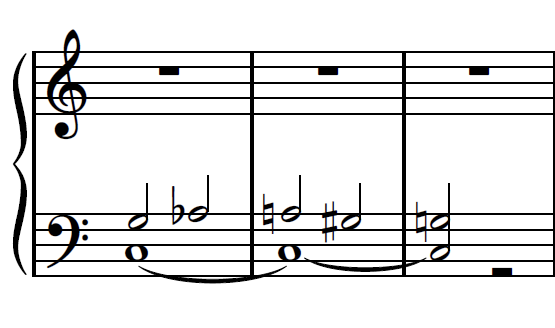
Taruskin’s nega motif
Marina Frolova-Walker points to the cherry-picking in Taruskin’s interpretations and demonstrates extensive musical evidence that the same nega motif also appears in completely unrelated contexts, including Russian romances, comic scenes of drunkenness, and music expressing grief. Even in Prince Igor itself, the figure is neither exclusive to the Polovtsian scenes nor consistently present where Taruskin’s interpretation would lead us to expect it. Frolova-Walker therefore rejects its identification as a musical sign of nega, while acknowledging that Balakirev and the Kuchka composers were largely responsible for popularizing the motif in Russian Romantic music. She consequently proposes the more neutral term “Kuchka pattern,” a general, unmarked device of their style. For listeners today, in the age of the omnipresent Hollywood-codes, the 5 - ♯5 - 6 - ♭6 - 5 motion might be recognized primarily as the James Bond theme (quite the polar opposite of the eroticized Oriental feminine figure).
More recent research suggests that the Orientalism of the Russian Five may not have served to mark the inferiority of the Other, as would be expected from a purely postcolonial perspective. Even Taruskin himself does not deny the salient position of the Orientalist elements in Prince Igor. Responding to Edward Rothstein’s defense that “Borodin created some of his most beautiful melodies for them,” he retorts: “Yes, that is just the trouble, isn’t it?”
In this view, the primary goal of the Russian Five’s Orientalism was to demonstrate/codify a distinct Russian identity as a synthesis of Western and Oriental elements in equal measure, rather than presenting a distinction between “us” and “them.” Frolova-Walker traces the Kuchka Orientalism back to Mily Balakirev’s trips to the Caucasus, where he collected melodies and presented them to his colleagues upon his return. Balakirev subsequently adopted this language as a core part of his own composition. This second-hand exposure was still enough to influence strongly the musical language of the other Kuchka composers, who viewed Balakirev as something of a mentor/guru. The shift was especially pronounced in Borodin, whose early works (predating this encounter) were dominated by the influence of Schumann and Mendelssohn. The Oriental elements in Borodin’s Prince Igor are evidently not confined to the scenes depicting the Polovtsian tribe. In fact, one of the most obviously oriental melodies in the entire opera is “Yaroslavna’s lament”, which further complicates Taruskin’s propositions: in this strict binary view, Yaroslavna, the Russian wife of Prince Igor and mother of Vladimir, would have represented the epitome of Rusianness, and traditional family values, standing in opposition to the sexualized female characters of the “savage” Polovtsian tribe.
Furthermore, while Taruskin claims that Borodin’s changes to the libretto of the original epic poem served an agenda of subjugating the Other, David Schimmelpenninck van der Oye presents arguments to the contrary, pointing to the differences between Borodin’s final version of the libretto and the scenario drafted by the music critic Vladimir Stasov, the chief ideologue of the Kuchka, who had initially proposed the subject to the composer:
“If Stasov emphasized the conflict between the Rus and their alien foes, Borodin toned them down. Thus he deleted a violent fit of rage by the khan and instead stressed his chivalry. Stasov’s scenario had also included a group of foreign merchants in Putivl who join Prince Galitskii’s reign of debauchery after Igor leaves. But in Borodin’s libretto the usurpers are all native Russians. And Borodin ends his opera differently. According to Stasov, the formulaic happy-ending nuptials had Prince Igor’s son return home with the khan’s daughter, where the two would be joined in a Christian ceremony and presumably live happily ever after as Konchakova was fully assimilated into the Rus. By contrast, Borodin’s Vladimir Igor’evich does not escape from the Polovtsian camp and instead settles down as Konchak’s son-in-law.
Like its composer, who had both European and Asian blood, Prince Igor’s West and East are two sides of the same coin. His Asia is not a Saidian Other, but the Christian Rus’s alter ego. Together they created Russia; both Prince Igor and Khan Konchak are the empire’s ancestors. ‘Nowhere [in the sources] was there any mention of a decisive victory over the Polovtsians’ Borodin reminds us. The composer clearly was no musical Skobelev, wielding bass clef and quarter time instead of shashka and knout to subjugate the Orient. As he saw it, Russia did not vanquish the Orient but joined with it, much as the Christian Prince Vladimir Igor’evich was united to the pagan khan’s daughter Konchakova in marriage.
Borodin had remarked about his composition that it was ‘essentially a national opera,’ written for Russians who wanted to see the origins of their nationality brought back to life on stage.”
Adalyat Issiyeva points out that while members of the Kuchka may have sincerely believed they were engaging with a shared, native Eurasian heritage, from the perspective of non-Russian imperial subjects, the asymmetrical power dynamic behind their collecting, reharmonizing, and orchestrating of Eastern musical motifs was still ethically problematic and amounted to cultural appropriation. Both Issiyeva and Taruskin also mention Balakirev’s “Georgian Song” as an example of the typical carelessness with which the Orientalist art treats its subject material: even though Balakirev traveled to the Caucasus and collected the melodies himself, and so must have been aware of their regional specificities, he seemed to care little that the motifs in the piece are closer to Armenian or Persian melodies than to anything found in Georgia, the artistic effect mattered more than authenticity.
Issiyeva’s persuasive critique applies quite directly to Prince Igor as well, yet Borodin’s specific approach deserves a more detailed assessment. His engagement with Eastern musical sources was unusually extensive for a European composer of his time, complicating any simple accusation of superficial exoticism. It is tempting to link this thoroughness to his primary profession (Borodin was a working chemist, trained in the habits of scientific rigor). Schimmelpenninck van der Oye documents that Borodin undertook research trips to the regions where the events of the source material, the twelfth-century epic poem The Lay of Igor’s Campaign, were said to have taken place. With the help of a Hungarian scholar, he sought out the descendants of the Polovtsians, who had disappeared from Russia as a distinct people but survived as a community in Hungary. He also obtained transcriptions of Arabic, predominantly Tunisian, music from Paris in order to study how Eastern melody is constructed (much as we are doing today on this blog). Of course, these methods fall far below the standards of modern ethnomusicology, but in all fairness, they do predate the emergence of the discipline itself and, for their time, have few parallels among his contemporaries in European art music.
One could also interpret the polarity between European and Oriental sides of Borodin’s Russianness as the contrast between the Western harmonic (vertical, static) and Eastern modal (horizontal, kinetic) aspects of music. Although Borodin’s approach of studying Tunisian melodic language in order to represent a culture from the Pontic-Caspian steppe may seem absurd at first glance, the method is more defensible than it first appears when viewed from the perspective of the transcultural maqām research behind this series. For instance, in Konchakovna’s Cavatina (from the Act II of Prince Igor), we can observe clear parallels to the maqām principle of melodic building blocks, the seyr leading through blocks up to the awj, as well as other transcultural elements of maqām melody:
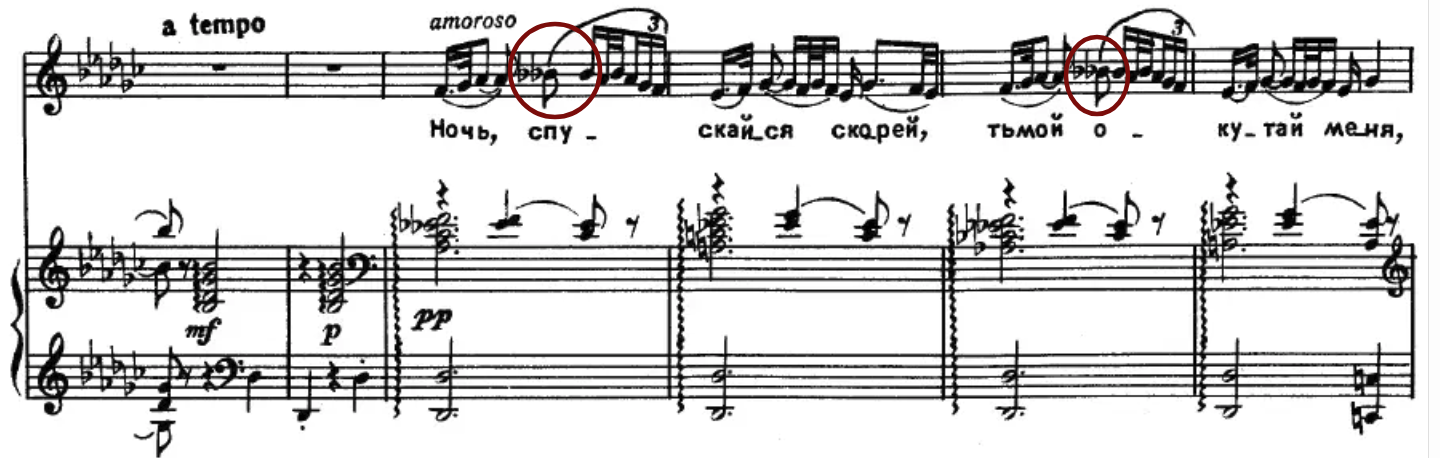
Gestural Saba-IV tones in the opening motif of Konchakovna’s Cavatina
2. Maqam and Soviet Self-Exoticism
Above we followed the use of maqām-related melodic language through Russian Orientalism, where the Eastern Other was staged by an imperial center that also claimed the East as part of itself. This part turns to the Soviet republics where those Eastern cultures were rooted, with a particular focus on Azerbaijan, which can serve as a bellwether case for subsequent developments in other Soviet Asian republics. The territory that was first ruled by the Russian Empire and later became the Azerbaijan SSR (today’s independent state of Azerbaijan) is only one of two main areas of Azerbaijani settlement, since, by most estimates, more ethnic Azerbaijanis live in northwestern Iran than in the republic itself. Within the Azerbaijani national canon as we know it today, maqām (Azer: Mugham; bearing numerous structural similarities to the Persian dastgāh) represents the central musical tradition.
The relationship of the composers from Eastern Soviet nations to their folk material, and to musical identity, was a complicated one. A central figure here is Uzeyir Hajibeyov, whom we have already mentioned several times in this series. He wrote several mugham-operas, the first of which, Leyli and Majnun, dates from as early as 1908, but his greatest success came with Keroglu in 1937. The developments between these two works present a good example of the societal shifts of the period. As Frolova-Walker reports, from the late imperial period and well into the Soviet era, generations of composers from the Eastern ethnicities studied in St. Petersburg and Moscow, becoming immersed in the Russian classical music scene, including its Orientalist repertoire:
Westerners approaching the Stalin-era music of the [eastern non-russian] republics should also take care to remember a further twist in the history of Russian Orientalism, namely that Western reception of Russian music, from Diaghilev onwards, failed to see the distinction between the “Russian” and the “Oriental” styles. This was partly because Western audiences lacked the experience of their Russian counterparts - they were unable to trace any Russian elements back to Glinka, and they had never been able to build up a repertoire of associations through operas that unmistakably presented the opposition between the Russian and the Oriental on stage. Nevertheless, the first misleading impressions could have been overcome with time, if it were not for the fact that Western audiences received Russian music itself as something exotic - as a product of the Orient. Western listeners, to the extent that they lack the knowledge or desire to overcome this tradition of misinterpretation, are therefore twice removed from the perceptions of the young composers of the republics when they were confronted by Russian Orientalism during their conservatoire training in Moscow or Leningrad. These composers were able to see on the operatic stage the lurid fantasy worlds, and hear the associated musical idioms that were supposed to represent their homelands. Many - most prominently Khachaturian - were apparently content to accept the entire package of Russian Orientalism.
In Azerbaijan the question soon became a matter of official cultural policy. After the establishment of Soviet rule, the People’s Commissar of Education, Mustafa Kuliyev, began a series of reforms. He called for abandoning Persian cultural influences and modernizing the operatic language along Western and Russian models. Among his targets were the early mugham operas, such as Hajibeyov’s Leyli and Majnun, in which traditional performers sang and played in traditional non-tempered tuning, a practice the reforms regarded as something to be overcome. The attitude behind such reforms was not imposed from outside alone. Inna Naroditskaya documents how Azerbaijani intellectuals themselves otherized mugham and denied its Azerbaijani identity, going so far as to invent alternative names for it:
The use of expressions such as “Eastern orchestra,” “Eastern concert,” “Muslim language,” “Muslim stage,” or “Tatar amateurs,” applied to long-established musical traditions, manifests an obscure notion of the ethnic and cultural identity of Azerbaijanians. This attitude, typical of cosmopolitan Baku, in many respects defined the viewpoint of Azerbaijanian intellectuals who laid the foundation of modern Azerbaijanian culture.
It was in this climate that Reinhold Glière, one of the most respected post-Kuchka Russian composers, was brought in from Moscow to write a national opera, Shahsenem (1927), in the Russian Orientalist mould. Uzeyir Hajibeyov was critical of the result and of the style it represented:
Augmented seconds in music, images of the nightingale and rose in poetry, flower-bud ornaments in the visual arts, multi-coloured costumes and ceremonious bows in the theatre: all this pseudo-Eastern style can only jar on an Eastern people and violate their spirit and tastes.
Hajibeyov’s answer to Shahsenem was Keroglu, which was meant to be his magnum opus: a national opera more faithful to Azerbaijani music than Glière’s Orientalist work. Where his early operas had let mugham and the Western orchestra stand side by side, Keroglu set out to synthesize the two. In practice, he ran into difficulties trying to fit essential features of mugham into the framework of Western opera, and the finished score became a record of compromise, not only musical but also intellectual, since in the process Hajibeyov gave up positions he had previously defended.
Frolova-Walker documents a sharp turn in Hajibeyov’s claims about tuning. He had initially argued that Azerbaijani music is bound to the seventeen-tone division of the octave on the tar and is incompatible with twelve-tone equal temperament. By this 1939 statement, however, he was already a well-positioned composer in Soviet cultural circles, and his views appear to have changed:
I myself ignore the groundless claims of some musicologists that the international musical alphabet is not sufficient for the representation of the characteristics of Azerbaijani music. This opinion is wrong, since the chromatic scale satisfies us completely.
The same shift can be traced in harmony. Hajibeyov had earlier maintained that Azerbaijani monodic melodies could and should be harmonized, but only provided the chords were built to fit the tonality of the mode, which in his theory favored perfect fourths over the triads typical of Western harmony. Frolova-Walker shows, however, that the harmonic language of Keroglu comes much closer to Glière’s Shahsenem and adopts the Orientalist harmonic patterns established by the Kuchka. It also makes extensive use of the augmented second/harmonic tetrachord, which Hajibeyov had earlier explicitly rejected as a Western Orientalist device foreign to the Azerbaijani tradition.
In his later writings, Hajibeyov gives the harmonic tetrachord a central role within the national canon, naming mugham Čahargah, an equal tempered approximation of the Persian Čahārgāh (see: 12 Flavors), as one of the primary modes, and assigns it a special significance as the embodiment of heroism and the struggle for one’s homeland. The association with heroism also appears in Persian sources on Čahārgāh, whereas the struggle for the homeland is Hajibeyov’s Azerbaijan-specific addition (Note: Hajibeyov’s Čahargah corresponds directly to what we have called Hijaz, or Hollywood Hijaz, in the previous articles. This is a typical “false friends” situation in the linguistics of the maqām world: in the Persian and Azerbaijani traditions, the term Hijaz (Azer: Hicaz) exists, but refers to a different, unrelated modal structure in the flavor of Husseini/Šur).
Hajibeyov’s compromise has reflected the logic of Soviet nationality policy. As Frolova-Walker observes, nationalism among the colonized peoples of an empire normally arises as opposition to imperial rule: a desire for economic and political independence, from which the various aspects of nationalist culture then follow. Stalin’s policy effectively reversed this order, granting the republics a nationalist culture while closing the door on the political and economic aspirations that would ordinarily have produced it.
However, this erosion of meaning, and Hajibeyov’s eventual submission to the dominant cultural ideology, should not lead us to underestimate the historical significance of his early Leyli and Majnun (1908) for the use of maqām within Western art-music frameworks. In this work the traditional mugham ensemble is not an ornamental addition to a Western opera, but its main carrier, while the orchestra and choir play secondary roles. Sanubar Bagirova describes Leyli and Majnun as a “gigantic mugham dastgah” in which the traditional parts are arranged according to a dramaturgy typical of Azerbaijani dastgah: a gradual increase of emotional tension. By building the opera on this structure, Hajibeyov preserved an essential feature of mugham, namely improvisation. The choice was also practical, since few of the musicians involved could read notation. As a result, the score is less a score in the usual sense than a set of directions: a working version of the poetic text, with indications of which mugham was to be performed to which segment of verse. Hajibeyov notated only the overture, the intermissions between the acts, and the song-like and dance-like episodes, including marches and waltzes. Mugham was therefore not adapted and reshaped to fit the mould of Western opera but was presented in its living form. This kind of direct, indexical presence of the source tradition would not become common in Western art music until much later, with the advent of postmodernism. Such revolutionary approach can also be seen as product of its specific time and place: Baku in the early twentieth century was an oil-boom city, with a rapidly growing, cosmopolitan population and wealthy local patrons, and this provided fertile ground for artistic experimentation. Some time later, the port of Baku was also the stage of Arseny Avraamov’s Symphony of Sirens, which used factory sirens, ship horns, and artillery as its instruments.
Keroglu, written fifteen years after the Symphony of Sirens, belonged to a different cultural order of the consolidated Stalinist state, in which such experimentation was no longer welcome and the national opera was expected to follow an approved model. Both Keroglu and Glière’s Shahsenem found wide acceptance in Moscow, and this updated Orientalist style was soon adopted across the republics as an acceptable way of creating national approximations. Frolova-Walker summarizes the result of this process:
Given the requirements of the task, the composers of the republics eventually had to settle for a combination of Orientalist conventions, together with some new conventions of their own, all overlaid upon already distorted versions of their own traditional melodies, adapted for Western instruments. Some Orientalist conventions were even found acceptable as reasonable approximations. […] Insofar as any non-Western music is poured into the moulds of Western institutions (whether opera houses, orchestras, harmony or equal temperament), it will have great trouble escaping the Orientalist legacy, whether the impulse is indigenous (as in the cases of Turkey and pre-’30s Azerbaijan) or external (as in the Stalin-era Caucasian and central Asian republics). The arbiters of Socialist Realism were shrewd enough to see that Bartók’s and Stravinsky’s approaches to folk music would subvert the national-music project, but this greatly narrowed the scope of legitimate artistic endeavour for the national composers of the republics. They were left with the Russian Orientalist classics, but long after that tradition had grown stale, and worse, they generally lacked the technical expertise of Russian Kuchka epigones such as Glière. Their knowledge of local musical traditions sometimes led them to conduct valuable ethnomusicological work, but this knowledge usually went to waste because it was not assimilable to the required Western framework.
Therefore, across the Soviet republics, the pattern we have seen in Azerbaijan repeated itself: national styles were built on a canonized version of the “national folk music,” treated through the filter of Russian Orientalism. A notable special case are the Uyghur composers, whose national music was not that of a republic of their own but of a community living inside other republics, above all in Soviet Kazakhstan. Even so, it was embraced and institutionally supported in Almaty and, to a lesser extent, in other Soviet Central Asian cities.
Clark and Kamalov document how the 1962 exodus of more than 60,000 Uyghurs and Kazakhs from Xinjiang into Soviet Kazakhstan moved Moscow to pivot in its stance toward the Uyghur minority. To counter Beijing’s assimilationist policies, the Kremlin heavily funded Soviet Uyghur cultural institutions, including the State Republican Uyghur Theater of Musical Comedy in Almaty, which was expanded during the Sino-Soviet propaganda war of the 1960s. The message to Xinjiang was clear: in the USSR, Uyghur culture flourished with state support, symphonies, and professional theaters, while under Maoism it was being erased. Around this institutional base, a scene of ethnically Uyghur composers centered on Quddus Khojamyarov developed in Almaty, cultivating an Uyghur national style that existed alongside the styles tied to the individual Soviet republics, exemplified by Khojamyarov’s opera Nazugum and his muqam symphonies.
In the cadenza of his 1979 trumpet concerto Khojamyarov quotes the canonized muqaddima (opening section) of the Uyghur Oshshaq muqam directly, realizing his drifting tones in form of notated sixtuplet and septuplet figures. The characteristic Oshshaq opening motive that Khojamyarov uses to open the cadenza has persisted in an unchanged form even in the canonized version of muqam as it is performed today in China.
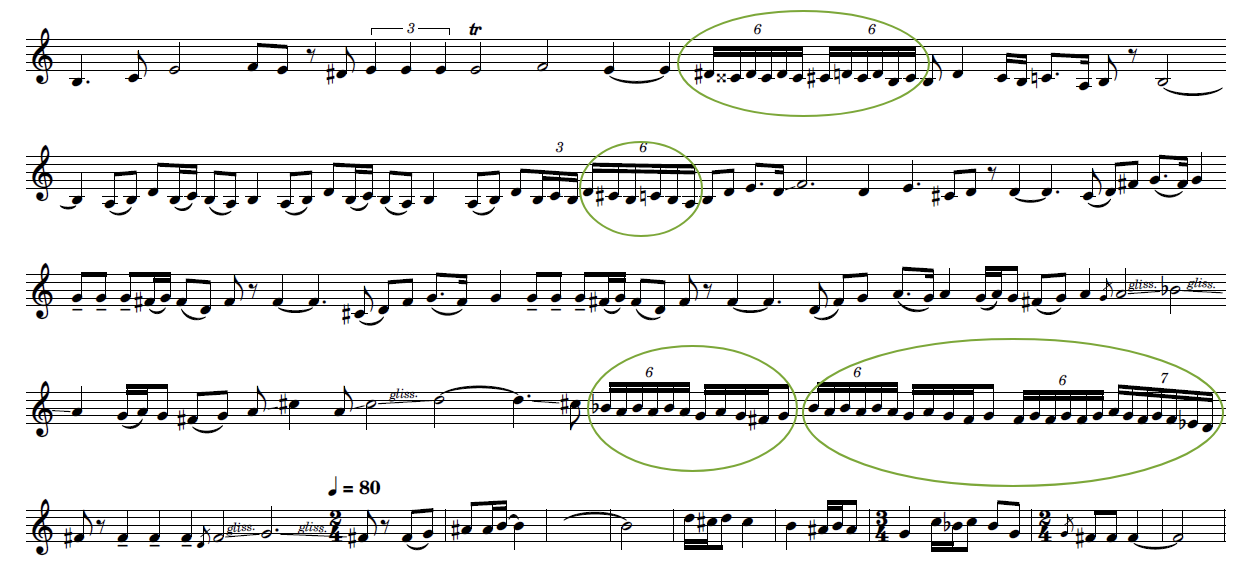
Quddus Khojamyarov: Trumpet Concerto, an opening cadenza of the 2nd movement - a muqaddima of the muqam Oshshaq of On-Ikki Muqam tradition.
3. Maqam and (Post)modernism
The notion of a “zero hour” (Stunde Null) in post-1945 musical modernism rested on the conviction that tradition in music had been discredited and that a radical rupture (tabula rasa) was necessary. The philosophical backdrop for this position is found in Theodor W. Adorno’s Philosophy of New Music (1949), which frames the traditional, Romantic musical materials of preceding decades as both historically exhausted and ideologically compromised. This also extended to any use of folkloric idioms as markers of national identity. Although different strands of postwar musical modernism continue to be identified through national labels (Darmstadt School as “German,” New York School as “American,” or the IRCAM circle as “French”), this was in its essence a global cultural phenomenon whose aspirations were quite explicitly anti-nationalist. Therefore we can view such designations as mere residues of nineteenth-century approach to historiography, manifestating itself in a tendency to situate cultural phenomena within fixed geographical boundaries.
Modernist compositional approaches to musical syntax rejected thematicism, and with it melody as a primary carrier of musical meaning. Expectedly, modal melodic traditions such as maqām had little purpose within this aesthetic framework. In his essay “Oriental Music: A Lost Paradise?” (1967), Pierre Boulez argued against the incorporation of Eastern musical elements into contemporary classical music, warning against the pitfalls of cultural tourism. Nevertheless, some Western composers immersed themselves deeply enough in Eastern traditions to make them a core element of their compositional language. Lou Harrison studied Javanese and Balinese gamelan, built gamelan instruments with his partner Bill Colvig, and composed for them, often combining gamelan with Western instruments and tuning systems based on just intonation. For Claude Vivier, a student of Stockhausen who also spent extensive periods in Bali in the 1970s, the encounter with Asian music was a more personal matter, a way of working through his own inner struggles rather than a purely artistic project. Giacinto Scelsi, too, turned to Asian thought as a personal path, one that informed a compositional practice at odds with both the serialist mainstream and the Western conception of the composer as the sole author of a musical work.
Although the clearest influence on Scelsi came from Indian raga, his compositions for solo instrument are especially interesting in the context of maqām, as they offer parallels to the improvised instrumental preludes (taqasīm) of the maqām traditions . The resemblance holds in form (adhering to Elsner’s maqām principle), and also in compositional process, particularly to the meditative elements of Sufi performance practice (asar) discussed in our previous article on the kinetic and temporal aspects of maqām. Scelsi would work at the electronic keyboard (ondiola) equipped with a pitch bender, often concentrating on a single pitch or a small tone group, and exploring the inner life of tones through microtonal inflections. These improvisations were recorded and then notated by assistants, and Scelsi came to describe himself less as an author than as a medium through which the music passed, going so far as to withhold his name from some of his scores in favor of a symbol.
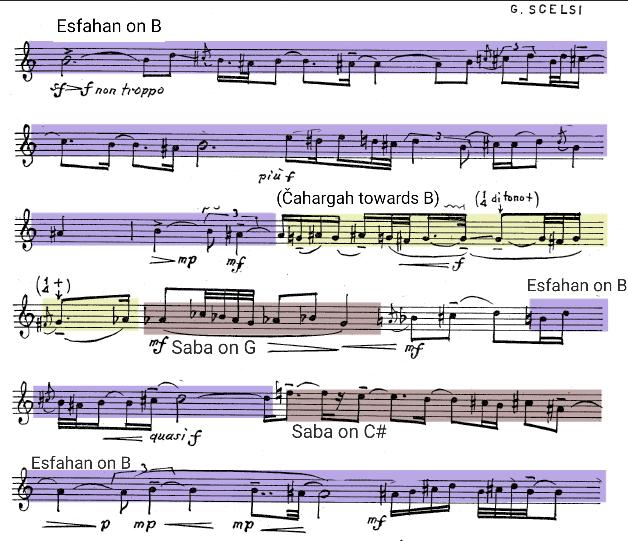
Flavor analysis of G. Scelsi’s Quatro pezzi per tromba sola (1956)
Maqām in its explicit form, however, only entered the European avant-garde concert scene more prominently from the 1980s onward, particularly through the work of Klaus Huber. Huber’s interest in Arabic music was partly a reaction to the political climate of the early 1990s (in the aftermath of the first Gulf War). Huber saw the increased normalization of Islamophobia in Western discourse as an expression of what he called a “postmodern crusader mentality,” so that engaging seriously with the demonized culture emerged as an inner necessity and a political/ethical commitment. Maqām tonality also offered a way beyond the twelve-note pan-chromaticism of equal semitones which Huber has long considered outdated and worn out, having already been working with third-tones since the 1960s, and systematically since La terre des hommes (1987-89). As part of his research, Huber worked closely with the French qānūn player Julien Jalâl Ed-Dine Weiss, founder of the Sufi music ensemble Al-Kindi based in Aleppo, Syria; while also consulting various literature on Sufi mysticism as well as maqām theory translations found in Rodolphe d’Erlanger’s La musique arabe. The first major work of this period, Die Erde bewegt sich auf den Hörnern eines Stiers places European and Arab musicians side by side, among them Weiss and the Al-Kindi ensemble, and sets the opening Islamic formula of the basmala, sung by the Sufi singer Hamza Shakur, beside a political text by the Iranian writer Mahmoud Doulatabadi. In his subsequent works he moves from the mere assemblage towards integration. Maqām melodic cells are woven into the musical fabric through processes of fragmentation, while non-musical elements likewise become integral to the compositional process: the temporal design of his central work of this period, Die Seele muss vom Reittier steigen, draws on the Sufi image of a cosmos in continuous, periodic movement of expansion and contraction.
Petra Zidarić Györek analyzes Huber’s work alongside that of several Arab composers, and identifies three (not mutually exclusive) categories of the mechanisms by which Arabic music (and, by extension, music of the wider maqām world) is adopted into contemporary art music: (1) musical difference, (2) aesthetic enactment, and (3) abstraction.
With musical difference, the binary is clearly defined through culturally distinct instrumental layers, which reveal a specific cultural code. Typical techniques here are collage and the layered interweaving of idioms, often with the aim of preserving the contrast between two distinct aesthetics, the modernist and that of maqām, for instance between fully notated music and improvisation. Hajibeyov’s 1908 Leyli and Majnun, where the mugham ensemble and the Western orchestra likewise stand side by side, could stand as an early proto-example of this approach. Aesthetic enactment draws predominantly on spiritual elements or Islamic rituals as sources of inspiration. These are transferred to Western ensembles without the participation of traditional Arab musicians and are thus “staged” compositionally for a predominantly Western audience. The music usually is fully notated, leaving no room for improvisation, and since the instruments are entirely Western, the cultural code is not foregrounded: the boundaries between cultures shift from the obvious to the subtly perceptible, and the human voice often becomes the main carrier of the “Eastern” meanings, through iconic-indexical signification.
Abstraction is characterized by estrangement and transformation, which dissolve musical difference, and it is explicitly shaped by a contemporary compositional language. Arabic sources serve purely as material, with no direct relationship to the musical qualities of Arabic music. Maqāmāt belong here when they are used chiefly as a pitch reservoir and an extended palette of sound color, without regard for their characteristic melodic movements and turns. This technique also has earlier precedents: In his late-1930s compositions written during his stay in Palestine, Stefan Wolpe extracted the micro-intervallic building blocks of the Arabic maqāmāt into abstract pitch-class cells, subjecting them to non-hierarchical permutation. İlhan Mimaroğlu manipulated recorded vocal and instrumental inflections of the Turkish makam through tape splicing, filtering, and delay in his electroacoustic compositions of the 1960s and 1970s; transforming horizontal modal lines into vertical sample-textures. These examples are not exhaustive, since abstraction and fragmentation are modernist devices in their essence, and comparable cases can be found throughout the postwar avant-garde.
Between the late twentieth century and today, we can observe a gradual shift in the compositional approaches toward eclecticism, seen, among other things, in a more relaxed attitude toward a melody. In postmodernism the melody was no longer forbidden, but placed within new intertextual relations. While both the national schools and high modernism each rested on a totalizing frame: the nation and its canonized folk music in the one; abstracted, autonomous material in the other; postmodern thought is defined by the loss of such grand narratives, in favor of many voices and “little narratives” (Lyotard). In Jonathan Kramer’s account, postmodern music avoids totalizing forms, refers freely to the music of many traditions and cultures, treats music as bound to its cultural and political context, and locates meaning with the listener more than with the score.
Also, by that time, classically trained composers from most parts of the world, including the countries of the maqām realm, had already been exposed to and immersed in the avant-garde techniques and began finding strategies to connect them with their personal cultural memory and heritage. Many have also engaged consciously with philosophy and published written theoretical articulations of these creative processes. Somewhat freed from the grand narratives, composers engaging with maqām could give greater care to the endosemiotic meanings found in the deep structures of maqām tonality and tuning, than to its surface-level symbolisms.
Two composer-researchers with whom we collaborated during this research project pursue this attention to tuning by working within the framework of extended just intonation. Idin Samimi Mofakham, whose artistic-research PhD at the Norwegian Academy of Music produced what he calls the holographic composition technique, builds on medieval Iranian tuning treatises and the radif, linking them to the psychoacoustic phenomena of combination tones (faint additional pitches that the ear itself produces when two tones sound together). Stefan Pohlit, who conducted his doctoral research on the just-intonation qānūn of Julien Jalâl Ed-Dine Weiss, treats tuning practice based on pure ratios as a philosophical and ecological imperative. Through his proprietary artistic concept of a "Green New Deal," Pohlit advocates for a return to the natural acoustic properties of sound and melody, framing this harmonic shift as an interrogation of high modernism and arguing that twentieth-century compositional paradigms are complicit in the global and cultural destruction driven by materialistic technocracy. Our article on trumpet tuning and maqām contributes to this line of inquiry by examining the acoustic properties of brass instruments, offering a practical and theoretical basis for composers seeking to explore similar approaches to tuning and melodic organization.
Literature
Adorno, Theodor W. 2006. Philosophy of New Music. Edited, translated, and with an introduction by Robert Hullot-Kentor. Minneapolis: University of Minnesota Press.
Boulez, Pierre. 1986. “Oriental Music: A Lost Paradise?” In Orientations: Collected Writings, edited by Jean-Jacques Nattiez, translated by Martin Cooper, 421-24. Cambridge, MA: Harvard University Press.
Clark, William, and Ablet Kamalov. 2004. "Uighur Migration Across Central Asian Frontiers." Central Asian Survey 23 (2): 167–182.
Frolova-Walker, Marina. 2007. Russian Music and Nationalism from Glinka to Stalin. New Haven, CT: Yale University Press.
Issiyeva, Adalyat. 2021. Representing Russia’s Orient: From Ethnography to Art Song. New York: Oxford University Press.
Kramer, Jonathan D. 2002. “The Nature and Origins of Musical Postmodernism.” In Postmodern Music/Postmodern Thought, edited by Judy Lochhead and Joseph Auner, 13-26. New York: Routledge.
Lyotard, Jean-François. 1984. The Postmodern Condition: A Report on Knowledge. Translated by Geoff Bennington and Brian Massumi. Minneapolis: University of Minnesota Press.
Naroditskaya, Inna. 2002. Song from the Land of Fire: Continuity and Change in Azerbaijanian Mugham. New York: Routledge.
Pohlit, Stefan. 2019. "Das Schwarze Loch. Modernismus und globale Vernichtung." MusikTexte, no. 163 (November): [26-31]
Samimi Mofakham, Idin. 2022. “Holographic Composition Technique.” PhD diss., Norwegian Academy of Music Oslo
Schimmelpenninck van der Oye, David. 2010. Russian Orientalism: Asia in the Russian Mind from Peter the Great to the Emigration. New Haven, CT: Yale University Press.
Taruskin, Richard. 1992. “‘Entoiling the Falconet’: Russian Musical Orientalism in Context.” Cambridge Opera Journal 4 (3): 253-80.
Taruskin, Richard. 2009. On Russian Music. Berkeley: University of California Press.
Uitti, Frances-Marie. 1995. “Preserving the Scelsi Improvisations.” Tempo [online]. Cambridge University Press (194), 12-14
Zidarić Györek, Petra. 2026. “Rezeption arabischer Musik und Musiktheorie in der Neuen Musik.” PhD diss., University of Music and Performing Arts Graz.