Maqam and meaning
“Melodies contain apparent things and hidden things. Among the apparent things one counts, for example, acuteness and gravity, heaviness and lightness, sweetness and hardness, heat and cold. The hidden things are expressed in various ways in the unfolding of these [apparent things]. Among them one counts: good composition, correct distribution [of notes and/or phrases], excellence of creation [of a song] which consists in making the character of melodies correspond to that of the poems; this is the most difficult. But we enter into the greatest mystery when it comes to recognizing the meaning of melodies. […] The meaning of the melody is therefore the object that the composer seeks to attain through it, as the poet proposes a certain goal and a certain meaning. Perhaps he succeeded and attained his goal, perhaps he erred, or perhaps failed (completely), or (merely) came close. It is therefore necessary that these goals be determined by the melodies, notes and sounds themselves; these must reflect them as articulated human language reflects his states of soul and the different circumstances in which he finds himself. And what does have meaning, then its effects on the soul, whether in (moments of) seriousness or frivolity, are numerous and well known.”
Part I: Maqām semiotics
The passage above stems from Kitāb kamāl adab al-ghināʾ (The Perfection of Musical Knowledge), by the 10th-century Arab music theorist al-Ḥasan al-Kātib. Drawing extensively on the musical thought of al-Fārābī while placing greater emphasis on the performer’s agency, Al-Kātib’s central concern is the relationship between theoretical and practical musical knowledge: neither is complete without the other, and musical understanding ultimately has to be grounded in the realities of performance. In Nidaa Abou Mrad’s reading, al-Kātib deliberately adopts an exegetical approach to music theory, in contrast to al-Fārābī’s more mathematically grounded account. His questions concerning the meaning and ethos of melodies, and above all the relationship between their ẓāhir (apparent) and bāṭin (hidden) dimensions, raised above, remain relevant to us today.
Parts of the analysis above draw on Nidaa Abou Mrad’s Éléments de sémiotique modale (2016). To my knowledge, this is the only book-length study of maqām semiotics from an explicitly transcultural perspective, and this in a field where even the semiotics of individual national traditions are still relatively underexplored. Abou Mrad’s geographical scope differs considerably from that of Harold Powers and the Maqām Study Group: it excludes the Persian and Turko-Central Asian traditions while including Christian modal music from both sides of the Mediterranean. Nevertheless, it belongs to the same broader intellectual project of seeking the underlying structures that unite modal practices across different musical cultures, and has therefore served as a major source .
Abou Mrad offers a critique of referential musical semiotics, which treats musical meaning as a matter of translation between music and verbal language. Against this, he proposes that a primary layer of modal musical semiosis is the one intrinsic to the musical system itself, manifested in its tonality. He calls this endosemiotic meaning, a term originating in biosemiotics. Thomas Sebeok introduced the distinction between endosemiotics and exosemiotics to differentiate sign processes occurring within an organism from those arising in its relation to the outside world. For Abou Mrad, the endosemiotic meaning of maqām arises from the interaction of its syntactic and phonological components. It is generated by the grammar of the mode: by the hierarchy of degrees and by the vectorial relationships between focal notes. Nicolas Meeùs, in his preface to the book, describes this as a “strictly autonomous” semiotics, one that presupposes no connection to anything outside the musical structure itself.
On top of this endosemiotic foundation, Abou Mrad proposes a secondary, exosemiotic layer, which he divides into two forms. Logogenic exosemiosis, from logos, concerns language, convention, and the stylistic codes through which particular musical traditions organize modes, melodic formulas, rhythmic patterns, aesthetic schemes, and topoi. These conventions are historically and culturally situated, shaping the ways in which a musical system is understood and realized in practice. Pathogenic exosemiosis, from pathos, concerns the subjective and affective dimension of music: tempo fluctuations, dynamic shadings, timbral inflections, pitch inflections, and other suprasegmental features through which a performer leaves a personal trace in an underlying modal structure. Here, meaning is generated through the individual’s embodied and sensorimotor experience of musical expression.
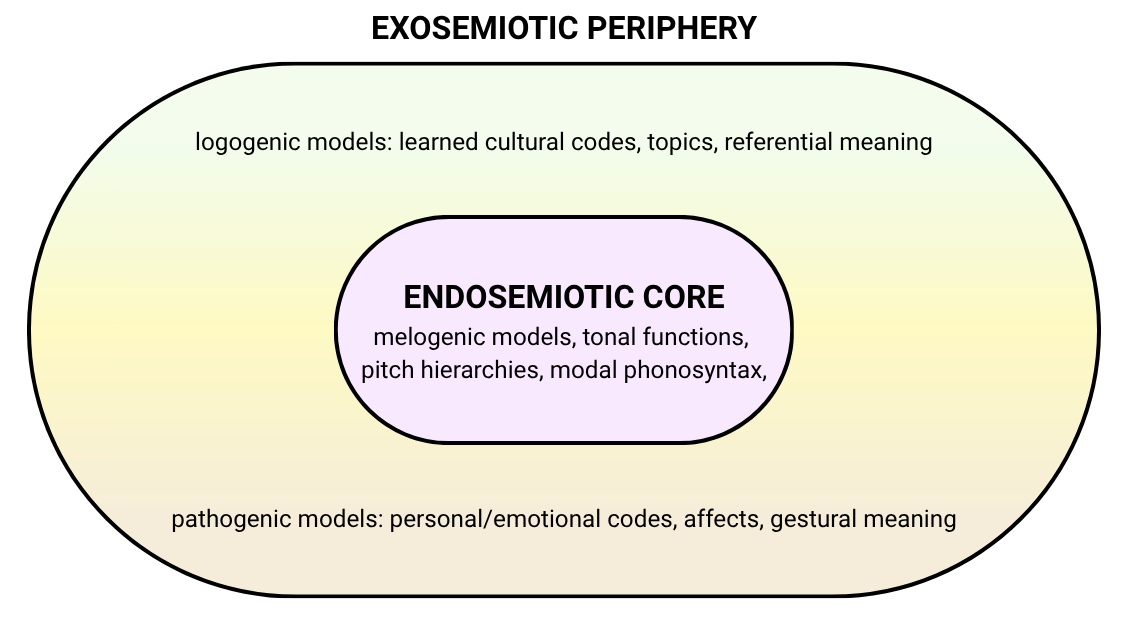
A graphical representation of the Nidaa Abou Mrad’s endo/exosemiotic model
In essence, basic modal meaning is grammatical rather than referential. A mode does not “mean” sadness or love in the way a word refers to an object. Instead, it generates a field of syntactic relationships that a competent listener recognizes as coherent. The performer actualizes this endosemiotic structure through the exosemiotic resources of learned style, while also introducing a personal reading through ornamentation, gesture, timing, timbre, and other expressive choices.
A majority of the theoretical concepts we have analyzed so far in this blog would fall strictly within the core endosemiotic category: the pitch content of modes, tonal functions, tonal hierarchy, and archetypal motives.
How the core transforms the periphery, and vice versa
The graphical model used above to represent Abou Mrad’s concepts draws on the center vs. periphery framework in cultural semiotics of the Tartu-Moscow School and Yuri Lotman in particular. This theoretical model is itself part of a broader organismic lineage that intersects, at a distance, with the biosemiotic models from which the terms endo and exosemiotic derive. We will return to these connections later in more detail; for now, it is important simply to recognize the dynamic nature of the relationship between center and periphery.
In Lotman’s model, the periphery is a zone of accelerated semiotic activity, where foreign or peripheral structures of meaning can be translated into the system and eventually move toward the center, transforming its characteristics. At the same time, the center exerts a formative influence on the periphery, establishing the dominant structures and norms through which the wider cultural space is organized.
This dynamic relationship is particularly important to understand, since the meanings associated with a cultural model such as maqām are historically changeable. The outward influence, stemming from the endosemiotic core (the pitch content and hierarchy of the mode) extending to the exosemiotic meanings has long been recognized, from the ancient Greek concept of ethos onward: particular intervals and tonal relationships were seen as carrying characteristic effects upon the listener. Much of this can certainly be understood through enculturation: listeners acquire perceptual expectations and affective associations through prolonged exposure to the musical language of their culture. Yet some developmental and cross-cultural research also suggests that some responses to pitch relationships emerge before extensive musical enculturation, pointing to the possibility that their effects cannot be explained entirely by cultural conditioning.
The impact of the endosemiotic core on the periphery can take various forms. We have already encountered it in our discussion of the tonal functions of the twelve flavors, where the directional tendencies and tensions between degrees acquire associations with particular affective and thematic domains. There is, however, another and more explicitly hermeneutic way in which meanings can radiate outward from the tonal structure.
This possibility is explored in Abou Mrad’s discussion of what he calls a-verbal musical hermeneutics. He distinguishes between two complementary orientations: the anaphatic, which apprehends musical meaning without reducing it to verbal propositions, and the sophianic, in which musical structure becomes a vehicle for the revelation of a deeper, hidden meaning. Abou Mrad considers al-Kātib’s opening passage an example of the anaphatic approach. By moving from the apparent qualities of melody toward its hidden dimensions and ultimately toward its meaning, al-Kātib treats the musical sounds themselves as capable of carrying meaning. The sophianic dimension appears more explicitly in later medieval hermeneutic thought, particularly in the metaphor of the Transmodal Tree (see the article on 4 models). Here the modal system is understood as the manifestation of a deeper order: its genealogical relationships bear traces of a hidden structure that the hermeneutic interpretation seeks to disclose. The resulting religious and cosmological interpretations (found in both Sufism and Christian Orthodox theology) associated with the Transmodal Tree are seen as latent in the modal structure itself, revealed through its symbolic and genealogical organization.
While the center shapes the meanings and practices that develop around it, the accumulated forces of the peripheral meanings can, under certain conditions, penetrate much further inward, altering the very structure of the endosemiotic core itself.
We have already seen how an imposed logogenic meaning, in the form of nationalist and Westernizing language and discourse, contributed to changes in the very nature of maqām by altering intervallic structures that had become embedded in collective musical consciousness. The resulting tectonic shifts are especially apparent in the disappearance of traditional Zalzalian intervallic relationships. After several generations of Western equal temperament becoming the normative system, Zalzalian intervals have, in many contexts, lost their claim to authenticity within the living tradition.
What about pathogenic meaning, rooted in subtle individual codes? Surely this could not have exerted an influence on the musical structure of maqām on anything like the same scale? Anyone who asked themselves this question may have forgotten what exactly we have called our original “authentic tuning” just now. It is, after all, traditionally attributed to one man, Manṣūr Zalzal, and to the particular way in which he positioned his hand on the neck of the lute so that his middle finger could reach further down the fingerboard. What begins as an embodied, individual action can, under the right circumstances, become a habit, then a convention, and eventually develop into a crucial part of the core structure that a musical culture will come to experience as a given, such as the case with wusta al zalzal. However, that is not the only case of pathogenic exosemiosis contributing to a core structural identity of the system.
Gestures and ornamentations as generators of meaning
In this chapter we will stay closer to Abou Mrad’s primary generators of pathogenic meaning, ornamentation and gestural pitch inflection, we can still observe instances in which these seemingly peripheral expressive phenomena become incorporated into the very tonal material that a tradition treats as structurally significant to modal identity. Here we will examine several types of ornamentation and gesture, arranged according to the degree of their impact on the endosemiotic core, from the most structurally consequential to the least.
Drifting tone
We begin with the phenomenon in Uyghur Muqam known as the drifting tone (sometimes also referred to as “living tone”): a wide, lamentative, glissando-like inflection performed by the voice or a bowed instrument and associated with specific degrees of the modal structure. Its position on the scale is therefore structurally prescribed, even though its actual realization remains mobile. As Wang Wenjing documents, drifting occurs systematically on scale degrees III, VI, and VII, having its tonal “epicenter” on a quarter-tone position, around ¾ tones away from the neighboring degree, which somewhat parallels the wusṭā al-Zalzal position on the maqām masterscale.
Furthermore, its occurrence is tied to specific melodic directions (such as in the Mothaghayyer tonal function): the drifting tone may drift upward or downward toward neutral positions depending on its intervallic relation to the central tone. Wang gives the upward drift as generally extending from the basic position (0 cents) to approximately +100 cents, with only rare cases reaching a minor third, while downward drift is generally more extensive, ranging from approximately −100 cents to excursions of more than a minor third, with a maximum of about 350 cents. The extent and direction of the drift also vary according to the melodic progression in which the tone occurs.

Tone rows of On-Ikki Muqam with the drifting tones on fixed scale degrees (Zhou Ji - A study of the tonal system of the Uyghur Muqam)
From this we can surmise that the structural importance of the drifting tone as a mode-defining degree is comparable to that of the wusṭā al-Zalzal, and that it possesses an undoubted endosemiotic capacity. The Chinese scholarship referred to here does not provide an account of meanings associated with the drifting tone. We can nevertheless gain some perspective by comparing it with its close Uzbek equivalent, nola, which is performed in a broadly similar manner but is not typically tied to a particular scale degree. In Uzbek maqom, nola has a strongly expressive-poetic function. According to some theories, it is specifically tied to a gesture of lamentation; according to others, it serves as a more general intensifier of the affective content of the text. Taken together, these observations, along with the correlation of the drifting tone to the wusṭā al-Zalzal, open an entirely unexplored question: can a single scale degree itself carry endosemiotic meaning, independently of the intervals that surround it?
Gestural Saba tone
In this project, we propose that, alongside the drifting tone, there is another instance of a scale degree that is gestural in nature, while maintaining a structural role within the tonal system: the diminished top note in the forms of Saba flavor (IV in the Saba tetrachord, III in the Mo’alef trichord). The basis for this claim is the clear and recurring gestural pattern associated with this degree: a falling minor second in which the upper note carries the principal weight, thereby supporting the downward motion, often reinforced by a glissando. This is a highly characteristic gesture that extends beyond maqām and appears in European classical music as the pianto, a figure documented since the Renaissance. In the Baroque period, descending-second figures, such as the characteristic descent found in Saba, became associated with rhetorical figures expressing profound grief and death.
Following Karbusický’s and Tarasti’s application of Peircean semiotic categories to music (symbol, icon, and index) the pianto can be understood as an iconic-indexical form of signification. It is indexical insofar as it conveys a felt emotional state, while its melodic contour is iconic insofar as the falling gesture evokes the physical and vocal characteristics of crying.
Furthermore, this note typically appears as an Ersatz for the degree a whole tone above its lower neighbor, marking a temporary excursion (çeşni) into Saba from the pre-established mode of Husseini (or alternatively, Nawa and Kurd).

If we apply here the sort of hermeneutical approach derived from the tonal relationships (as discussed above), the gesture can be interpreted as an embodiment of weakness and physical pain, manifested in the inability to complete the upward step: the motion reaches toward the expected upper degree (a secondary tonal center of the mode, serving as a point of transfer for the sayr to move up), but fails in that motion and falls back.
Seeing how this gestural configuration recurs systematically around a particular degree within Saba, this raises the possibility that the particular tonal function of this pitch degree is pathogenic in nature, and has acquired structural significance through the sedimentation of a characteristic gesture and its associated expressive meaning. Consequently, the core semiotic identity of the Saba IV is defined not only by the semitone interval but by its gesturality. It should be noted that this distinction does not universally apply to all modes and compositions that may be known under the name Saba across the regions, but only to the Flavor of Saba as defined by the 12 Flavors system.
Non-structural ornaments
A particularly characteristic family of ornaments, with a less direct influence on the core tonal structure because they can occur at freely chosen points in the melodic line, consists of rapid, non-lexical throat trills. These are known as tahrir (تحرير) in Iran and zəngulə in Azerbaijan, while similar techniques also occur in Iraqi maqām without a universally agreed name. Distinct from ordinary vocal inflections, these ornaments involve a specialized laryngeal mechanism in which rapid and highly controlled glottal strokes (tekyeh) produce abrupt movements of the fundamental frequency toward higher pitches. This physical "breaking" or cracking of the voice functions as an autonomous, compositional element, one that is meticulously replicated in the instrumental variations through complex articulation techniques. Culturally, this particular mode of vocal production has been associated with the elicitation of hāl, the transient state of heightened emotional and spiritual absorption central to classical Irano-Islamic aesthetics. Because tahrir operates outside the semantic structure of language, it marks a transition from the semantic constraints of poetic text toward an abstract, non-lexical mode of vocalization, functioning as a semiotic marker within the performance. Within this aesthetic framework, the vocal effect becomes a means of expressing spiritual vulnerability and the dissolution of the individual ego before the divine.
A further non-rhetorical class of ornaments, originating in the vocal performance, is known universally as ululation (termed zaghrūta in Arabic, kel in Persian, vigelegele in Swahili, and ililta in Amharic). This technique is an acoustic phenomenon produced through supraglottic modulation, driven by the rapid, lateral or sagittal oscillation of the tongue against the alveolar ridge. Ululations function as a structured, highly gendered signifier of collective affect, primarily deployed by women during pivotal communal milestones such as weddings and other lifecycle transitions. Its high acoustic intensity and rapid frequency serve as explicit sonic cues that traditional instruments (a piercing, high pitched zurna, rapid tremolos on the oud, to the accelerating rhythmic shifts of Persian percussion like the daf) frequently mimic, support, or answer in antiphonal arrangements, demarcating the moments of intersubjective ecstatic outbursts. In that original context, ululation operates as an indexical and pathogenic sign. When the same gesture is detached from these contexts and incorporated into staged or mediated performance, its semiotic function can shift into a more logogenic and referential function, recontextualized as a marker of cultural identity or tradition, as documented by Jennifer E. Jacobs, in her ethnographic work on Levantine zaghareet.
Beyond these, there are countless types and subtypes of expressive or gestural inflection: various local iterations of what the European Renaissance called suspiratio (a sudden interruption of airflow that amplifies the “sighing” gesture of the preceding note), falling microtonal glissandi on the final note of a phrase, chokes (a momentary dip in pitch within an otherwise sustained tone), and many others. Many of these gestures are highly localized and stand in a direct relationship to local dialects and patterns of pronunciation. In such cases, their connection to spoken language gives them a combined logogenic and pathogenic character, arising simultaneously from linguistic convention and embodied vocal expression. These localized gestures perhaps correspond most directly to the purely exosemiotic category, remaining external to the core tonal structure while only shaping its realization in performance. Taken together, however, these examples suggest that gesturality and ornamentation are not merely aids to the realization of musical meaning, but can themselves play an active role in its generation.
Part II: The semiosphere
We now return to cultural semiotic models of the Tartu-Moscow school, and to Yuri Lotman specifically, whose concepts provide the principal semiotic framework through which the conceptual scope of transcultural maqām is explored in this project.
A central idea here is the semiosphere: the larger semiotic space within which languages, texts, codes, and other sign systems exist and interact. Lotman introduced the concept explicitly in 1984, describing the semiosphere as the space necessary for semiosis to take place. Within this space, a text is understood in the broad semiotic sense as an organized carrier of meaning, rather than simply as a verbal or written message. A piece of music, a ritual, an image, or a verbal work can therefore function as a text insofar as it constitutes an integrated semiotic whole. A cultural text is such a text understood within the cultural codes and conventions through which it acquires, transmits, and transforms meaning.
In Lotman’s view, the internal space of a semiosphere is heterogeneous by definition, “at the same time unequal yet unified, asymmetrical yet uniform”. Earlier, we touched on the structural distinction between the centre and periphery of the semiosphere. The centre tends toward stability, organization, and the reproduction of established structures, while the periphery is characterized by greater instability and accelerated semiotic activity, making it a particularly important site for innovation and the emergence of new meaning-structures, which according to Lotman happens under certain conditions:
“In order that all this mass of constructions are perceived as bearers of semiotic meaning we must make a ‘presumption of semioticity’: the semiotic intuition of the collective and its consciousness have to accept the possibility that structures may be significant.”
The emergence of new meaning can therefore occur through the two-way dynamic between centre and periphery, as demonstrated earlier, but also through contact with entirely different sign-systems with which the system comes into contact.
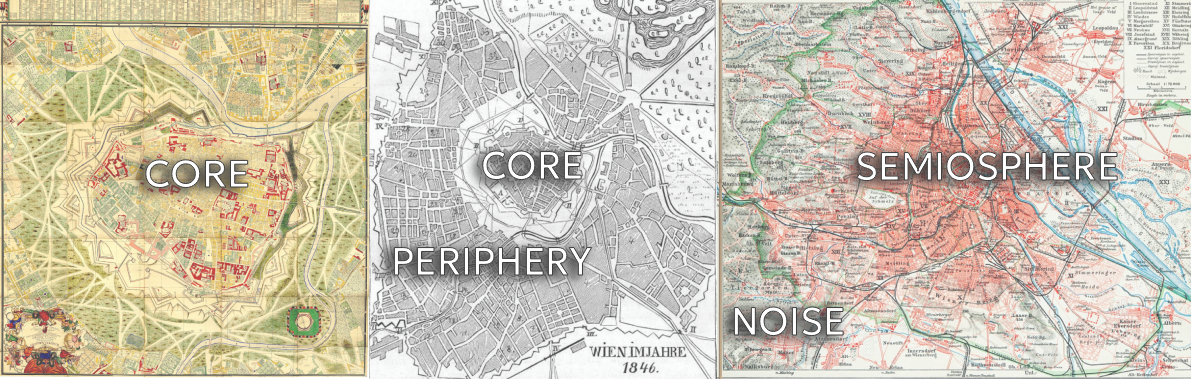
The expanding model of the semiosphere, illustrated with help of historical maps of the city of Vienna from the early 18th century, the mid-19th century, and the early 20th century. (Source: Wikimedia Commons)
Using the above illustration of the geographical development of the city of Vienna over the course of two centuries as a conceptual aid, we can project Lotman’s spatial models onto the development of what we shall call the maqām semiosphere, and consider how they relate to it. The endo- and exosemiotic model from which we started represents the complete set of meanings traditionally understood as maqām and associated with it. It consists of an endosemiotic inner layer and an exosemiotic outer layer. However, when we take into consideration the dynamic two-way influences discussed above, and view the system from a sufficient distance, these two layers begin to melt into a single semiotic space. Their inner boundary becomes less relevant, leaving only the outer boundary that distinguishes what maqām is from what it isn't. This boundary, too, is constantly adjusted through a process of filtering.
What lies outside the boundaries of an established semiotic system is referred to in Lotman’s earlier writings as noise: information that is foreign to its existing codes and therefore not intelligible within them. Yet the boundary functions as a filter rather than an enclosure. Through processes of translation, something that was initially external or unintelligible can be incorporated into the semiosphere and acquire meaning and textuality within the receiving system.
“No semiosphere is immersed in an amorphous, ‘wild’ space, but is in contact with other semiospheres which have their own organization (though from the point of view of the former they may seem unorganized) there is a constant exchange, a search for a common language, a koine.”
In this sense, noise can also become a source of new information and new semiotic possibilities, arriving through translational processes from adjacent semiospheres. In the case of maqām, such processes can be observed in its encounters with neighboring Greek/Byzantine, Indian, and, to a somewhat lesser extent, Chinese musical systems.
Through this, we can observe a close historical correspondence between the geographical space encompassed by the medieval Islamic empires and their historical remnants, and the semiotic space within which maqām developed and circulated. The political and cultural networks connecting these territories provided the material conditions for the formation and expansion of the maqām semiosphere. From the early Baghdad period onward, constant migratory movements, the circulation of musicians, and exchanges between different musical cultures within this heterogeneous space contributed to the continual transformation of its semiotic boundaries. This internal circulation was further enriched by contact with neighboring semiospheres whenever conditions allowing for such exchanges were met:
“…if dialogue without semiotic difference is pointless, when the difference is absolute and mutually exclusive dialogue becomes impossible. So asymmetry assumes a degree of invariancy. But there is another condition necessary for dialogue: namely the concern of both participants for the message; and their capacity to overcome the semiotic barriers that must inevitably arise.”
Intonational crisis
A similar idea, but more closely tied to music is found in Boris Asafiev’s concept of intonatsiya, especially in its more all-encompassing definition as any “historically meaningful vocabulary of musical utterance.” The historical qualifier points to a more temporal understanding than the spatial one we have been working with so far. Asafiev, writing from a Soviet Marxist perspective, but presenting a rather universal definition of a principle at hand, introduced the concept of intonational crisis, referring to processes in which established intonational values and meanings undergo fundamental re-evaluation in the times of major societal upheavals. In Lotman’s terms we could speak of a situation where a semiosphere is confronted with another, much larger semiosphere to which it only registers as an insignificant noise. Asafiev introduced the concept with an example from the history of Russian classical music:
“The sharp turn to western European instrumentalism, with its academic norms, transferred almost mechanically onto Russian soil, evoked a complex and prolonged intonational crisis. The essence of the matter was not simply a new type of "musical training in a new manner" by foreigners, but in a completely different method of auditory (intonational) thought expression; indeed, both the attitude and world outlook of the people were affected”
The significance of this example for the present discussion lies in the asymmetry of the encounter: the other semiotic system is too large and self-absorbed to allow for a possibility of a true dialogue. A comparable process can be observed in nineteenth-century Europe, where prolonged intellectual and artistic interest in the cultures of the Middle East and North Africa led Romanticist composers to employ particular melodic and intervallic devices as recognizable, ready-made references to these regions. Derek B. Scott identifies the augmented second (Hijaz), together with Phrygian (Kurd), among the recurring devices through which Western composers constructed images of Orient, and notes that such conventions could become recognizable independently of the musical practices they purported to represent. For the moment we can leave aside the historical inaccuracy of treating the equally tempered augmented second as an exact representation of the Hijaz interval, which was historically much closer to a 5/4 tone (see 12 Flavors, Hijaz/Čahargah). We can also leave aside the larger question of why there was such an urgent need for an instantaneously recognizable musical marker of the “Big Other.” Musician Farya Faraji has proposed that the choice of the adoption of Hijaz, and to a lesser extent Kurd, as a main vehicle of musical Orientalism may be related to their compatibility with twelve-tone equal temperament. Among Middle Eastern modes containing intervals unfamiliar to European ears, Hijaz and Kurd were comparatively easy to reproduce on fixed-pitch Western instruments, whereas other non-Western modes (still) routinely incorporated Zalzalian intervals at the time.
The musical language developed by nineteenth-century Romanticism subsequently became a major component of the emerging vocabulary of the Hollywood film score. Hollywood inherited a musical system particularly suited to the rapid characterization of places, peoples, situations, and emotions. In this process, the already established Orientalist musical code was transferred into a new medium, where its conventions could function as immediate cinematic cues. Kay Hardy Campbell notes that Arab musicians refer to the equal-tempered, written representation of Hijaz found in Western musical imitations of Arab music as “Hollywood Hijaz,” distinguishing it from the more variable intonation employed in actual Arab performance practice. Within the maqām semiosphere, the flavor of Ḥijāz had accumulated numerous logogenic, mostly poetic, associations: heroism, victoriousness, abundance, love, longing, separation, and devotional yearning, among others; in Hollywood Hijaz, these were replaced with a self-referential empty signifier, recognizable globally as a marker of “anything Middle East”, or as Faraji refers to it: the “desert-level music”. As Philip Tagg observes, “After incorporation into the pre-existent musical tradition, new means of musical expression tend to lose their original referentiality and may even become so stylised that they end up as indicators, not of the style they borrowed from but of the one that did the borrowing.”
Ultimately, these globally circulating musical simulacra can end up reabsorbed by the very cultures they simulated, as composers and musicians from the othered and exoticized regions begin reaching for Hollywood codes to represent and perform their own identities. Assaf Shelleg has described a related process as auto-exoticism, examining how assimilated Jewish composers in early twentieth-century Europe could become more familiar with the musical stereotypes through which Jewishness was represented in Western art music than with the vernacular or synagogue traditions those stereotypes supposedly represented. Onur Güneş Ayas’s study of the musical discourse in Republican Turkey documents the internalization of the simplified conceptual East-West framework through which the “Orient” had been represented from outside. Mesut Cemil, for example, presented Turkish classical music as the proud legacy of an Oriental past, while Hüseyin Saadettin Arel instead sought to reposition Turkey on the Western side of the cultural divide. Their positions differed substantially, but both were operating within an internalized Orientalist binary mindset, as the external codes grew into an internal vocabulary of self-expression. With his 1975 volume The Music of the Arabs, German-based Palestinian musicologist Habib Hassan Touma offered what was, for decades, one of the most comprehensible overviews of Arabic music in Western scholarship (at least until the later work of Scott Marcus and Farraj/Abu Shumays). In a short chapter on the emotional content of Arabic modes, he mentions some of the connotations we encountered in earlier hermeneutic theories, including the masculine/feminine associations of Rāst and Bayātī (Ḥusaynī), respectively. The only association he gives for Ḥijāz, however, is the suspiciously vague phrase “the distant desert.” The sources for these associations are not clearly given, although the chapter is presented as resulting from conversations with Arab musicians. This may therefore represent another manifestation of the internalized Orientalist code.
Seen through the combined lens of Lotman and Asafiev, this provides a blueprint for the accute crisis of the maqām semiosphere. It begins with the attempted dialogue between maqām and the European Romanticist semiosphere, but without what Lotman described above as the “concern of both participants for the message.” The resulting asymmetry produces an Orientalist simulacrum of maqām, a mock-code. Eventually, camouflaged within a larger cultural package, and globally transmitted by the mass media, this mock-code is reabsorbed, spreading and overtaking the semiosphere from within. This is why this “East-West cultural exchange” is fundamentally different from the earlier encounters among neighboring musical cultures, where traditions could mutually influence and enrich one another within a relatively shared semiotic space. In this encounter, maqām was to be reduced to a hunting trophy on the wall, in the quest of constructing a single global semiosphere, modeled on the West in its core, and embroidered with meaningless tokens as souvenirs of other, absorbed cultures. Within this superficial, neatly palatable global model, the endosemiotic properties of the maqām semiosphere (its tonal relationships, historically shaped by a non-tempered tuning system) are replaced by twelve-tone equal temperament. The logogenic exosemiotic meanings that had developed around these tonal relationships are likewise replaced. Then, the repeated self-referencing and thinning of this conceptual richness reduces the differentiated expressive vocabulary available to performers, which in turn diminishes the possibilities for pathogenic meaning production. Some Flavors can exist within twelve-tone equal temperament and share their intervallic structure with Western modes, such as Mahur (major scale) or Esfahan (harmonic minor). Their distinctively maqāmic character therefore depends on the characteristic gestures and melodic motives through which they are differentiated from their Western counterparts. When these gestures and motives are forgotten, the remaining pitch structure is simply absorbed into the corresponding Western modal category. Other Flavors, whose defining intervallic structures cannot be reproduced within twelve-tone equal temperament, are erased altogether.
What mechanisms of resistance are available to a semiosphere under such intonationial threat?
According to Umberto Eco’s model of communication, every message involves a sender, a channel, and a receiver, with transmission normally presupposing a code shared by the participants. Yet the receiver may possess multiple codes and need not decode the message through the code intended by the sender; the same message can therefore acquire meanings or functions different from those intended by its source. Eco describes this process as “semiological guerrilla warfare”: the receiver retains the capacity to appropriate, redirect, or subvert the meaning of a message without controlling its means of transmission. In this way, a semiosphere in crisis can retain its vitality through various subversive practices that work around the sign systems imposed by dominant structures. In his article “Sur les traces de Zalzal: soviet maqâm vs qadim maqâm,” Jean During examines the efforts of the Uzbek tanbur master Abror Zufarov (seen in the above video example on ornamentations), who maintained two parallel tuning systems for performing traditional Bukharan Šašmaqom: an “official” Soviet-imposed twelve-tone equal temperament, and an “authentic” system reconstructed through historically informed research but ignored by academic and cultural authorities.
In Lotman’s view, such acts of subversion have the capacity to produce accelerated semiosis: once a receiving structure reaches a certain saturation point, it shifts from passive reception to the rapid production of new texts, returning them to the structure that provoked them. A subversive artistic practice can similarly reverse-appropriate Western “icons” and transpose them into the maqām semiosphere. In the 1950s, the Lebanese singer Fairuz recorded one of her greatest hits, Yā Anā, using the melody of Mozart’s Symphony No. 40. Through its circulation in this new context, the melody became familiar to audiences who had never encountered Mozart’s original, to the point that Fairuz’s version could become their primary point of reference for the melody. More recently, oud player Nawras Altaky performed a semi-improvised, non-tempered version of Yā Anā in a duet with Richard de Waardt, carillonneur at Rotterdam’s Laurenskerk, as part of de Waardt’s Great Rotterdam Songbook. Launched in 2019 as a project to give each of Rotterdam’s roughly 170 nationalities a familiar song, the project originally collected one folk song for each nationality represented in the city; with Yā Anā (Mozart) therefore representing Lebanon.
One pattern does begin to emerge here: projects concerned with the reconstruction or reinvigoration of traditional maqām, as well as creative and subversive artistic experiments that push the boundaries of what maqām can be, increasingly involve members of Middle Eastern diasporas working in the West, as well as foreign musicians working in the Middle East or elsewhere. The traditional cultural-geographical space of maqām therefore no longer maps neatly onto the space within which its semiosis actually takes place. Its boundaries have become increasingly virtual, sustained and continually reshaped by transnational networks of researchers, performers, and audiences, for whom shared engagement and deep curiosity can become more significant than ethnic or geographical origin.
Finally, we may have arrived at two outcomes that could be simultaneously true: In the optimistic Lotmanian reading discussed above, the maqām semiosphere survived and is even reinvigorated through its decoupling from fixed geographical boundaries. But what if that is not what happened? It could also be that what we have been calling the maqām semiosphere is long gone. In the next chapter we will examine what remains of the semiosphere when its core structures that sustained its semiosis have collapsed and it can no longer reproduce itself as a living system.
Part III: Specters of Maqām
“our shadows will roam Vienna, haunt the castles, spook the lords”
(a carving found on the wall of Gavrilo Princip’s prison cell in Theresienstadt/Terezin)
In Specters of Marx (1993), Jacques Derrida responds to the widespread declaration that Marxism had become obsolete following the collapse of the Soviet Union and the proclaimed “end of history.” Not arguing directly against these claims, he points instead to the paradox that something can be declared dead, and still continuing to structure (“haunt”) the present through its unresolved questions and demands, so that, in effect, its very absence becomes a source of renewed disturbance. With a semiosphere pronounced dead, its traces may nevertheless remain capable of semiosis. Before exploring these possibilities, however, we can ask whether there may still be some last-chance attempts at resurrection.
Here it is important to differentiate between two opposite mechanisms through which maqām meanings “die”: death by embalming and death by erasure.
Pierre Boulez explicitly and infamously described traditional non-Western musics as dead in his 1967 essay “Oriental Music: A Lost Paradise?”. The music, in his view, has reached a state of “perfection” in which it has become “frozen,” its capacity for further development exhausted and preservation and repetition taking the place of ongoing creation. Theodore Levin uses the same terminology, “frozen music,” in describing state-sponsored performances of Uzbek Šašmaqom, in which large student orchestras perform fixed transcriptions in unison. Paradoxically, this form of death is diagnosed precisely through the continued performances, through its repeated, meaningless iterations. In Boulez’s words: “one cannot preserve and exhibit at the same time”. Still, to stick with the metaphor: the frozen tradition is preserved in a fixed, lifeless state, but its underlying “DNA” may still be intact; in which case the process of eventual resurrection would be more-less straightforward.
Resurrecting a semiosphere after an act of erasure, in form of a direct physical destruction, would be different. In his 2009 book The Withdrawal of Tradition Past a Surpassing Disaster, the artist and film theorist Jalal Toufic uses somewhat unusual language to describe these mechanics: A surpassing disaster, for Toufic, is an event, or a series of events, whose consequences extend beyond physical destruction, leaving a lasting scar on a collective consciousness of the society. As an effect, the disaster directly affects the ability of surviving cultural texts to continue to generate meaning. This condition constitutes what Toufic calls the withdrawal of tradition. While some direct erasure is certainly to be expected (under the rubble of a city razed to the ground, there may very well be a rare manuscript or a recording of a historical maqām performance that we will have lost forever), for Toufic, this is not the central point. In his view, withdrawal can occur even, and maybe specifically so, where the material traces of a tradition survive enough for its practices to continue.
“collateral damage includes much of what those who are insensitive to such a disaster view as having been spared. A filmmaker, thinker, writer, video maker, or musician who, in relation to a surpassing disaster, still considers that tradition has persisted, and who never has the impression that he has to resurrect even some of what ‘survived’ the carnage, is hypocritical, that is, ‘hypo-critical’: still this side of the critical event of the surpassing disaster. [Such a person] can ask, ‘Why have I survived and why has this building been spared while so much else was destroyed?’ without any suspicion that the building in question, as well as many books and artworks that had the good fortune of not being destroyed materially, have nonetheless been immaterially withdrawn by the surpassing disaster. I have to do my best to physically preserve tradition, while knowing that what I will save physically from the surpassing disaster still needs to be resurrected: one of the limitations of history as a discipline is that the material persistence of the documents blinds it to the exigency of the resurrection”
Resurrection therefore begins with the recognition that continued performance is no longer sufficient evidence of the tradition’s survival, that it is now rendered meaningless in much the same way as the embalmed one (even with the same requirements for diagnosis). The first task is therefore to recognize and disclose the withdrawal itself, to perceive that what appears to have survived has been affected at its core. Only then can an attempt be made to resurrect what has withdrawn. For Toufic, resurrection is consequently not a matter of simply restoring or reproducing the surviving forms. After a surpassing disaster, the traditional means through which the tradition was transmitted can no longer be assumed to provide direct access to it. Any attempt at resurrection must therefore negotiate the rupture produced by the disaster, and in doing so necessarily risks producing something other than what it seeks to recover.
“With regard to the surpassing disaster, art acts like the mirror in vampire films, it reveals the withdrawal of what we think is still there:
‘You have seen nothing in Hiroshima’ (Duras’ Hiroshima mon amour, 1961)
Does this entail that one should not record? No. One should record this ‘nothing,’ which only after the resurrection can be available. We have to take photographs even though because of their referents’ withdrawal, and until their referents are resurrected, they are not going to be available as referential, documentary pieces … …a vicious circle: what has to be recorded has been withdrawn, so that, unless it is resurrected, it is going to be overlooked; but in order to accomplish that prerequisite work of resurrection to avert its overlooking, one has initially to have, however minimally, perceived it, that is countered its withdrawal, that is, resurrected it.”
In Undeserving Lebanon (2007), a mixture of theory and storytelling, Toufic had already explored possible artistic methods for the resurrection of meaning through intertextual associations with surrealist cinema. Unable to bear the post-traumatic amnesia of his people, Toufic’s subject volunteers for an experiment that takes him to another dimension of the multiverse where these events never happened, in part to make them not remember him without having forgotten him (this strategy of not to remember-without forgetting is juxtaposed with a reading of another Alain Resnais film, Last Year at Marienbad). Further methods of fragmentation and zapping (“not a manner of changing channels but of mixing, editing them on the fly”) are explored both in theory and simultaneously in the structure of the prose itself. Together with the broken time-continuums, the repeated appearance of ghost-like subjectivities throughout Toufic’s prose is significant, suggesting Derridean hauntology as a final method of meaning generation when all else has collapsed.
Hauntology
The term hauntology (French: hantologie) refers to a mode of existence in which what is absent, past, or dead continues to inhabit and affect the present. It belongs to the family of so-called autological words - expressing a property that it also possesses: by inserting the silent h of hanter (“to haunt”) into ontologie (“ontology”), Derrida makes the word itself enact the intrusion of the specter into being. In spoken French, hantologie is indistinguishable from ontologie; it is only in writing that the inserted h becomes perceptible and alters the meaning.
There is a tension between the Tartu-Moscow School’s concept of the semiosphere and the deconstructive approach of Jacques Derrida, particularly in his understanding of textuality and the relations between texts. With our possibilities for analyzing the meanings of maqām through the lens of the semiosphere depleted, we can turn to Derrida’s perspective.
For Derrida, meaning is never fully contained within a text, nor can it be fixed permanently by the context in which a sign appears. Every sign bears traces of other signs and other contexts, and remains capable of being repeated and displaced into new ones. In another of Derrida’s autological word-concepts, différance (an alteration of the French word différence), meaning is produced through differences between signs while simultaneously being deferred, never arriving at a final, fully present meaning. His concept of the trace refers to the marks left within a sign by what is absent from it. A sign does not contain only what is presently expressed through it; its meaning depends upon relations to other signs and upon previous contexts that are no longer fully present. The trace is therefore the persistence of an absence within the present sign. Finally, dissemination describes the continual dispersal of meaning as signs are detached from particular contexts and enter others. A text can generate meanings beyond those intended by its author or established by its original context, and these meanings cannot be gathered back into a single authoritative interpretation. The metaphor is deliberately botanical: meaning can be scattered and produce unforeseen effects in different contexts. Under this perspective, broken pieces of the maqām system of signs are disseminated across different textual/cultural contexts, continuing to affect and alter the meanings they enter into relation with.
However, the central idea in this transposition of Derridean frameworks into musical analysis is the capacity of absent signs to participate in semiosis through haunting. This is not an entirely foreign idea within musical semiotics, and we have already encountered related forms of it in the previous article: in the Sufi concept of invisible beings, as well as in the transcendental dimension of Eero Tarasti’s existential semiotics, particularly his category of musical trans-signs, which point toward (or belong to) something absent from present reality. Continuing this line of thought, Derrida’s specter would therefore acquire Tarastian, subject-like qualities, manifested through the Greimassian modalities. For this purpose, one might even consider replacing vouloir (wanting) with exiger (demanding).
In recent music history, hauntology has become closely associated with the legacy of a British political theorist and music critic Mark Fisher, together with a strand of British electronic and experimental music that emerged around the turn of the millennium, and was collectively refered to as retrofuturism. Artists associated with this loosely defined genre frequently recycle fragments of postwar electronic, television, and film music, using obsolete recording technologies, samples, tape hiss, vinyl crackle, and other degraded sonic materials to evoke cultural memories that seem simultaneously familiar and strangely inaccessible. Fisher takes from Derrida the idea that the specter unsettles the distinction between presence and absence, as well as the linear distinction between past and future, an idea which Derrida developed through his reading of Hamlet (“the time is out of joint”): something that is no longer present can continue to act upon the present, while something that has never become present can nevertheless haunt it as a missed possibility. Fisher therefore identifies lost futures as a central concern of musical hauntology: utopian visions of the 21st century that were anticipated and culturally encoded in the music, art, and technological imagination of the post-war period, but which subsequently failed to materialize.
This narrow reading of the “ghosts of futures past” might initially suggest that British music-hauntology has little relevance to maqām. The connection becomes more apparent once Fisher’s historical diagnosis is considered beyond its surface value. The global post-war Zeitgeist from which the referred cultural sign-system emerged was hardly confined to Britain, or even to the West, more than anything else, it might have been shaped by a (then still widespread) belief that technological progress would continue to contribute to the betterment of humanity, rather than primarily serving the interests of a small economic elite. Fisher identifies period the late 1970s and early 1980s as a decisive point at which the post-war orientation toward the future began to unravel. Perhaps relatedly, the cultural texts from this period have been found to carry most iconicity in the later retrofuturist esthetic, with the 1982 movie Blade Runner and Vangelis’s soundtrack among the most quoted examples. Of course, the given period in question is implicitly placed in connection with the political and cultural shift associated with Thatcherism and Reaganism. This may be the specifically Western component of his diagnosis, but the consequences of these transformations were quickly felt beyond the West as well, making the resulting loss of confidence in the future a globally relevant development. The vague image of a, now ending, “golden age” may likewise have been experienced in parts of the maqām realm, particularly as this period coincided with the outbreak or intensification of devastating conflicts across several regions in which maqām traditions were cultivated. But to speak of nostalgia for better times would capture only the most obvious surface of this phenomenon:
“Both in Derrida’s original articulation of the concept, and its current recirculation, fifteen years after Specters of Marx, ’hauntology’ must be understood in relation to postmodernity. Postmodernism, in turn, has to be understood, as Jameson has taught us, as ‘the logic of late capitalism’… …Jameson and Baudrillard understood that this user generated content, together with the concomitant retreat of the cultural elite that has enabled it, would not lead to new kinds of creativity, but to pastiche and retrospection. Just as the capitalist language of ‘diversity’ is a cover for new modes of homogeneity. ‘The duplicity that operates here is more a strange structural effect than any deliberate attempt at mystification’, Jameson observes. What Jameson calls the ‘nostalgia mode’ is one expression of this homogeneity. This remains one of Jameson’s most ingenious formulations - the nostalgia in question is not manifested in a psychological state but in a kind of unacknowledged formal reiteration.
Hauntology is the counterpart to this nostalgia mode. The preoccupation with the past in hauntological music could easily be construed as ‘nostalgic’. But it is the very foregrounding of temporality that makes hauntology differ from the typical products of the nostalgia mode, which bracket out history altogether in order to present themselves as new”
Perhaps another way of translating Fisher’s idea of lost futures into the context of maqām could also be to think of a less strictly defined moment at which a musical style ceases to be experienced as a living, forward-moving practice and increasingly becomes something one may feel is endangered and therefore needing preservation (ergo: freezing). In A. J. Racy’s article on Saltana, which we analyzed in the previous article, interviews with participants in the Syrian/Egyptian tarab scene of the late 1980s reveal a recurring sentiment that the scene is losing its vitality: there are fewer and fewer true sammiʿa attending concerts, and the instances of the ecstatic performance experience became rare. What Fisher provides us may be a general vocabulary for thinking about what happens when a culture loses confidence in its own future: “part of the reason why hauntology should appeal to us so much now is that, unconsciously, and increasingly consciously, we suspect that something has died”. Cassette tapes from the “golden ages” of various regional styles are increasingly becoming revered and sought-after artefacts. Their persistence is therefore doubly spectral: they preserve music from a historical period that has receded, while their own obsolete material form survives as a trace of the technological world of the “futures past”. This intersects with the media-archaeological perspective of Jussi Parikka and others, who documented the mechanisms by which obsolete media resist disappearance and remain available for new forms of cultural use. It also intersects directly with the aesthetics of British music-hauntology, where the indexical signification found in the markers of deteriorating sound carriers plays a critical role.
Since we cannot refer to prior examples of the semiotic capacities of “maqām hauntology” (as this project is, in effect, constructing the concept from scratch) the trans-signs found in the work of these British artists can serve as a possible road map for how hauntological meaning might be generated. Mark Fisher singled out two artists in particular, the Caretaker and Burial, in his definitive 2008 article No Future 2012. This text is particularly rich in definitions and formulations relevant to the present discussion, so it is worth quoting at length.
“The great sonic-theoretical contribution of the Caretaker to the discourse of hauntology was his understanding that the nostalgia mode has to do not with memories but with a memory disorder. The Caretaker’s early releases seemed to be about the honeyed appeal of a lost past: Al Bowlly’s aching croon in the Strand ballroom in prewar tearoom London, buried beneath the sound which constitutes something like the audio-correlate of hauntology itself: crackle. In veiling the past, crackle also makes the dimension of time audible. It is through this scratching of the scanner-lens that we can hear the time-wound, the chronological fracture, the expression of the sense, crucial to hauntology, that ‘time is out of joint’. Dyschronia.
As the Caretaker project has developed, though, it has become more about amnesia than memory. ‘Theoretically pure anterograde amnesia’ is not about the inability to remember, so much as the incapacity to make new memories. The inability to distinguish the present from the past. The cultural pathology of a clip-show culture locked into endless rewind. It as if the Caretaker has taken us from an Overlook Hotel/Dennis Potter theme park into a simulation of neurological disorder. Fragments of tunes providing minimal orientation in a labyrinth of abstract sound. Have you heard this before? You can never be sure.
But if there is one act which makes a case for the supreme pertinence of the concept of hauntology in relation to music today, it is Burial. Precisely because Burial deals with nostalgic longings, his music does not belong to the nostalgia mode. What you hear in Burial’s two LPs is a craving for a past which nevertheless appears irretrievably lost, veiled behind a relentless drizzle of crackle. Beyond the longing for a particular moment or a particular musical genre is a longing for the ceaseless forward motion of a culture which once appeared capable of infinite renewal, but which is now used up, involuted. The nostalgia for modernism resists the postmodern nostalgia mode.
Burial’s music is possessed by an extraordinary sense of space. This isn’t only a question of the production, it is also about what images the music evokes - very vivid audio-vignettes of South London in this decade. Edward Hopper sound paintings of London after the rave. A city populated by ex-ravers gone to seed, like Nigel Cooke’s dejected vegetables. The long comedown after all the highs. Serotonin crash and anti-depressants. The spaces that are the correlates of such disaffected states. All day cafes and night buses glowing like diving bells in the undersea murk of the early hours. What haunts here is not only the past but possible futures. A drowned world catastrophe leaking back in time.
Haunting is about space as much as time - about the spaces where the time rift becomes perceptible, and, with Burial’s debut LP in particular, it was as if you were hearing double: hearing both the current dereliction and the former collective ecstasy. Flashbacks flaring in the gloom. What you are attuned to is a specific sense of place, as opposed to the “third place” - the space that is neither home nor work, but which combines elements of both. Spaces of consumer convalescence which could be anywhere. Burial’s ‘In McDonald’s’ relocates the spatially-indifferent multinational capsule of the corporate franchise in a specific city: London, once again the capital of Capital. Once the sooty, smoggy centre of industrial capital, now the main hub of cybercapital. Open for business. Closed to almost anything else.
Burial’s second LP includes a sample from Lynch’s Inland Empire: ‘I saw your light. It burns forever.’ You could hear this as the secret key to Burial’s whole sensibility. Like Lynch, Burial is attuned to the muffled, muted light flashes of the numinous that can be fleetingly glimpsed through the mundane. Distant lights, or lights that can be apprehended only from a distance.”
The markers of musical spectrality, or trans-signs, found in Burial’s musical vocabulary could be grouped into three main types: 1) ping - typically a single, chime-like, high-pitched electronic sound, reminiscent of a submarine sonar or the signal preceding a public announcement; 2) voice scrap - a short sample of an expressive singing voice, long enough to transmit a full message/phrase as an unbroken musical motif; 3) crackle - probably the main vehicle of hauntological vocabulary. In Burial’s music, it rarely takes the form of the characteristic pop-crackle of a vinyl record; it is a more neutral and diffuse noise found across all deteriorating audio and audiovisual media.
The basic logogenic stratum of the both Burial albums is provided by short and dry song titles, while the lyrics contained in melody scraps and spoken voice samples from film dialogues present a more distanced, intertextual layer. A hauntological musical work can therefore be understood as a fragment of a complex cultural text, disseminated with traces and signs originating just as much (or more so) in the cinema as in other musical genres. Much of the writing on Burial, for instance, remarks on the unusually precise visual imagery evoked by his music. A substantial layer of its subtext is transmitted through the subtle collective codes discussed earlier: the shared audiovisual vocabulary produced by Hollywood and absorbed through mass culture. Music hauntology makes extensive use of these cinema-born codes either to subvert their established meanings, in Eco’s sense of semiological guerrilla warfare, or to disseminate them into seemingly unrelated intertextual contexts, where they generate additional layers of meaning within the receiving text.
The entire persona of the Caretaker (one of the pseudonyms of music producer James Leyland Kirby) is a direct reference to the figure from Kubrick’s The Shining, while the central vocabulary of his project is heavily marked by the film’s temporally dislocated ballroom scenes, in which the protagonist, the caretaker, faces the apparition of his predecessor. The core hauntological theme of time- and memory dislocation is continuously developed throughout Kirby’s entire opus produced under this pseudonym. What were initially sonically manipulated samples of ballroom music in earlier albums increasingly came to include more direct references to associated mental states, shifting the multidisciplinary focus from cinema to cognitive neurology. In the sleevenotes for the Caretaker’s 2006 album Theoretically Pure Anterograde Amnesia, Mark Fisher notes that the hauntological dimension in the Caretaker’s music has reached a culmination here:
“The theme was once homesickness for the past. Now, it is the impossibility of the present. If his earlier records suggested spaces that were mildewed but still magnificent - grand hotels have gone to seed, long-abandoned ballrooms - Theoretically Pure Anterograde Amnesia invokes sites that have deteriorated into total dereliction, where every unidentified noise is pregnant with menace.”
However, having died in 2017, Fisher did not get to witness a further culmination and Kirby’s final project as the Caretaker, the monumental 2019 work Everywhere at the End of Time. Spanning more than six hours, produced over the period of three years, the composition progressively transforms its thematic material, beginning with full-length 1920s ballroom music tunes, which are gradually fragmented and subjected to increasingly severe distortion and sonic degradation until they ultimately reach the state of an entirely unintelligible, muffled static. The trajectory is explicitly conceived to closely follow the six successive stages of dementia, as defined in medical literature. These are also reflected in detail through the titles of the individual tracks and stages, written from the first-person perspective of a patient gradually succumbing to the condition.
Addendum to Part III: a quick round of Q&A
WHAT IS HAUNTOLOGY IN MUSIC?
Is hauntology a semiotic method for musical analysis?
It can be used as one. It directs attention to how absent, past, withdrawn, or unrealized things continue to generate meaning through their traces in musical texts. As a conceptual framework, this can be approached through a combination of Derridean deconstruction, (particularly the concepts of trace, différance, and dissemination), and Eero Tarasti’s existential semiotics.
Is it also a compositional method?
If we read between the lines of Mark Fisher’s writings, music hauntology can also be understood more concretely as a deliberate compositional strategy, rather than merely as a possible interpretation imposed by the listener/theorist. These two definitions of hauntology are quite different, but they are conceptually compatible. A composition deliberately constructed through hauntological procedures will most naturally lend itself to analysis through a corresponding semiotic framework.
What are some defining characteristics of a hauntological semiotic reading?
Chronological fracture - some sort of disturbance exists within relations between past, present, and future.
Mental-temporal dimension (chronestesia) - some sort of mental-temporal activity is involved in the generation of meaning, typically rememberance/forgetting (past), but also anticipation/disillusionment (future), imagination/aphantasia (alternative present)
Political dimension - some unresolved historical or political circumstance is involved: something has been denied, suppressed, destroyed, or otherwise prevented from participating in the generation of meaning through a political act (in the broadest possible sense of the term)
The specter as sign/subject - it is possible to clearly define the form of the absent entity, which can be anything at all: a person, an event, a lost object, a past state of affairs, an unrealized future, a cultural tradition, or even an abstract possibility.
WHAT IS A SPECTER?
What exactly is a specter?
Something absent or excluded, that nevertheless continues to act upon the present.
Is a specter a sign?
In this framework, yes. Its absence/exclusion becomes productive of semiosis.
Is a specter the same thing as a trace?
Not quite. A trace is the mark of absence within a sign; the specter emphasizes the active, haunting persistence of what is absent.
What is required for a specter to appear?
A specter is always here, by virtue of never being here (a trait it does share with a trace). But, for a specter to appear to us, its condition must first be perceived/recognized (Toufic's image of the vampire in the mirror is useful here). The first requirement for a specter to appear is the act of recognition that a withdrawal/death/embalment has affected the cultural text.
Does every disappearance produce a specter?
No. Something can simply cease to exist after exhausting its historical necessity. A specter emerges when its absence remains somehow operative, when the disappearance itself continues to matter. It should also be noted that the judgment on whether or not something has indeed outlived its necessity is personal and arbitrary, and in many cases, turns out to be wrong.
When does an absent/excluded thing become a subject in a musical work/cultural text?
When it is treated as an entity capable of acting upon the present. In the Tarastian-Greimassian framework, the specter is given subject-like modality, with exiger (“to demand”) as its primary modality.
Why exiger rather than vouloir?
Because the specter does not merely express a desire. Its persistence places a demand upon the present. This demand is what gives the absent entity its subjectivity as a specifically undead entity.
What does “undead” mean here?
Something more than simply “not living.” The undead is something whose death-proclamation has failed to terminate its capacity to act. Through “undead” we can open up a connection between Derrida’s and Fisher’s hauntologies and other compatible theoretical approaches, which use a slightly different terminology: Jalal Toufic’s vampires, Achille Mbembe’s phantoms and death worlds, as well as Jussi Parikka’s zombie media (and its representative, the cassete tape). These related concepts may not completely conform to all four defining characteristics of hauntological reading (as given above) but are still directly relevant to this project.
Then what is a “specter of maqām”?
Any aspect of the maqām semiosphere whose historical existence has been affected by a temporal fracture, a withdrawal, or a political violence, and whose absence consequently remains capable of generating meaning. In most cases, the three given factors (temporal fracture, withdrawal, political violence) would have constituted different sides of the same process.
WHAT IS HAUNTOLOGY AS A COMPOSITIONAL METHOD?
Does a work have to sound “hauntological” to produce hauntological meaning?
No. The relevant issue is the semiotic relation between presence and absence. A composer/improviser/producer may or may not make use of established sonic archetypes of spectrality/haunting and already accumulated iconic and indexical signs associated with it (scraps, crackles, pings, distorted or slowed-down recordings, radio static, deep humming, or infrasound) but to prescribe any particular sonic vocabulary would run directly against the Derridean premise underlying the concept. Ultimately, hauntological meaning depends on the context in which a work is placed by its creator, as well as the multiplicity of contexts in which it may be perceived. Hauntological semiosis is nevertheless still somewhat shielded from completely arbitrary association, by virtue of its temporal and political grounding.
Here we can take the most banal example: the cuckoo motive in classical music, such as the one in Beethoven’s Sixth Symphony, is often given as an elementary example of an iconic sign. Now if there was to occur a preventable, human-induced climate disaster, which would cause all cuckoo birds to become extinct, in the next performance of Beethoven’s Sixth, this motive would still be iconic but now it would also be a specter.
Can a traditional maqām performance be hauntological?
Potentially, if something absent, withdrawn, or otherwise historically disjointed participates in its semiosis. Again, the framing plays a role. If you heard the first stage of the Caretaker’s Everywhere at the End of Time on the radio without knowing what it was, it could sound like relatively ordinary 1920s ballroom music. Its hauntological meaning emerges through the knowledge of what the project represents and through the historical and conceptual context in which the recording is encountered. A traditional maqām performance can operate in the same way: the performance itself need not contain an obvious “hauntological” sound; the spectral dimension may arise from what the performance comes to signify in relation to what is absent.
TARTU-MOSCOW SEMIOTICS VS. DECONSTRUCTION AND HAUNTOLOGY
How is musical meaning generated according to the TMS framework, and how according to deconstruction and hauntology?
Both frameworks recognize that meaning can be shaped by political and historical conditions; however, they differ in one core principle. The TMS/Lotmanian framework begins with the presumption of a functioning semiotic system whose signs generate meaning through dynamic relations within and between adjacent semiotic systems: translation, incorporation, dialogue, boundary-crossing, and the reorganization of existing codes. Meanwhile, according to Derrida, il n’y a pas de hors-texte: there can be no position outside of a system of signs, since every sign is already implicated in other textual and semiotic relations. Meaning therefore emerges through traces, displacement, repetition, and dissemination, with signs remaining capable of generating meanings beyond the contexts in which they originated. Consequently, deconstruction and hauntology become useful methods of analysis when the presumption of a functioning (living) system is no longer applicable.
What does this mean concretely in musical analysis?
TMS is particularly useful when we are inside the maqām semiosphere and examining what enters it: how foreign signs are translated and incorporated within the existing system. Deconstruction is useful when we move outside the maqām semiosphere and examine what happens to its signs after they leave it: how they are detached from their original context, disseminated into other systems, and acquire new meanings. Hauntology becomes relevant in addition to deconstruction when the four defining conditions outlined above can be identified. Eero Tarasti’s existential semiotics provides a point of intersection between the two perspectives and is probably most useful as a base methodology.
In general, TMS can serve as a particularly applicable method for exploring intersections with other musical styles, whereas deconstruction and hauntology could get more useful for connections with other disciplines (cinema, literature, philosophy, but also more distant ones, such as medicine - as the Caretaker has demonstrated)
So, is maqām dead or alive?
Maqām is a Schrödingers cat
Literature
Abou Mrad, Nidaa. 2016. Eléments de sémiotique modale: Essai d’une grammaire musicale pour les traditions monodiques. Paris: Geuthner.
Ayas, Onur Güneş. 2024. "Self-Orientalist Representations of Turkish Classical Music in the Republican Era: Orientalism and Orientalism in Reverse." The World of Music (new series) 13 (1): 167–208.
Baudrillard, Jean. 1994 [1981]. Simulacra and Simulation. Translated by Sheila Faria Glaser. Ann Arbor: University of Michigan Press.
Billiet, F., Abou Jaoude, N., Abou Mrad, N., Chouvel, J., Saade, C., & Yassine, H. 2022. Discrimination cognitive des modalités sémantiques des monodies modales . Revue des Traditions Musicales, 16 (1) 44 - 64
Boulez, Pierre. 1986 [1967]. "Oriental Music: A Lost Paradise." In Orientations: Collected Writings, edited by Jean-Jacques Nattiez, translated by Martin Cooper. Cambridge, MA: Harvard University Press.
Campbell, Kay Hardy. 2009. "Ottoman Musical Forms: The Samāʿī, Bashraf and Longa in the Arab World and Beyond." In The Arab Lands in the Ottoman Era: Essays in Honor of Professor Caesar E. Farah, edited by Jane Hathaway, 251–274. Minneapolis: Center for Early Modern History, University of Minnesota.
Derrida, Jacques. 1976. Of Grammatology. Translated by Gayatri Chakravorty Spivak. Baltimore: Johns Hopkins University Press.
Derrida, Jacques. 1981. Dissemination. Translated by Barbara Johnson. Chicago: University of Chicago Press.
Derrida, Jacques. 1994 [1993]. Specters of Marx: The State of the Debt, the Work of Mourning and the New International. Translated by Peggy Kamuf. New York: Routledge.
During, Jean. 2023. "The Persian Tahrir as Glottal Technique and Melismatic Form." Paper presented at the Space of Mugam 6th International Music Festival, Heydar Aliyev Foundation, Baku, Azerbaijan, June 2023.
During, Jean. 2019. "Sur les traces de Zalzal: Soviet Maqām vs Qadim Maqām." In La modalité au prisme de la modernité, edited by Fériel Bouhadiba, 217–40. Tunis: Sotumedia.
During, Jean, and Zia Mirabdolbaghi. 1991. The Art of Persian Music. Washington, DC: Mage Publishers.
Eco, Umberto. 1977 [1967]. "Towards a Semiological Guerrilla Warfare." In Travels in Hyperreality, translated by William Weaver. San Diego: Harcourt Brace Jovanovich.
Fisher, Mark. 2014. Ghosts of My Life: Writings on Depression, Hauntology and Lost Futures. Winchester: Zero Books.
Fisher, Mark. 2018. k-punk: The Collected and Unpublished Writings of Mark Fisher (2004–2016). Edited by Darren Ambrose. London: Repeater Books.
Grimalt, Joan. 2014. Mapping Musical Semiotics. Cheltenham: Edward Elgar Publishing.
Hassan, Scheherazade Qassim. 1980. Les instruments de musique en Irak: Et de leur rôle dans la société traditionnelle. Paris: Éditions de l'École des Hautes Études en Sciences Sociales.
Jacobs, Jennifer E. 2007. "‘Unintelligibles’ in Vocal Performances at Middle Eastern Marriage Celebrations." Text & Talk 27 (4): 483–507.
Levin, Theodore. 1999. The Hundred Thousand Fools of God: Musical Travels in Central Asia (and Queens, New York). Bloomington: Indiana University Press.
Lotman, Yuri. 1977 [1970]. The Structure of the Artistic Text. Translated by Ronald Vroon. Ann Arbor: University of Michigan Press.
Lotman, Yuri. 1990. Universe of the Mind: A Semiotic Theory of Culture. Translated by Ann Shukman. Bloomington: Indiana University Press.
Lotman, Yuri. 2005 [1984]. "On the Semiosphere." Translated by Wilma Clark. Sign Systems Studies 33 (1): 205–229.
Mbembe, Achille. 2003. "Life, Sovereignty, and Terror in the Fiction of Amos Tutuola." Research in African Literatures 34 (4): 1–26.
Mbembe, Achille. 2019. Necropolitics. Translated by Steve Corcoran. Durham, NC: Duke University Press.
Nettl, Bruno. 1987. The Radif of Persian Music: Studies of Structure and Cultural Context. Champaign, IL: Elephant & Castle Press.
Parikka, Jussi. 2012. What Is Media Archaeology? Cambridge: Polity Press.
Qurbonova, Shoxisanam. 2025. "Analysis of Ornamentation in Uzbek Maqom Vocal Performance." European Review of Contemporary Arts and Humanities 1 (5).
Scott, Derek B. 1998. "Orientalism and Musical Style." The Musical Quarterly 82 (2): 309–335.
Sebeok, Thomas A. 1976. Contributions to the Doctrine of Signs. Bloomington: Indiana University Publications.
Shehadi, Fadlou. 1995. Philosophies of Music in Medieval Islam. Leiden: Brill.
Shelleg, Assaf. 2014. Jewish Contiguities and the Soundtrack of Israeli History. New York: Oxford University Press.
Tagg, Philip. 1987. "Musicology and the Semiotics of Popular Music." Semiotica 66 (1–3): 279–298.
Tarasti, Eero. 1994. A Theory of Musical Semiotics. Bloomington: Indiana University Press.
Tarasti, Eero. 2015. Sein und Schein: Inquiries into the Semiotics of Art, Literature and Music. Berlin: De Gruyter Mouton.
Toufic, Jalal. 2007. Undeserving Lebanon. Beirut: Forthcoming Books.
Toufic, Jalal. 2009. The Withdrawal of Tradition Past a Surpassing Disaster. Los Angeles: CalArts/REDCAT.
Touma, Habib Hassan. 1996 [1975]. The Music of the Arabs. Translated by Laurie Schwartz. Portland, OR: Amadeus Press.
Tull, James Robert. 1977. "B. V. Asaf'ev's 'Musical Form as a Process': Translation and Commentary." PhD diss., Ohio State University.
Wang, Wengjing. 2009. "A Study of Tone Rows of the Uyghur Muqam." In Muqam in and outside of Xinjiang/China, edited by Jürgen Elsner and Gisa Jähnichen, 423–42. Urumqi: Xinjiang Art Photography Publishing House
Wright, Owen. 1992. The Modal System of Arab and Persian Music, A.D. 1250-1300. London: Oxford University Press.
Zhou Ji. 2009. "A Study of the Tonal System of the Uyghur Muqam." In Muqam in and outside of Xinjiang/China, edited by Jürgen Elsner and Gisa Jähnichen, 423–42. Urumqi: Xinjiang Art Photography Publishing House