
Russian Music of the Early 20th Century
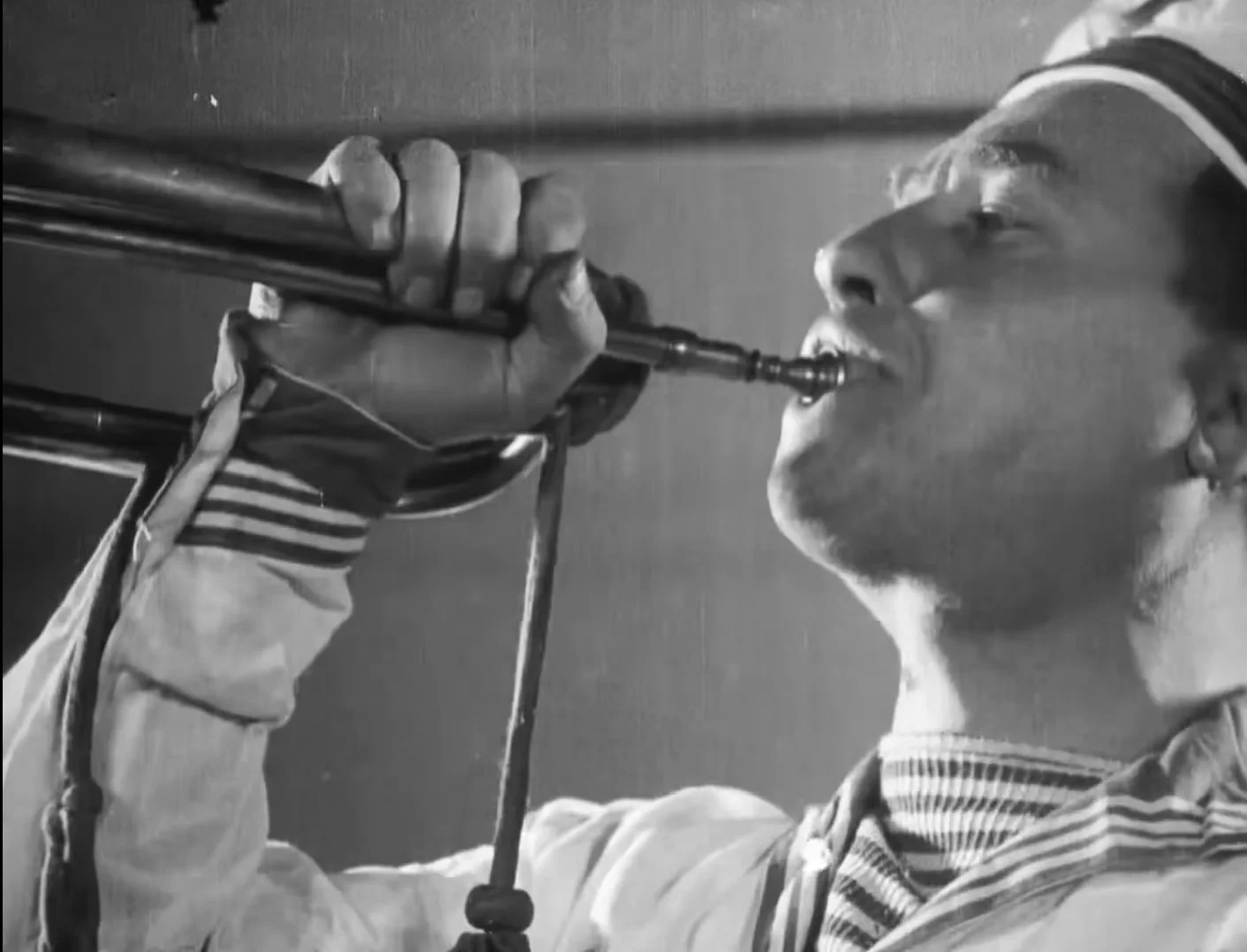
A trumpeter at the "Battleship Potemkin" by S. Eisenstein (1925)
I have been interested in this period of Russian music for a long time. It is significant not only within the broader history of Russian music, but also in the development of the modern trumpet as a solo instrument. The starting point for this programme could be situated in St. Petersburg in 1899, with the first concerto for valved trumpet, composed and performed by Oskar Böhme. From this point, the programme encompasses roughly three decades of musical history, extending from the late Romantic and Post-Romantic traditions through the aesthetics of the Russian Silver Age and its association with Symbolism and mysticism, to the radically different musical language of the early Soviet period, bringing together works that reflect the remarkable stylistic plurality of the early 20th Century.
Alongside the established Romantic tradition, represented particularly by the trumpet concertos, it includes music shaped by Symbolist aesthetics, emerging modernism, experimentation with new harmonic and intervallic systems, and the increasingly mechanistic and technologically oriented artistic language of the early Soviet avant-garde. This juxtaposition makes it possible to observe how different, and sometimes contradictory, musical conceptions coexisted within a relatively short historical period.
It is not a defined concert program, but rather a loosely related collection of original solo works, existing transcriptions by Timofey Dokshizer and others, as well as my own arrangements of works originally composed for voice, violin, violoncello, or theremin. I continue to select from this repertoire according to the context of each performance, constructing individual recital programmes from the available material.
The resulting programmes can bring together markedly different approaches to harmony, melody, rhythm, and instrumental expression. Wishnegradsky’s Meditation, with its use of sixth-tone divisions of the octave and its connection to the harmonic world of Scriabin, represents one form of radical experimentation with pitch organization. In A. Kreyn’s music, traditional Jewish melodic material is placed within a highly individual harmonic language. These approaches contrast sharply with the clarity and formal directness of Shostakovich’s early dances, while Obukhov’s settings of Balmont introduce an expressionistic language in which archaic and modern elements coexist. The concertos, in turn, provide a different perspective, rooted in the late-Romantic and Post-Romantic tradition and characterized by expansive melodic writing and the virtuoso conception of the trumpet as a solo instrument.
The choice of instruments is likewise determined by the repertoire. In addition to the standard B-flat trumpet, I use the C trumpet in works by Roslavets and Shostakovich, the flugelhorn in Glazunov, and the piccolo trumpet in selected passages of Obukhov. Schillinger’s miniatures, originally conceived for theremin, are performed on soprano trombone, whose particular timbral and technical characteristics can have a striking resemblance to the theremin.
CONCERTOES:
O. Boehme: Trumpet concerto in E
V. Schelokov: Trumpet concerto no. 1
A. Goedicke: Trumpet concerto
A. Glazunov: Saxophone concerto (arr. Dubravko Marković)
R. Gliere: Concerto for coloratura soprano (arr. Timofey Dokshizer)
EXISTING SHORT FORM COMPOSITIONS:
D. Shostakovich: Three fantastic dances (arr. Timofey Dokshizer)
E. Goldstein: “Albumblatt” and “Concert Waltz” (falsely signed as A. Glazunov and A. Arensky respectively)
V. Blazhevich: Scherzo
A. Geifman: Romance
S. Rakhmaninoff: Zdes’ Khorosho
S. Rakhmaninoff: Vocalise
NEW TRANSCRIPTIONS:
N. Obukhov: 4 Balmont Songs (soprano and piano)
I. Wishnegradsky: Meditation op. 4 (cello and piano)
N. Roslavets: Meditation (cello and piano)
A. Kreyn: Ornaments Op. 42 (voice/viola and piano)
A. Lourie: 2 poems op. 5 (voice and piano)
Y. Schillinger: Two short pieces for theremin and piano
I: Vocalise No. 1
II: Mouvement electronique pathetique